

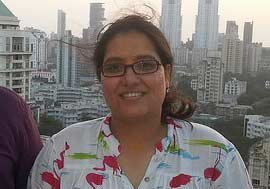
MEERA CHOUDHARY, wife of noted filmmaker Shubhradeep Chakravorty, on his first death anniversary, shared her struggle and impact on her life after his death and urged the people, friends and well-wishers to acknowledge his contribution and promote his work in order to pay real tribute to him in an interview with MOHAMMAD NAUSHAD KHAN.
How has your life changed after Shubhradeep’s demise?
Personally, my life has changed like anything because we were very happy together. In general scenario, there are people who come together, stay together and somewhere in between differences crop up due to hard and fast life. But we were not like that because we were working towards the same goal together and worked 24/7. I left my job after marriage and started assisting him. I learnt the art of documentary from him. Personally, it is a huge loss for me and I cannot explain it in words.
Obviously, we have lost such a great filmmaker. He gave me a lot of free hand in terms of doing research work for his film. Earlier, we both were doing that but now I am doing it alone. Frankly speaking, he was very brave and I am not that brave. And it is a reality. I have not seen anybody who is so brave and goes so deep in his research to find out truth. He was very focused and committed because every time he was attacked by communal people, he committed himself more into coming with such films and accepted it as a challenge. I think credit goes to him for what we have.
How he used to react after coming to know about any communal violence?
See, frankly speaking, since his first film Godhra Tak and then a film on encounter of five people, who were called terrorists and that they had gone there to kill Narendra Modi and they were killed by the Gujarat police. In our investigation, we came to know that some politics was going on at the upper level. You cannot prove the entire thing all the time. During our investigation, we found out that there were some lacunae on the part of administration itself. It means there was some fishy role played by the administration. One cannot prove everything but the circumstances that we came across during investigation cannot be ruled out completely. We always came across that it was a certain political party involved in these activities. We also found that they wanted to take advantage of some situation.
So, when riots broke out in Muzaffarnagar, he was not surprised at all. We went there after one month but before that some NGOs came out with their reports. Some activists already went there like a team from JNU and activists like Seema Mustafa, Kamal Mitra Chenoy and Harsh Mander visited the place. We went through all these reports and Shubhradeep was very sure that it was all done by the people belonging to a certain party. I was very new into such a filmmaking and it was my first experience and I was not sure who has done it. But I was very eager to find out who was behind it. He never said it explicitly that they have done it; he used to smile; he was very confident about who might have done it. But when you want to say it explicitly to others then you have to prove it. We went there to find out the truth. There also we came across that it was the activity of the BJP.
During our investigation, we came across that Samajwadi Party played the role of only a mute spectator. We had to say in our film through a voice over that the state government played the role of the mute spectator. During the process of our research we couldn’t come across any person who explicitly named any Samajwadi Party leaders or blamed the Samajwadi for it. We found many people saying that it was done by the government and it was part of the politics but nobody said that it was done only by the Samajwadi. But we came across some people from the Jat community itself who said BJP local MLA was involved in it. And they told us with some a kind of justification. Now, that area is communalised and polarised. People at that point of time were really surprised as to why Samajwadi Party did not take any action. The BJP played the role of the instigator.
What according to you could be the real tribute to Shubhradeep?
I think, the real tribute would be to promote his work as much as we can do. We have not done anything after the Censor Board banned the screening of our film. In the past one year, I have struggled a lot. I have met many people. I wanted public screening of his film but that has not happened as yet. We wanted more and more people to watch his film and talk about it. Not only this film but his earlier films as well because he was known for his earlier films as well. But with this film we can say that his struggle ended, which is very unfortunate.
The real tribute is to promote his work is not to forget him. In journalism also, you can hardly find people who are digging out and going deep inside to find out the truth. They are actually doing research and actually willing to go out in such a situation. Even journalistic writing or documentary film should be backed by proper research. And I think the real tribute to Shubhradeep would also be to promote such people who are doing something to bring out truth.
The screening of Muzaffarnagar Baaqi Hai was stopped in Delhi. How do you respond to it?
I think this is quite natural because Shubhradeep also faced such reactions against his screening. Those were the students Shubhradeep also faced. They came with their trishul and knife and with all kind of sticks in their hand. It happened with Shubhradeep in Bhopal, Jaipur, Godhra, and Kerala and in Ahmedabad also. I think this will happen to everyone who will try to bring out truth. The reaction is they are doing pan India screening. I really liked that they have not stopped and trying to screen it all across India.
Any particular memory of Shubhradeep which you feel is important and must be shared with people?
I think he was so committed to his work. One thing, I would like to say that Shubhradeep was such a person who never boasted of his work. He never tried to impose his work. Even in his films he never forced me to this or that. He always concentrated on his responsibilities and was always guided by his conviction and his responsibility was to bring truth.
When you look at India and her people, what troubles you the most?
What troubles me the most is these things are not stopping anywhere. None in the government is looking into the long-term solutions but instead all parties are playing politics and that is for the short-term gains. I don’t think any party is nationalistic, thinking in terms of being a nation. It is a simple thing that they have learnt the art of divide and rule. There is a lacuna in our leadership. Either they don’t want to stop it or they want to remain silent.
Have Muzaffarnagar riots changed the rules of the game socially or politically?
Yes, now every newspaper and channel are telling the story that whole of Western Uttar Pradesh is polarised. BJP was nowhere before Lok Sabha elections. The RLD which was dominating is also wiped out. We all know what happened to other regional parties. Yes, we can say it has changed the rules of the game. If riots can take place in Muzaffarnagar then people should be very careful because riots can happen anywhere.
Any message to friends and well wishers of Shubhradeep?
I wish all of them should gear up to forward his work in any way for any kind of reward. People should come forward to make films on social issues. Somehow, we will have to remember his works and efforts. Every time he made films he was challenged. They should not allow his effort to go in vain.