

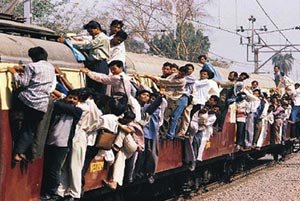
ARSHAD SHAIKH comments on the recent rail fare hike in India and argues how Islam leads to a huge surplus of fund (credit balance) for the government of the day which can judiciously utilise it for subsidising essential services and providing people with welfare schemes.
The Union Ministry of Railways recently announced that from 25 June, rail passenger fares will increase by 14.2% and freight rates by 6.5%. Under pressure from its own allies notably the Shiv Sena, the government exempted suburban passengers holding second class tickets up to a distance of 80 km from the fare hike. While opposition parties have slammed the steep increase in the rail fare, the ruling party is justifying the move as a bitter medicine that had to be administered.
THE BEHEMOTH CALLED INDIAN RAILWAYS
The state-owned enterprise, owned and operated by the Government of India through the Ministry of Railways is one of the world’s largest railway networks comprising 115,000 kms of track over a route of 65,000 kms and 7,500 stations. It has over 12000 passenger trains and carries over 8,900 million passengers annually or more than 24 million passengers daily (roughly half of which were suburban passengers) and 2.8 million tons of freight daily. In 2011-2012 Indian Railways had revenues of US $19 billion which consists of US $12 billion from freight and US $4.8 billion from passenger’s tickets. Indian Railways is the world’s ninth largest commercial or utility employer, by number of employees, with over 1.4 million employees.
THE WHITE ELEPHANT
However Indian Railways has been a loss-making organisation for a long time now. In the year 2012-2013, it reported losses of $4.53 billion. Converting this amount into Rupees, at a rate of one dollar = Rs 55, the losses work out to a whopping Rs 24,915 crore i.e. almost Rs 70 crore daily. It is estimated that Indian Railways, to break even on its passenger operations, needs to increase fares by almost 50%, inclusive of fuel surcharge. The Minister of Railway Sadananda Gowda hopes to earn about Rs 8,000 crore during the rest of the year through the fare hike.
REASONS FOR THE RED BOTTOM LINE
Business analysts say that low investment and populist policies by successive governments to subsidise fares at affordable levels have slowed down growth in new lines and withheld private investment. Indian trains are among the world’s cheapest. A ticket on an overnight sleeper train running the roughly 1,400 kilometres between New Delhi and Kolkata, for example, can cost as little as 520 rupees ($8.65). The average passenger fare-to-freight ratio in India is one of the lowest in the world. In 2011-12, for instance, the Railways’ average income from transporting one tonne of goods over a one km distance – what is called revenue per net-tonne-km (NTKM) stood at Rs 1.04. As against that, it grossed hardly 27 paise from moving an average passenger for every km, translating into a fare-to-freight ratio of 25.9 per cent.
Rail commuters in China, Korea and France pay 1.2-1.4 times more than those who move cargo by rail. At 70% of revenue, its fuel, wage and pension bill is abnormally high. Then there is also the issue of little-used non broad-gauge network – over 11,000 route-kms or about 18% of the total rail network is completely underutilised as it carries only 1% total railway traffic.
SUGGESTED BUSINESS PLAN
In order to expand, modernise and improve safety, the Indian Railways would need to invest about Rs 25 lakh crore or US $400 billion, over the next 10 years. Currently, China invests $90 billion every year in its rail system compared to India’s US $10 billion. If the Government chooses to invite private participation into Railways, the outcome would definitely be an upward revision of fares as private companies would look for sizable returns and profits against their investment. The government has constituted various committees and study groups to suggest ways of turning around the Indian Railways.
The most notable has been the work of the Expert Group also known as the Rakesh Mohan committee. It recommended among other things: a) increase in the average speed of goods trains; b) high speed modern passenger services; c) commodity specific freight strategies; d) introduction of new technology and harnessing information technology for freight operations; e) introduction of private management for commercial operations of specialised services; and g) increase in capacity through advanced signalling and communication systems.
IS THERE REALLY NOTHING LIKE A FREE RIDE?
Ram Vilas Paswan has defended the rail fare hike by recalling the rationale offered by former Prime Minister V P Singh for the then petrol price hike, that “it was better to run your vehicle with costlier petrol than not being able to run the vehicle at all”. However one must understand that there is a difference between a privately run and owned company and a government (read public) funded enterprise. The basic objective of a government-run essential service such as railways cannot be only profit and self-sustenance.
The government is committed to the welfare of the people and its basic responsibility is to ensure social and economic justice. All its efforts must be directed towards ensuring that the rights of the have-nots are not usurped by the haves and that the poor and needy are not left to the mercy of the market. It is this fundamental world view about governance that shapes the policies of governments towards cross subsidisation and affordable pricing for all. Yes, it is a business requirement of the Indian Railways to increase fares but it is the government’s responsibility to generate sufficient revenue for subsidising the needs of millions for affordable long distance public transport.
Moreover, the spill-over effects of hike in rail fares on the consumer price index (CPI) and the wholesale price index (WPI), the possible contract in aggregate demand and the negative impact on a host of industries because of the dip in passenger traffic have also to be assessed and evaluated.
THE SWEET TONIC CALLED ISLAM
It is the responsibility of the adherents of Islam to propagate the guidance that Islam offers in different domains of life including managing the economy. The Qur’ān gives broad guidelines with detailed implementation embedded in the Sunnah and the lives of the pious companions of the Holy Prophet (peace and blessings of Allah be to him).
In the Islamic system of governance the rights of the poor and needy are duly acknowledged, respected and taken care of through a system of Zakat and Ushr. This system, if properly implemented in letter and spirit, leads to a huge surplus of fund (credit balance) for the government of the day which can judiciously utilise it for subsidising essential services and providing people with welfare schemes for basic necessities like food, housing, education, health and transport. Bitter medicine is being forcibly disbursed. Time to taste the sweet tonic called Islam.