

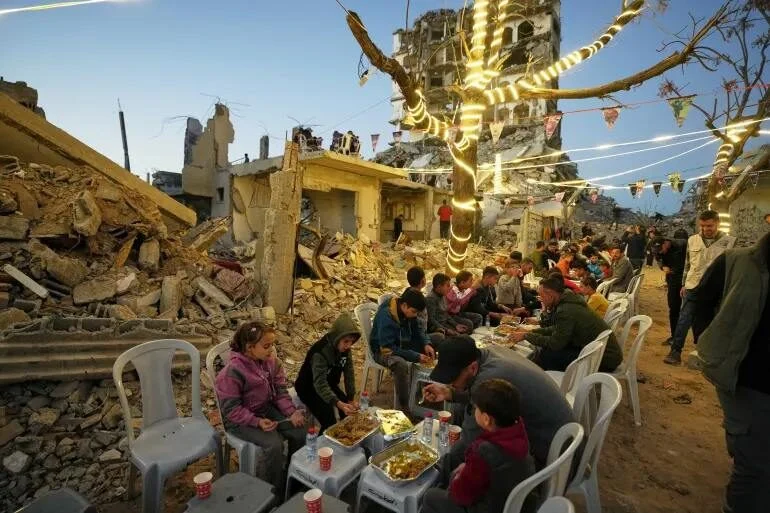
At dusk in Khan Younis, the sky softens. The harsh daylight that exposes every crack in shattered concrete finally loosens its grip. For a brief moment, the ruins almost look gentle until memory returns.
The air carries dust, smoke, and salt. A wall that once framed family photographs stands like a torn page, its rooms ripped open to the wind. Steel rods jut outward like exposed ribs. The silence is not peaceful; it is the silence that follows too much loss.
On one fractured wall, where a bedroom once stood, someone has painted a crescent and a lantern. The paint is fresh, bright against grey concrete. Between two damaged buildings, a thin wire stretches across the gap, holding paper stars and a string of small lights that flicker when the generator hums to life. They are fragile decorations. Not meant to dazzle. Meant to endure.
Similar scenes have been reported this Ramadan by international correspondents. Residents in Khan Younis and Rafah have painted “Welcome, Ramadan” on broken walls and strung lanterns across collapsed structures. In tent encampments, displaced families have hung handmade ornaments to preserve a sense of celebration for their children. But the decorations do not erase the devastation.
As sunset approaches, Abu Khaled, 52, spreads a plastic sheet over the dust where his living room once stood. His wife, Amina, places a small bowl of dates at the centre. Their youngest daughter, Mariam, arranges cups of water carefully, counting so no one is forgotten.
There is a vacant place on the mat. It belongs to their eldest son, Youssef, killed months earlier. No one mentions his name aloud at this moment. But when the call to prayer rises, Amina’s hand pauses for half a second over the empty space before she withdraws it. It hurts. And it surely hurts a great deal.
Ramadan does not soften the absence of a son. It does not quiet the memory of a father’s voice or refill an empty chair. Grief returns at sunset with the light.
Yet believers lean into a conviction older than the ruins around them. They remember the assurance of Prophet Muhammad ﷺ that “the greatest reward comes with the greatest trial.” In that promise, suffering is not beautified; it is dignified. The pain is real, but so is the belief that it is seen.
The fast is broken. Water passes from hand to hand. Above them, the painted crescent glows faintly in the fading light. This is not the story of one family; across Gaza, from Khan Younis to Rafah, nearly every home now breaks its fast beside an absence.
Grief and Devotion, Side by Side
This Ramadan arrives after extraordinary loss. Entire neighbourhoods have been erased. Displacement has scattered families across makeshift shelters. The humanitarian strain is immense.
In a tent settlement on the outskirts of Khan Younis, 34-year-old teacher Salma al-Najjar decorates the entrance of her canvas shelter with scraps of coloured paper. Her two children, Omar and Lina, watch carefully as she tapes a paper lantern above the flap.
“Ramadan must feel like Ramadan,” she says quietly. “Even if we have nothing else.” It is not denial. It is insistence.
News agencies have documented displaced families in Gaza hanging lights over tents and painting festive messages on debris. Volunteers have strung lanterns across bombed streets. Artists have written Qur’anic verses on damaged walls. These acts are small. They do not rebuild homes. But they restore rhythm.
Sorrow and devotion coexist here. Tears are swallowed with water. Names of the dead are whispered in night prayers. Faith does not erase pain; it steadies it.
The paradox is not that Gaza is at peace. It is that amid devastation, the spiritual calendar still holds.
Faith as Psychological Architecture
Psychologists define resilience not as the absence of trauma, but as adaptive coping – the ability to frame hardship within a narrative that preserves dignity.
Research consistently shows that individuals who derive meaning from suffering exhibit lower levels of psychological distress after trauma exposure. In prolonged conflict zones, shared rituals often serve as stabilising mechanisms.
Ramadan provides structure where daily life has collapsed. Fasting from dawn to sunset restores discipline. The call to prayer punctuates uncertainty. Night recitations gather scattered communities into a single moral cadence.
But for Gazans like Abu Khaled and Salma al-Najjar, resilience is not improvised. It is rooted in narrative memory.
Many look to the Seerah, the biography of the Prophet Muhammad ﷺ, recalling his years of boycott and deprivation in the valleys of Makkah, when his small community endured hunger, isolation, and loss. During that period, known as the Boycott of Banu Hashim, food was scarce and social ties were severed. In that history, they find not fantasy, but precedent.
Their endurance is earned through belief – belief that trials are not abandonment, that injustice is not unnoticed, that while the world may turn away, the “Lord of the Oppressed” doesn’t.
In psychological terms, this functions as meaning-making. In spiritual terms, it is trust.Where structures have collapsed, belief becomes structure.
The Qur’an at the Centre
At the heart of Ramadan lies the Qur’an, the month commemorates the beginning of its revelation more than fourteen centuries ago. For believers in Gaza, this is not symbolic detail. It is the core of the season itself.
Ramadan is not merely about abstaining from food. It is about reconnecting with a text that addresses fear, hunger, loss, and justice directly.
“In the remembrance of God do hearts find rest.”
“With hardship comes ease.”
For 19-year-old university student Ahmed Darwish, who now studies by candlelight after his campus was damaged, these verses are not abstract. “When everything feels unstable,” he says, “the Qur’an feels stable.”
The text reframes hardship. It does not deny suffering; it contextualises it. It insists that injustice is not ultimate and that dignity is not measured by material power.
In a territory where walls have fallen, this book becomes a wall.Its verses are memorised in childhood, recited in shelters, whispered over graves. They function as psychological orientation, offering continuity in chaos.
For secular observers, this raises a serious question: what kind of text sustains a people under such strain?
One does not need to share the belief to examine the phenomenon. But one must be willing to consider the source.
Prosperity and the Question of Peace
Modern societies often equate peace with prosperity – smooth highways, financial growth, digital connectivity. By those measures, Gaza possesses none.
Yet wealth has not shielded affluent nations from loneliness, anxiety, and fragmentation. Material abundance has not guaranteed inner calm.
In Gaza, scarcity is visible. Uncertainty is constant. But communal bonds remain dense. Neighbours break their fast together because they must. Prayer is shared oxygen.This is not romanticizing ruin. No parent would choose rubble over safety.But the comparison invites reflection:Is peace merely the absence of conflict – or is it the presence of meaning?
Ramadan in Gaza suggests that inner coherence – shared belief, ritual, moral narrative – can outlast shattered infrastructure.
A Lesson the World Rarely Studies
The world analyses Gaza through statistics, strategy, and diplomacy. It debates ceasefires and corridors.Rarely does it study Gaza’s inner architecture.How do communal rituals buffer collective trauma? How does fasting, a voluntary hunger, restore agency amid imposed deprivation? How does a sacred text shape emotional endurance?
Mental health professionals have described Gaza as facing one of the most severe psychological crises in modern memory. And yet, people continue to gather at sunset, to decorate ruins, to whisper prayers over vacant spaces.This is not aesthetic calm. It is active conviction.
Abu Khaled does not sit beside rubble because he finds it beautiful. He sits there because he refuses to let devastation dictate his identity.
Salma al-Najjar hangs paper lanterns not because suffering is poetic, but because despair is unacceptable.
Ahmed Darwish recites verses not because trauma has vanished, but because faith anchors him when nothing else does.
Return to Dusk
As evening falls again over Khan Younis, families sit beside debris that once held their memories. A lantern glows softly. The painted crescent catches the fading light.There is still a vacant place on the iftar mat.
The call to prayer rises – fragile, unwavering – threading through broken walls.
Amina lifts a date to her lips. Abu Khaled closes his eyes for a moment before drinking water. Mariam looks up at the lantern as if it were a star.
The buildings are broken. The rhythm is not.In a world that measures peace by skylines and stock markets, Gaza offers a quieter definition: peace as steadiness of heart. Peace as dignity under strain.
Under a painted crescent on a broken wall, Ramadan continues – sustained not by infrastructure, but by revelation.And in that continuation lies a light that rubble cannot bury.
Perhaps the world, too, might turn to the book revealed in this sacred month – a text that, for millions, gives suffering meaning and strength not only to endure it, but to rise from it with dignity.