

MOHAMMAD NAUSHAD KHAN analyses the Kandhamal and Muzaffarnagar riots anniversaries held recently and underlines the need for creating an atmosphere conducive to peace and communal harmony in the country.
Very recently, anniversaries of Kandhamal and Muzaffarnagar riots were observed in different parts of our country with renewed sense of hope and feelings to compensate and rehabilitate riot affected victims. And to collectively think to create an atmosphere in which incidents like Kandhamal and Muzaffarnagar riots are not repeated in any part of India. Civil society has felt the need to make continuous efforts for communal harmony in order to overshadow hate campaign against the minorities.
John Dayal, a renowned journalist and human rights activist, while replying to a question, can we ever think of a riot-free India, told Radiance that NarendraModi still does not answer questions on the 2002 violence. In his Independence Day speech after unfurling the national flag at the Red Fort in New Delhi, Mr. Modi called for development and governance, the slogans that brought him to power, as well as for toilets and gender security. And, then, he called for a ten-year moratorium on violence which had roots in castes, ethnic identities or religious confrontations. No one has so far asked him why he did not call for a zero tolerance policy on such violence, and action against hate campaigns that lead to it. A ten-year moratorium would end in 2024, which presumes a ten-year reign for the BJP, assuming it wins the 2019 general elections. This is a calendar fraught with dangerous implications, as political pundits and human rights activists point out.
“Modi and the BJP are unabashed about their loyalty to the RSS and the expanding group of organisations it has spawned, collectively known as the Sangh Parivar. Mr. Modi is himself a former RSS leader, as are several of his Cabinet colleagues. Some ranking RSS officials have in recent weeks been inducted as general secretaries of the BJP, leaving absolutely no one in any doubt of the seamless fusion of the political party and the Sangh, which styles itself as a social and cultural organisation. RSS Chief Mohan Bhagwat has repeatedly asserted that everyone in India is Hindu, including Muslims and Christians. Mr. Seshadri Chari, former editor of RSS mouthpiece Organiser and member of the BJP national executive, who enjoys a deserved reputation as a sober and reflective commentator, is quoted in the Outlook Magazine, saying that Hindus have always been a majority in India but the manifestation of majoritarianism has been reflected in the cultural and social field. Now it is reflected in the politics of the country. A large number of foot-soldiers in the RSS-BJP do believe that the political Hindu has arrived.” Dayal said.
According to Dayal, such manifestation puts religious minorities on notice. It is for Mr. Modi to assure them that the Constitution, and the rule of law will prevail. This cannot be done through moratoriums. This should be the backbone of the promise of good governance. Till he breaks his silence on the hate campaigns of the Sangh Parivar and BJP leadership, especially in Uttar Pradesh, the fear of communal violence will always remain hovering.
On the question of what can be done to ensure that Kandhamal is not repeated, Dayal replied, there is an urgent need to implement the Rabat Plan of action against hate speech formulated by the United Nations Office of the Human Rights Commissioner and announced last year. India has been silent over it.
In his reply to an answer to hate and riots politics, Dayal said civil society, religious minorities and marginalised groups such as Dalits and Tribals need to understand the conspiracy of hate and work in close concert with secular Hindus and the civil society to ensure that India remains secular.
The dust of Muzaffarnagar riots may have settled for a while but the pain, agony, sufferings, hate and animosity, lack of trust and sense of insecurity still prevail which is a concern for one and all. On political turf, Muzaffarnagar riots have changed the political discourse of Uttar Pradesh and polarised the sentiments to the maximum extent possible and left the state on the brink and vulnerable for such more incidents. One year passed by but the trauma and horror is still fresh for those who have suffered the most. Divisive and hate language has vitiated the Ganga Jamuni culture of Uttar Pradesh beyond repair.
Muhammad Ahmad, political secretary of Jamaat-e-Islami Hind
, while talking to Radiance on the eve of Muzaffarnagar riots anniversary, said that Muzaffarnagar riots were great setback for Muslims. In Muzaffarnagar, both the Jat and the Muslim communities had very cordial relations down the ages and participated in each other’s joys and sorrows. So in my view the loss of trust, brotherhood and amicable atmosphere was even greater than the loss of life and property because it takes years to build relationship, trust and cordial atmosphere. After riots, several organisations, including Milli organisations and the Jamaat provided relief and rehabilitation. It is a fact that no other organisation can do what the government can in such circumstances.
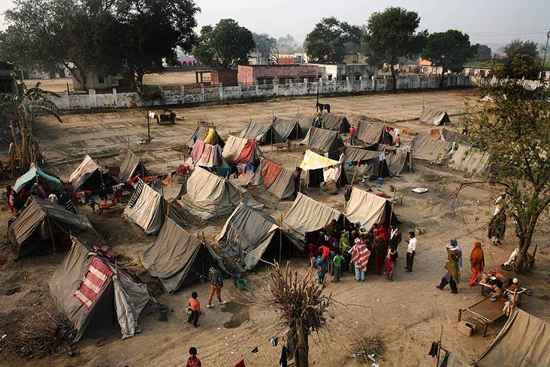
The responsibility of the government was not only to provide relief but to rehabilitate the victims and create an environment feasible for their safe return to their respective villages without fear. The Government has failed rather miserably to create that required feeling of sense of security in them even after the passage of one year; it is a matter of concern for one and all. And till now the atmosphere is not that conducive so that the victims can muster courage to return to their native land. It is very painful that even after one year victims are still living in camps and we all know how unhygienic and painful it could be. After one year what we as a community have lost is far greater than what we have received as compensation.
“The dangerous trend that has emerged out of Muzaffarnagar riots is that people with Hindu right wing ideology have developed a sense that they can do anything and nobody is there to catch them. This mindset is very dangerous. Look at the language used by Yogi Adityanath these days, that ‘if they kill one then you kill one hundred’. His statement has been condemned by all across India. Now if such languages are used then the return of riot victims will become even more difficult. The other dangerous trend, which has been established, that with riots election can be won is very dangerous.
On the question what should be done to ensure such incidents are never repeated, Ahmad said, that Jamaat-e-Islami Hind has continuously made efforts to bring the situation to normalcy and rebuild the trust and restore confidence between the communities along with relief and rehabilitation measures. Even at that point of time, Maulana Jalaluddin Omari, Ameer JIH held meetings with Ajit Singh, Azam Khan and other dignitaries of both the communities. During the meets it was emphasised that along with relief and rehabilitation measure, efforts should also be made to restore communal harmony. In Muzaffarnagar a very big programme was organised by the Jamaat along with others for communal harmony. Still we believe that continuous efforts should be made by all minority communities, including secular Non-Muslims for communal harmony not only in Muzaffarnagar but in all riot affected places and regions.