

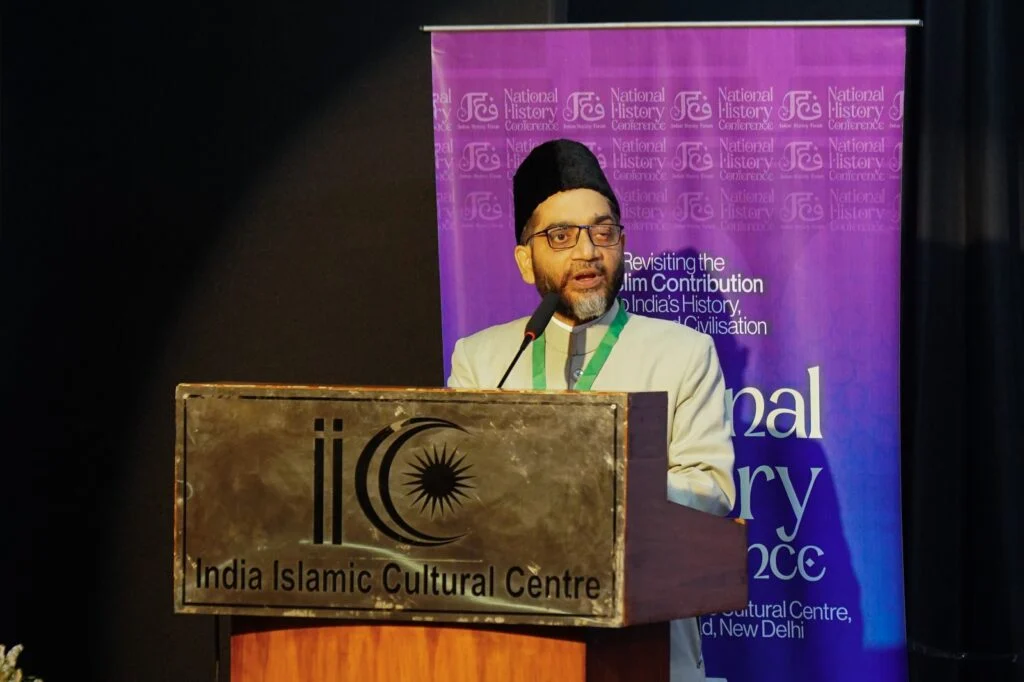
 Bringing together scholars, political leaders, and community representatives, a two-day conference which opened on April 11 at the India Islamic Cultural Centre in the national capital focused on deliberations surrounding the historical contributions of Muslims to India’s development. The event was organised by the Indian History Forum under the theme “Revisiting the Muslim Contribution to India’s History, Society and Civilization.”
The speakers underscored the importance of presenting an accurate and authentic understanding of history at a time when growing concerns are being raised over the distortion of historical narratives. Member of Parliament Shashi Tharoor stated that it is essential to clearly distinguish between verified history and narratives that lack any factual basis. He further called for sustained efforts to ensure that society engages with history rooted in truth.
Delivering his address on “Who Writes Our Past? Reclaiming History, Interpretation, and India’s Plural Identity,” Shashi Tharoor observed that discussions on history are no longer confined to academia but have become part of public discourse in visible and consequential ways, unfolding not only in seminars, conferences, and classrooms but also in legislatures, courtrooms, television debates, and across social media platforms.
He said that the question of who writes our past is as relevant outside the classroom as within it, as it raises fundamental concerns about who has the authority to interpret the past, whose voices are heard, and how those interpretations shape the way a nation understands itself. He emphasised that history is not a settled body of knowledge but a field of ongoing research and interpretation, where each generation revisits, re-examines, and reshapes it.
Explaining the distinction between history and historiography, he noted that history refers to what happened, while historiography concerns the way those events are recorded, interpreted, and presented. He said that such interpretation is never entirely neutral and is shaped by perspective, by the questions asked, the sources used, and by power. He added that the struggle over history is, in many ways, a struggle over identity and belonging.
Referring to colonial historiography, he pointed out that British accounts interpreted India through the lens of empire, emphasising divisions and stagnation to justify colonial rule. He said such narratives legitimised conquest and shaped how Indians saw themselves. He further noted that nationalist leaders resisted not only political domination but also intellectual domination by reclaiming historical selfhood.
He said that in contemporary times, history continues to be revisited and contested, often shaped by present-day political purposes. He emphasised that history is not a fixed inheritance but an ongoing conversation, and the way that conversation is conducted has deep implications for national identity. Referring to India’s civilisational nature, he said it is not a single linear narrative but a layered and evolving story shaped by interaction and exchange, invoking Jawaharlal Nehru’s idea of a palimpsest and Rabindranath Tagore’s idea of India rooted in plurality.
Syed Sadatullah Husaini, President Jamaat e Islami Hind,in his keynote address, emphasised that the real purpose of the conference is to understand the history of India from the right perspective. He said that history is very important for any nation and that every nation lives twice, once in reality and once in memory, with reality following memory. He stressed that nations are defined not only by achievements but also by what they remember and what they forget, making it essential that memory remains accurate.
He said that history is not merely nostalgia or information but a source of guidance and civilisational wisdom. He emphasised that history should be understood with neutrality and realism and should not be interpreted based on personal likes and dislikes or reduced to binaries of hero and villain, as such approaches harm collective memory.
He noted that the present global situation reflects a post-truth condition where the difference between truth and falsehood has become minimal, and history is increasingly curated, amplified, and weaponised through digital platforms. He warned that such distorted history misguides society, promotes polarisation, and weakens the nation.
He identified three ways in which history is distorted: deletion, distortion, and generalisation. He pointed out that large parts of Muslim history are being erased, misrepresented, or generalised into stereotypes. He said that revisiting history is not about glorifying any community but about restoring truth and presenting facts accurately.
He emphasised that Muslims are not marginal to Indian history but are co-authors of its civilisational journey, contributing to economic, cultural, and intellectual development. He highlighted contributions of Muslims to trade, knowledge exchange, institutions, languages like Urdu, and social development, stating that these connections enriched Indian civilisation and connected it with the wider world.
He further said that the most significant contribution lies in the principles of Islam, particularly the message of unity of humanity, which fostered social cohesion. Quoting Maulana Abul Kalam Azad, he emphasised the shared civilisational journey and called the conference the beginning of a movement to bring truth back into public discourse.
Dr.SadabMunawar Moosa, Convener of the Indian History Forum, in his inaugural address, highlighted key challenges in the study and dissemination of history. He said that across universities, professors, and research scholars, three major problems have emerged. The first is the spread of superficial, misinformed, and propagandist narratives through digital platforms and social media.
He pointed out that alongside this, changes in educational curricula, including NCERT and university syllabi, are altering the pattern of study and research. He stressed that this is a critical issue that needs correction through objective narratives.
He further noted that historical representation in museums, archives, and public spaces also reflects bias and marginalisation. Citing examples, he said that key figures are often excluded from representation, leading to incomplete public understanding of history.
He identified the second major challenge as the gap between academic research and public understanding. He said that historians have produced extensive scholarly work, but it remains confined to academic circles and does not reach the masses. Bridging this gap and making history accessible is essential.
The third challenge, he said, is interpretation. Writing history is one thing, but interpreting it correctly is equally important. He pointed out that colonial frameworks and communal narratives continue to influence historical understanding. He called for a balanced, centrist approach that avoids ideological extremes and presents history objectively.
Senior Congress leader and national spokesperson Gurdeep Singh Sappal said history has always been shaped by those in power, but today’s challenge is different due to the role of social media algorithms in shaping perceptions.He described the emergence of a “false memory infrastructure,” where algorithms create echo chambers and influence emotions, shaping public opinion. He pointed out that global political trends, including leaders like Donald Trump and Boris Johnson, reflect similar patterns. He emphasised that ordinary citizens must actively participate in creating and sharing factual content to counter misinformation.
Rajya Sabha MP Manoj Jha reflected on society, history, and democracy through personal anecdotes and literary references. He warned that electoral victories alone cannot ensure the survival of a nation if the social fabric is weakened by distorted history and divisions.
He emphasised the importance of preserving inclusive history and recalled figures like Mahatma Gandhi and Jawaharlal Nehru. He cautioned that present conditions resemble the period of Partition and urged society to remain vigilant and reflective.
Former MP Mohammad Adeeb criticised the distorted writing of history, warning that it misguides future generations and harms social harmony. He stressed the need to protect authentic history and raised concerns about growing prejudice and attempts to erase certain historical periods, including Mughal history, which he said could also impact understanding of other communities’ histories.
Ashok Kumar Pandey, an eminent author and journalist, discussed the relationship between media and history, highlighting how selective representation shapes public memory. He explained that media narratives often create distorted images, citing the example of Kashmir, where coverage focuses on conflict while ignoring everyday life.
He also criticised the use of unverified social media content as research and pointed out that debates on television often lack informed perspectives. He emphasised that repeated exposure to selective narratives leads people to accept them as truth, especially when they align with existing beliefs. He called for critical thinking and responsible engagement with history.
The conference concluded with a call for collective responsibility in preserving truth and promoting an objective understanding of history. Speakers urged students and citizens to engage critically with historical narratives and ensure that truth prevails in public discourse. They described the conference as the beginning of a broader movement to reclaim history and strengthen India’s plural identity.