

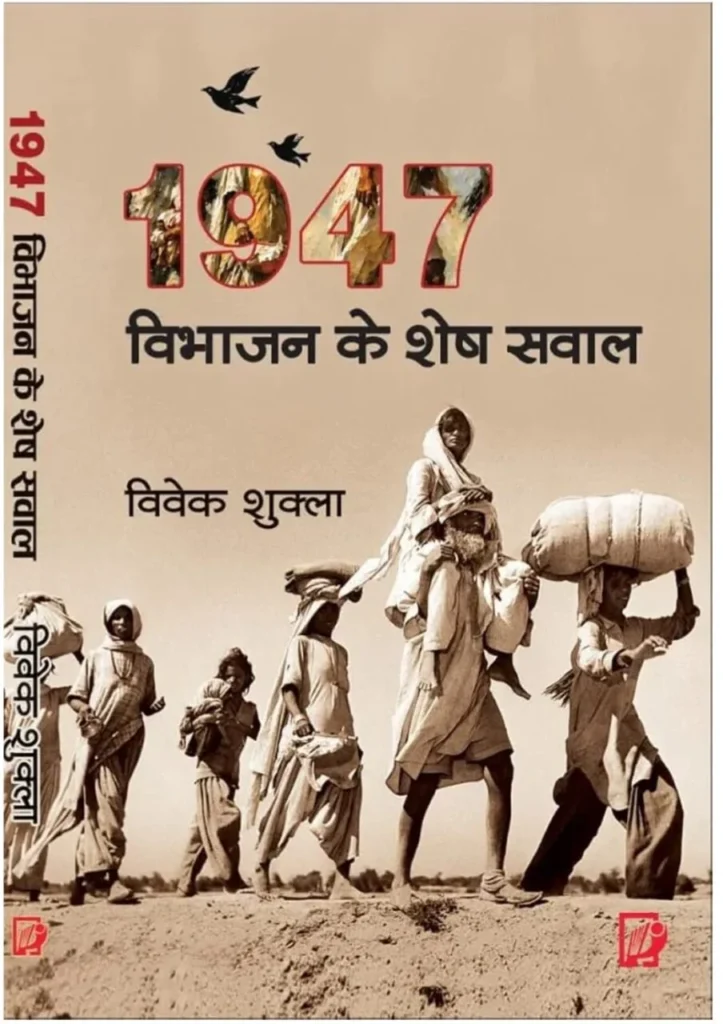
Book:1947 Vibhajan Ke Shesh Sawal (Hindi)
Author:Vivek Shukla
Publisher:Pravasi Prem Publishing, Ghaziabad, Uttar Pradesh
Price: Rs. 390 (Paperback)
Reviewed by Mohd Naushad Khan
The Partition of India in 1947 remains one of the most painful and consequential events in the subcontinent’s history. It brought an end to British colonial rule but also divided communities, uprooted millions of people, separated families and left behind memories of violence, displacement and loss. Nearly eight decades later, the human and political dimensions of Partition continue to demand serious historical examination. Senior Journalist Vivek Shukla’s book 1947 Vibhajan Ke Shesh Sawal, seeks to revisit this turbulent period by exploring questions and experiences that have often remained on the margins of mainstream historical narratives.
Divided into 42 chapters, the book examines the circumstances surrounding Partition, the people who opposed communal division, the experiences of refugees and the consequences of the separation for India’s social and cultural life. Rather than limiting itself to the familiar political negotiations that preceded Independence, Shukla attempts to recover forgotten stories and neglected perspectives. The result is an engaging journalistic exploration of a historical event whose significance extends far beyond the drawing of national boundaries.
One of the most compelling aspects of Shukla’s work is its connection with his own family history. His great-grandfather moved from Uttar Pradesh to Rawalpindi in 1897 to work in railway service. Subsequent generations of his family were born there, and his grandfather was serving as the station master of Rawalpindi railway station when Partition took place in 1947. The family eventually had to leave the city amid the violence and upheaval accompanying Partition.
Growing up, Shukla heard stories of displacement and communal violence from his relatives. His mother’s family also experienced migration, while accounts of refugees arriving in Delhi became a familiar part of his childhood. These personal memories helped shape his interest in the human consequences of Partition and encouraged him to investigate experiences beyond the conventional political account.
This personal foundation gives the book an important emotional dimension. Partition was not merely a constitutional arrangement or a disagreement between political leaders; it was a catastrophe experienced by ordinary people whose homes, livelihoods and relationships were suddenly threatened. By connecting family memories with wider historical research, Shukla attempts to bring these experiences closer to contemporary readers.
A noteworthy contribution of the book is its attention to Muslims who chose to remain in India despite the creation of Pakistan. The decision to stay was not simply a matter of geography. For many, it reflected their attachment to their homeland, professional commitments, family relationships and belief that India could accommodate citizens of different religious backgrounds.
Among the prominent personalities discussed in the book are Khwaja Abdul Hamied, founder of the pharmaceutical company Cipla; Badruddin Tyabji, an Indian Civil Service officer; Brigadier Mohammad Usman, who served in the Indian Army; and Hashim Premji, father of industrialist Azim Premji. These individuals rejected invitations or opportunities to move to Pakistan and continued a lot to the progress anddevelopment of India.
Brigadier Mohammad Usman’s story is especially significant. He chose to serve India despite the creation of a separate Muslim-majority state and died fighting Pakistani forces during the 1947-48 conflict in Jammu and Kashmir. His life illustrates how national commitment could transcend religious identity. Similarly, the decision of Badruddin Tyabji to remain in India and his involvement in organising the Independence Day celebrations under Jawaharlal Nehru demonstrate the role of Muslims in building the newly independent country.
Shukla also draws attention to Dina Wadia, Muhammad Ali Jinnah’s daughter, who chose to remain outside Pakistan. Such examples complicate simplistic narratives about Partition and demonstrate that religious identity did not automatically determine an individual’s political allegiance or national belonging.
The book’s emphasis on these stories is valuable because the history of Partition is frequently reduced to the movement of Hindus and Sikhs towards India and Muslims towards Pakistan. The experiences of those who remained, as well as Muslims who migrated to India from territories that became Pakistan, reveal a far more complex reality. Their stories deserve a greater place in public discussions of the period.
Another important dimension of the book is its attention to refugees and the suffering of women. Shukla recalls accounts of families fleeing violence, people arriving at Delhi Junction after losing their homes, and women facing abduction and other forms of brutalisation during communal riots.
These accounts remind readers that the consequences of Partition were profoundly unequal and deeply personal. The violence affected Hindus, Muslims and Sikhs, although the circumstances differed across regions. Women were particularly vulnerable, and many families resorted to desperate measures in the belief that they were protecting their loved ones from further suffering.
By acknowledging the experiences of different communities, Shukla encourages a more humane understanding of the tragedy. Remembering one community’s suffering should not require ignoring that of another. Such an approach is especially relevant when historical memories are invoked to deepen contemporary religious divisions.
The book also challenges the idea that all refugees followed the same pattern of migration or sought the same forms of rehabilitation. Shukla discusses Muslims who came to India and established new lives without demanding land or compensation. Their experiences broaden the understanding of displacement and demonstrate that the aftermath of Partition cannot be explained through a single community’s narrative.
Shukla also examines the significance of historical personalities whose political influence might have altered the course of events. His reflections on Bhagat Singh are particularly interesting. Revered in both India and Pakistan, Bhagat Singh remains an important symbol of anti-colonial resistance. His opposition to communalism and his association with a wider nationalist struggle make him a powerful figure through whom to consider alternatives to Partition.
The author draws attention to the coincidence that Bhagat Singh was executed on 23 March 1931, while the Muslim League adopted the Lahore Resolution on 23 March 1940. He considers whether Bhagat Singh’s continued presence in political life might have influenced the direction of the freedom movement.
Similarly, Shukla reflects on Subhas Chandra Bose and the Indian National Army, whose ranks included people from different religious communities. The INA’s shared struggle against colonial rule offers an example of how a common political objective could bring Indians together across religious boundaries.
These reflections are necessarily hypothetical. No historian can establish with certainty how the continued presence of an individual leader would have changed the course of history. Nevertheless, such questions can encourage readers to reconsider the political possibilities that existed before Partition and the forces that ultimately overwhelmed them.
The book’s scope extends beyond political history to examine the cultural consequences of dividing the subcontinent. Shukla discusses Lahore’s importance as a centre of Hindi publishing before Partition and expresses concern about the marginalisation of Punjabi in Pakistani Punjab.
His observations draw attention to an often-overlooked dimension of Partition: the disruption of shared linguistic and cultural traditions. Political borders separated communities that had long participated in interconnected social, literary and economic networks. The consequences extended beyond migration and violence to influence language, identity and cultural institutions.
This aspect of the book is particularly relevant because it demonstrates that the legacy of Partition cannot be measured only through the lives lost or the territories divided. It also reshaped how communities understood themselves and their neighbours.
Shukla approaches the subject primarily as a journalist rather than as an academic historian. He relies on newspaper reports, quotations, recollections and historical accounts to construct his narrative. This method makes the book accessible to general readers and helps connect historical events with individual experiences.
However, the author himself acknowledges a limitation concerning the systematic documentation of sources. For a work dealing with contested historical events, a comprehensive reference apparatus would strengthen its scholarly value. Readers seeking to verify individual claims or pursue further research would benefit from detailed citations, endnotes and a consolidated bibliography.
The hypothetical passages also require a distinction between documented history and speculation. Questions about what Bhagat Singh or Bose might have achieved are thought-provoking, but they should remain clearly separate from conclusions supported by historical evidence. These limitations do not diminish the importance of the subjects explored; rather, they indicate where the book could be strengthened in future editions.
This book is a worthwhile contribution to public discussions of Partition because it draws attention to people and experiences that deserve greater recognition. Its greatest strength lies in the effort to move beyond a narrow political account and recover the complex human realities of 1947.
The stories of Muslims who remained in India, refugees who rebuilt their lives, women who suffered during communal violence and nationalists who challenged religious divisions encourage readers to approach history with empathy and intellectual openness. The book also raises important questions about the preservation of shared cultural traditions and the responsibility of later generations to remember the past without reducing it to communal stereotypes.
Although stronger source documentation would improve its value as a reference work, Shukla’s journalistic approach makes the subject approachable for a wide readership. The book is particularly relevant to readers interested in modern Indian history, Delhi’s historical connections, the freedom movement and the continuing social consequences of Partition.
Ultimately, the significance of Shukla’s book lies in its reminder that the story of 1947 cannot be understood through division alone. It must also include the people who resisted communal hostility, maintained their attachment to India, and believed that people of different faiths could share a common future. By bringing these neglected questions into public discussion, Shukla invites readers to reconsider Partition not merely as a tragedy of the past, but as a continuing lesson in the importance of historical honesty, communal harmony and shared citizenship.