

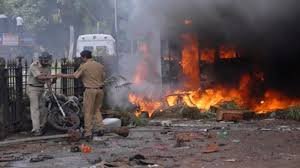
Religious minorities especially Muslims are still struggling to have complete assurance of the safety and security of their lives and property in plural, multi-cultural, democratic Bharat which will soon celebrate its 68th Independence Day. This sad state of affairs for the Indian Muslims has been a result of the methodical corrosion in the secular fabric of the socio-political landscape of this country and the unfortunate rise and acceptance of a communal narrative by certain groups and parties that seek to promote Muslim odium and brutal majoritarianism in the garb of nationalism and patriotism.
The venom of hatred espoused by these adherents of jingoism and fanaticism has been so vicious and widespread that it has forced the political proponents of secularism to go on the back-foot and become apologetic and weak when asked to stand up for minority rights, justice and fair play lest they be condemned as “pseudo-secularists” and “minority-appeasers” by their opponents.
SORDID SAGA OF COMMUNAL RIOTS
But is it true that Muslims in India are not safe, and the struggle to obtain security for their lives and property is lackadaisical? Is this mere propaganda by the ‘secularists’ or the allegation of “Muslims don’t feel safe in India” – borne by facts backed by chronicled data and statistics?
The Ministry of Home Affairs (MHA) comes out every year with data about communal incidents in the country. In its latest report, the MHA says that the first 10 months of 2103 have seen more bloodshed for religious and sectarian reasons than the entire three-year period of 2010-2012. No fewer than 725 communal clashes have occurred across the country till October 2013. By contrast, there were 668 incidents in 2012, and 580 in 2011.
Ever since the first major communal riots took place in Jabalpur in 1961, there has been a systematic attempt by the forces of bigotry and hate to engineer communal violence and disturbances in various cities and towns with a sizable Muslim population. Among the more than hundred thousand incidents since Independence that targeted Muslims, the most bloody and despicable were the riots of Rourkela, Calcutta & Jamshedpur (1964), Ahmedabad (1969), Bhiwandi (1970), Aligarh & Hyderabad (1978), Jamshedpur (1979), Moradabad (1980), Bihar Sharif (1981), Meerut & Baroda (1982), Malegaon & Hyderabad (1983), Bhiwandi (1984), Ahmedabad (1985) and Mumbai (1993).
Besides these, the most gruesome and macabre pogroms which were carried out against innocent Muslims were those in Nellie-Assam (1982) and in Gujarat (2002). More recently the riots of Muzaffarnagar (2013) demonstrate how the Muslim community has been systematically targeted and made to face the brunt of a diabolical campaign designed to humiliate and bludgeon them into a position where they do not dare to demand any rights and liberties guaranteed by the Constitution.
METHOD BEHIND THE MADNESS
The findings of a study report by the Institute of Peace and Conflict Studies, one of the premier research institutes and think tanks on South Asia, state: “Communal riots that took place from the 1960s to the 1980s followed a particular pattern. They occurred mostly in urban towns which are either industrial belts or trading centres with the economy largely based on a particular occupation. Most of these places had a considerable percentage of Muslim population whose political or economic interests clashed with those of the Hindus.
“Moreover, major riots occurred when the Congress was in power in these states or during the short and uncertain phase of the Janata Party coalition rule at the Centre. Riots in this phase might have occurred in the villages or rural areas like the Bihar Sharif riots, but they have often remained underreported. Therefore it is important to distinguish this phase from the 1990s during which the BJP and its sister organisations have been active in instigating communal riots.
“Communal violence since 1990s needs to be seen in the light of the changing political equations in the country. The decline of the Congress and the emergence of the BJP as a strong political force resulted in shifting patterns of communal riots. Communal violence in the last two decades is a result of the manipulation of religious sentiments of people by the Hindu right-wing organisations for political gains. The politicisation of the Mandir-Masjid issue and the subsequent demolition of Babari Masjid gave the BJP an opportunity to consolidate its vote bank. But in the process the controversy created a communal divide, and frequency of riots also increased during this time. Since partition, never before has one particular incident resulted in the emergence of violence in almost all the states. From the 1960s till 1980 local factors played a very important role in the emergence of riots, but since the late 1980s this trend seems to be changing.
“Communal violence has always occurred when the BJP has wanted to expand its base. In the recent years the South Indian states, particularly Kerala and Tamilnadu, have also witnessed communal violence and are slowly growing into communally sensitive areas. This is primarily because of the recent entrance of BJP in the political arena of these states. Apart from Godhra, other incidences of communal violence in the 1990s have been minor, yet they cannot be dismissed. These eruptions of communal violence have not been spontaneous, but are organised, and often have the support of local administrations.
“The state support to riots is a long established feature in India, yet the state has never been such an active participant in the violence before the Gujarat riots. Communal violence has entered a new phase with the Christians and members of other minority religions being made the victims of planned attacks. Communal riots in this decade have been both urban and rural features, but the extent of damage is always greater in the thriving centres of trade and commerce. Tribal population in rural areas is being forced to get involved in the attacks on Christians and Muslims by bringing them within the Hindutva framework. Apart from economic reasons, the call for Hindu unity which is primarily a means to achieve political advantage is the main source for communal violence in this decade.”
APPEASEMENT OR FOOLING?
The United Progressive Alliance (UPA One) supported by Left parties, under its Common Minimum Program (CMP), which promised a comprehensive legislature against sectarian/communal violence, circulated the first draft of Communal Violence (Suppression) Bill in the Parliament on 5 December 2005. It was later sent to the Standing Committee on Home Affairs which submitted its 122nd Report on The Communal Violence (Prevention, Control, and Rehabilitation of Victims) Bill, 2005 on 13 December 2006.
While the Bill was in Rajya Sabha, many civil society organisations, activists and Left parties opposed the Bill in its current form. The friction pressurised the UPA government to re-think about the Bill. UPA-II gave the task of drafting the Bill to National Advisory Council (NAC). NAC convened the Advisory Group with social activists to prepare a draft. After intense efforts for over a period of one year and a half the draft came to its final stage in May 2011.
Even this version of the Bill was opposed bitterly by the BJP and the UPA-2 then further diluted some of its clauses to assuage the opposition demands. However, the government faced a major embarrassment on the first day of the extended winter session of Parliament in February 2014 as a united Opposition forced the government to defer the Communal Violence Bill in the Rajya Sabha. As the opposition parties stepped up their attack on the government, accusing it of going against the spirit of federalism and encroaching upon States’ rights, Deputy Chairman P.J. Kurien deferred the Prevention of Communal Violence (Access to Justice and Reparations) Bill, 2014, in view of the mood of the House. That day will surely go down in history against the Congress party for being insincere and hypocritical about minorities’ welfare.
MUSLIMS’ APPREHENSION AND THE ROAD AHEAD
With the election of “Modi Sarkar” the Prevention of Communal Violence (Access to Justice and Reparations) Bill, 2014 has effectively been confined to the dustbin as the BJP government has made up its mind not to go ahead with a bill that it had attacked vociferously when it was in the opposition. The recent disturbances in Pune and Saharanpur point to the justifiable growing fear among Muslims that they are always under the threat of targeted violence by violent and blood-thirsty mobs who have been clinically indoctrinated by the forces of Muslim-hatred and dream of a ‘Hindu Rashtra’ where all other communities will only be able to live in the country if they agree to dissolve their religious identity and forgo their Constitutional rights of freedom to preach, practise and propagate their religion.
The only ray of hope is that these forces of jingoism are still a minority and the majority of Indians do not subscribe to the exclusivist and fascist agenda. Most Indians are peace- and justice-loving and do not look favourably towards minority bashing and majoritarianism. The problem is that this section of society is both figuratively and actually a “silent majority” allowing the loud rabblerousing minority to communalise the atmosphere, spread hate propaganda, engineer pogroms and massacres and give India a bad name in the international community. Communal riots in India can stop only if the silent majority becomes vocal and vociferous enough to condemn, reject and drown the frightening bawls of the peddlers of hate.