

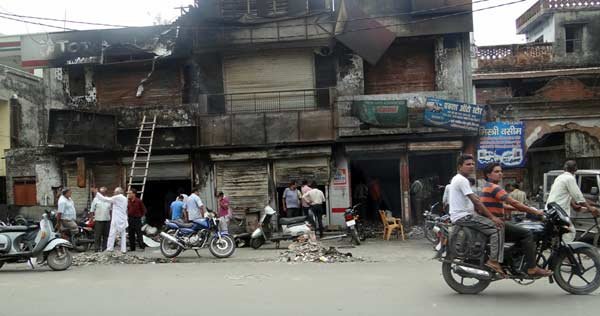
A delegation comprising leaders of various Muslim organisations, led by Mohammad Ahmad, political secretary, Jamaat-e-Islami Hind, visited the riot-hit Saharanpur district of Uttar Pradesh to find out the ground reality and placate the atmosphere of anger and suspicion emanated in the aftermath of the riots that broke out between Muslim and Sikh communities in which three persons were killed and dozens were injured. The government has set up an inquiry which will submit its report within two weeks.
The delegation was informed by the local people that the mosque which was more than 100 years old was built by Hasan Askari. Askari then migrated to Pakistan in 1965 and before that he had sold his properties nearby the mosque to two Hindu women and an agreement was signed between Askari and the women that the mosque will remain at the same place. After that it was bought by the Sikh community. Disputes started in 1990s between the Sikhs and the Muslims and the court stayed any kind of construction at the site. The mosque is registered under the Sunni Waqf Board.
Mohammad Ahmed, the leader of the delegation, while speaking to Radiance, said that over the years various right wing organisations have kept on assessing as to how to marginalise and isolate the Muslim community and also how to polarise the entire Hindus against them. There are various groups and communities who are in good terms with the Muslims. For example, there had been cordial relations between Jats and Muslims and even during independence Jat had encouraged the Muslims to remain there and since independence there had been no communal violence in the region. A very small incident which was a case of honour killing was conspired and blown up to a major communal violence to divide Jats and Muslims for political gains. Likewise, after 84 riots very good relation exists between Sikhs and Muslims. Here, it is not the issue of just a piece of land in the possession of Sikhs but the bigger conspiracy was to make the Sikh community against the Muslims.
In reply to another question, Mohammad Ahmed said that it is not true that Uttar Pradesh government has not learnt some lesson from gross debacle in the Lok Sabha polls because if we compare Muzaffarnagar riots and how long it continued and the Saharanpur riots which lasted for few hours. It seems that the government has acted swiftly and in a responsible manner this time. As per the findings of the delegation, they came to know that even District magistrate was at the sight to control the situation and the local administration was prompt and active as compared to other riots in the state; otherwise it could have flared up like another major communal violence.
On the question of whether the perpetrators have been able to divide and create mistrust the way they wanted to be between Sikhs and Muslims, Ahmed said, “As for our reading they have not been able to do so because when we met the people of the Sikh community in Gurudwara, where representatives of all Muslim organisations were there we came to know that even after riots and differences, there was a feeling that things should be normalised soon and the fissure if any must be bridged because if this gap is not bridged then both the communities will have to pay heavily for that. Another very noticeable change which came up during the visit was that some members of the Sikh community were in favour of creating a common fund by which the losses of both the communities can be compensated; it suggested that those who wanted to vitiate the relationship has not been able to do so.
Another delegation member Maulana Muhammad Rafique Qasmi, Secretary JIH, in reply to a question on the role of media, told Radiance that the media instead of reporting the facts with truth and clarity became judge in most of the cases without going into the details of the events. “This is not a healthy sign and does aggravate the situation. The role of media is to ameliorate and improve the situation after any incident or violence but not to flare up the fire or report any mischief, rumour or propaganda to make the situation worst. Recently, we have also seen the role of media and its result after the Lok Sabha elections and how long the country will have to face its consequences is yet to be ascertained.”
During riots both sides commit mistakes, the degree may vary; it was also in Saharanpur. Media takes a partisan role and sides with one community and holds responsible the other communities which they do not belong to. In Saharanpur, all the communities are interlinked in one way or the other in business and if such violence takes place more or less all will be affected. The Saharanpur riots broke out because of rumour which was deliberately made. If rumours are made that either a mosque or a Gurudwara is attacked then ultimately it will be followed by consolidate reaction by either side. This happened in Saharanpur when rumour was spread that the Sikh community was attacked by one mosque. In the Quran, it has been said that when any important news comes to you and if its messenger is not credible then verify it and crosscheck before reacting and if anyone reacts without going into the details or verifying it then it will have adverse effect.
Maulana Qasmi, who is a revered figure within the Sikh community, in his message to both the communities, said that a Muslim after looking at the debris of the Sikh property must feel that it is his loss and the Sikh after looking at the damaged property of Muslims must think that it is his loss and together they should think that it is the loss of the people and the nation. In the teachings of Sikh religion it is said not to help any oppressor; instead he must be stopped to do so which Guru Nanak had strongly advised his followers to obey. And in the same manner, in Islam, it has been said that the oppressor must be stopped from committing any crime or zulm instead victims be supported. If such are the teachings then both the communities should follow them instead of ignoring them.
Dr. Zafarul Islam Khan, president All India Muslims Majlis-e-Mushawarat, Abdul Hameed Nomani, General Secretary Jamiat Ulama Hind, Maulana Abdul Wahab Khilji, Vice President All India Muslim Personal Law Board, Dr. S.Q.R. Ilyas, General Secretary Welfare Party of India, and Inamur Rahman were also part of the delegation.