

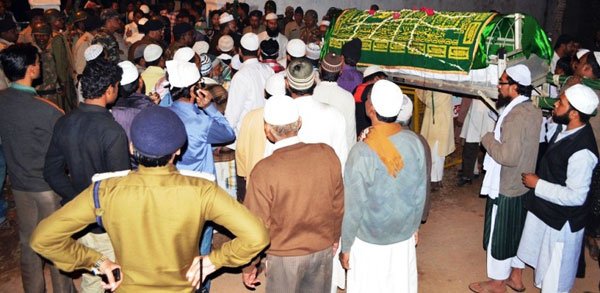
SAHAR KHAN analyses the Barelvis’ bid to refuse the burial of an elderly woman in Rajnandgaon Muslim graveyard, and the aggrieved party’s urgent petition in the High Court, which provided immediate relief and allowed the much-awaited burial in the same graveyard.
Chhattisgarh High Court, in a significant relief, on 3 January directed the state administration and other respondents to ensure that the body of an elderly woman, who was denied burial in a Muslim graveyard by Barelvi sect of the Muslim community, be laid to rest at the same ground after it was kept for over 52 hours at home in Rajnandgaon district of Chhattisgarh.
The last rite was performed late evening on 3 January under heavy security cover after the single bench of Justice Satish Agnihotri pronounced that the Qabristan (Muslim graveyard) belongs to the Muslim community and not to any particular sect, either Barelvi or Deobandi. The body of Zubaida Memon (around 65 years) was kept for over two days since the family members were left with no option except to move the court and file an interim application seeking immediate justice.
“The court has given interim relief and has given two weeks time for the other party to respond. We hope that such vexed disputes will end once and for all by the high court during the next four months,” said Prakash Tiwari, counsel of the petitioner Hashim Memon.
The conflict between two Sunni Muslim sub-sects – Barelvis and Deobandis – in the Indian subcontinent is nothing new. But the court’s decision to resolve the issue was the first of its kind in recent times.
The incident has shocked many. Not just various sections of the Muslim community but several non-Muslims too abhorred such occurrence, calling it an unjustified and inhuman act of not allowing the burial of an aged woman.
“It’s really a painful feeling of distress when such an incident occurred. When Muslims, irrespective of the sect, follow one Qur’ān, one Prophet, one religion, why does this needless issue emerge? There are people and few leaders among Muslims who are working to create differences among Muslims and spread baseless canards. It’s a really shameful act,” said chairman of Chhattisgarh State Haj Committee Dr Salim Raj.
Zubaida Memon, who breathed her last on 1 January, was cited as a Deobandi Muslim woman by the followers of Barelvi sect and therefore her burial was denied in Rajnandgaon, the district which happens to be the home constituency of chief minister Raman Singh.
Her aggrieved son Hashim Memon knocked the doors of district authorities and sought their interventions but owing to reported political influence of Barelvi’s sect in the state, the authorities proved to be of little help. All that the district collector and other officials did was an appeal to the two sects of Muslim community for reconciliation.
Left with no option, Memon left the body of his mother at home and rushed to Bilaspur High Court, around 200 km from Rajnandgaon, to file an urgent petition seeking space in the Muslim graveyard for his mother.
According to Memon, when he along with other relatives carried the dead body of his mother to the graveyard meant for the Muslim community, for burial, they had to face stiff opposition from Jawed Ansari, who is president of Gole Bazar Mosque in Rajnandgaon, and Haji Shafiq, a caretaker or Mutawalli of religious property in the area. The duo often were found to be staunchly opposing to anyone they believed to be Deobandis and even preventing them from entering the mosque for prayer. During the holy month of Ramadhan in 2012, Memon’s family was meted out with the same treatment when his father had died. Then the body had to be escorted by the police and buried about 100 km away at midnight while it was raining heavily.
It was very strange when the counsel Prateek Sharma on behalf of Shafiq and Jawed Ansari referred to the deceased and her family as kafirs (non-believers) in the court. Sharma was reported to be associated with Chhattisgarh Wakf Board, which was one of the parties against Memon.
There were allegations that the Chairman of State Wakf Board Saleem Ashrafi deliberately avoided to cooperate and resolve the issue. Rather he was reportedly one of the main opponents always standing against those who are seen as Deobandis. “When there was a claim that the Qabristan belongs to the wakf, we made several communications to the Wakf Board but Ashrafi never responded. So we have made him and the Wakf Board also among the respondents,” said Prakash Tiwari.
Ansari and Shafiq stated that they didn’t allow the burial as the graveyard was allotted to the followers of Barelvi sect and the petitioner and his family members belonged to Deobandi school of thought.
Justice Agnihotri, during the urgent hearing of the case, however, found that the state revenue record has declared the graveyard has been given for the purpose of burial of the deceased persons belonging to the Muslim (Sunni) community. “As per the record it was never meant for any particular sect of Muslims,” the court observed.
The state government had earmarked 7.1 acres of land long ago for purpose of burial of the deceased persons of the Muslim community, said Tiwari. “The court said that the petitioner has every right on the given land and directed the state authorities and the respondents to permit the petitioner to perform the last rites of his mother at the same graveyard,” the counsel added. The court further asked the administration to ensure the law and order be maintained in the wake of the mounting tension prevailing in the city.
Large sections of Muslims, who felt offended by the ‘cruel and wicked’ act, remain hopeful of the final and lasting solution to such a persisting problem continuing in other districts of Chhattisgarh as well. Ironically, in several mosques across the state one will find a board hanging at the entrance, warning the Deobandi (Wahabi) and Tablighi to desist from entering the mosques for prayers otherwise they will be responsible for the consequences.