

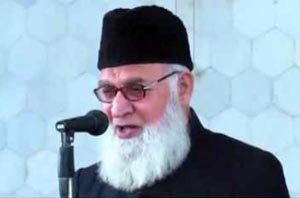
MAULANA RAFEEQ AHMED QASMI, Secretary Jamaat-e-Islami Hind, who was the convener of the 10-day convention for Ulema and madrasa graduates, shared with MOHAMMAD NAUSHAD KHAN, his viewpoints on the need of such a camp and urged the madrasa graduates to play an active role for the community in every sphere, keeping aside their petty sectorial differences, if any.
Why was the need for 10-day convention of Ulema and madrasa graduates?
The Qur’ān and Hadith are the two sources of inspiration and guidance. Prophet Muhammad (peace and blessings of Allah be to him) once said that as long as you abide by the teachings of the Qur’ān and the Sunnah, you will be successful in every field of life. When the period of Prophethood came to an end, the Caliphate period began. Muslims were successful in every sphere no matter in which field and in which direction they moved on. Muslims remained victorious on all fronts. And they were blessed with success and welfare. After Caliphates, when the period of monarchy began, Muslims remained dominant but at the same time the spirit of the Qur’ān and its purpose got affected.
When there came the period of kingship, the detachment from the Qur’ān got further widened. And because of this gap Muslims were bereft of dominance they could have retained, and the blessings of Almighty they could have received.
The triumph of the communities defeated by the Muslims during the latter’s peak time became certain. The fact remains that if the message of the Prophet (peace and blessings of Allah be to him) was held in true spirit and had the Muslims followed the guidance of the Almighty then surely it could have been the prerogative of the Muslims to hold power and dominance. But the Muslims chose to ignore the noble message, inviting their gradual decline.
What was the basic objective of this camp?
In the present, Muslims do remember those days in their speeches and debates but in practice, whether in individual capacity or collectively, are hardly following the path as shown by the Almighty. In the past too, the Baatil had no problem if Muslims followed their Din or did anything on economic grounds or anything for the sake of society. But the moment Muslims put their feet forward in politics problems and obstacles were put in place to discourage Muslims.
Muslims slowly and gradually confined themselves within the four walls of Madrasas and Mosques. And the impression gathered at that point of time was that those who are well versed in Islamic teachings should refrain from politics and should not step out of the outlined periphery. And because of that the leadership of Muslims got divided in two parts. One was Dīni leadership and the other political leadership. The people from Dīni background isolated themselves from those belonging to political leadership. The political leaders termed the Dīni leaders to be ignorant of worldly problems whereas the Dīni leaders were of the view that political leaders are only for worldly affairs and they have nothing to do for Dīn and Imaan. Both these leaders ignored the basic facts that the Prophet (peace and blessings of Allah be to him) led and guided the Muslims on both the issues of Dīn and Dunia at the same time.
The leadership during the periods of Rightly Guided Caliphs was not divided. The Rightly Guided Caliphs believed that to deal with political and worldly affairs in the light of the Qur’ān and Sunnah was as important as to say Namaz and follow the Dīn. In practising the Dīn and politics we must remain servants of the Almighty in all circumstances. The moment we dissociate ourselves from the guidance of the Qur’ān and Sunnah, we will be defeated at all fronts and our proximity with Allah will get disassociated. As per Islamic teachings our leadership is one and there is no controversy therein.
What was the message sent across through this camp?
Islam is the only solution to all problems of the individual and the people which these Ulema are well aware of. They were simply reminded of their responsibilities. There are 58 Muslim-ruled countries and every fifth man on earth is a Muslim. Despite this they are pushed to the corner everywhere; they are marginalized. They are helpless, and are in a state of inferiority complex. In spite of such a huge Muslim population and presence of a large number of Ulema, Muslims live in ghettos with worries around them. It puts a question mark before us. That’s why it was thought to invite these Ulema and madrasa graduates to sit together and discuss the way forward and come out with a solution to overcome the present malaise. The world is confronted with a variety of socio-economic problems. People who are rich are getting richer and are extracting blood from the poor. Factory owners want their workers to work more and more and in return pay to them minimum wages possible. This programme was organised to get benefit from the knowledge and experience of Ulema on various issues.
Was there any attempt to sort out sectorial differences in the larger interest of Muslim unity?
Jamaat decided to invite the Ulema in whom people repose faith so that the message from here goes clear. The basic idea was to collect people from all sects and schools of thought and ask them the solution of the problem. The Qur’ān is one, Dīn is one, Allah is one and Rasool is one. Then why it is so that one sect is not willing to see the face of another and why they are not willing to sit together. The camp was held so that people from all sects could sit together for a few days and let others know that unity among us is possible.
Would you like to share some development during this camp which you feel is important for other people as well?
I am very pleased that the camp was organised peacefully and there were no ill feelings during the camp. It was all together very successful. It was a very decent gathering. Nothing uncalled for. Those who had gathered here set an example for others to learn from it.
Do you think such programmes should be organised at different places?
If such programmes are organised on a routine basis by various organisations and groups, it would go a long way to find solution to the problems confronted by the Ummah. Unity in all walks of life should be for the sake of Allah and not for anything else.
It is true that unity among intellectuals, political and religious leaders and academicians is needed the most. This unity must be only for the sake of Allah. The motive which is above all must be followed in any kind of discourse. The Qur’ān has provided guidance in this matter. Keeping these perspectives in view, Ulema were invited. I am thankful to Allah that Ulema gathered here. The manner these Ulema enriched themselves and learnt and carried the message of unity along is the blessing of the Almighty.
Was there any difference between the camp organised last time and the present one?
Jamaat-e-Islami Hind decided to hold two such camps of Ulema and Madrasa graduates during the current four-year term. In 2012, one camp was organised and it was the first in the history of Jamaat. And what is done for the first time is always pleasant. In terms of quality the former camp was remarkable while in terms of quantity the latter camp was successful. In both the camps people participated with great interest and happiness and tried to gain knowledge. This time the teachers and trainers were invited in greater number as compared to the last one. The message sent from here was that the gathering was only to achieve unity in spite of any difference. All those gathered here were flag-bearers of unity and believers in the Oneness of Allah.
In these camps some former and present professors of Aligarh Muslim University, senior teachers from Darul- Uloom Deoband, and Nadwatul Ulema Lucknow and religious scholars from Hyderabad and other places were invited and they participated in the programme with keen interest. These people were from different schools of thought, different backgrounds and different religious institutions. With their coming to the programme the Ulema and Madrasa graduates came to realise that the purpose of this gathering was not to look upon sectorial differences but rather to talk and discuss the message of Islam. They were impressed upon that the Ulema and Madrasa graduates should not only sit in mosques or madrasas. They should not remain aloof from the issues and problems. They should get linked with the issues and try to find out the solution.
What role madrasa graduates can play in strengthening the community and the country?
If the role of madrasa graduates could have been out of mosques for the sake of justice and just world order as per the teachings of the Qur’ān and guidance from Sunnah then definitely the history of the world would have been different now. They confined themselves in the corridors of mosques and madrasas. Here in this camp it was emphasised that they ought to do what they are responsible for. Only having close affinity with Islam will not be sufficient unless and until they practise the teachings and guidance of the Qur’ān and Sunnah in their daily lives.