

Social Impact & Strategic Commutations Consultant
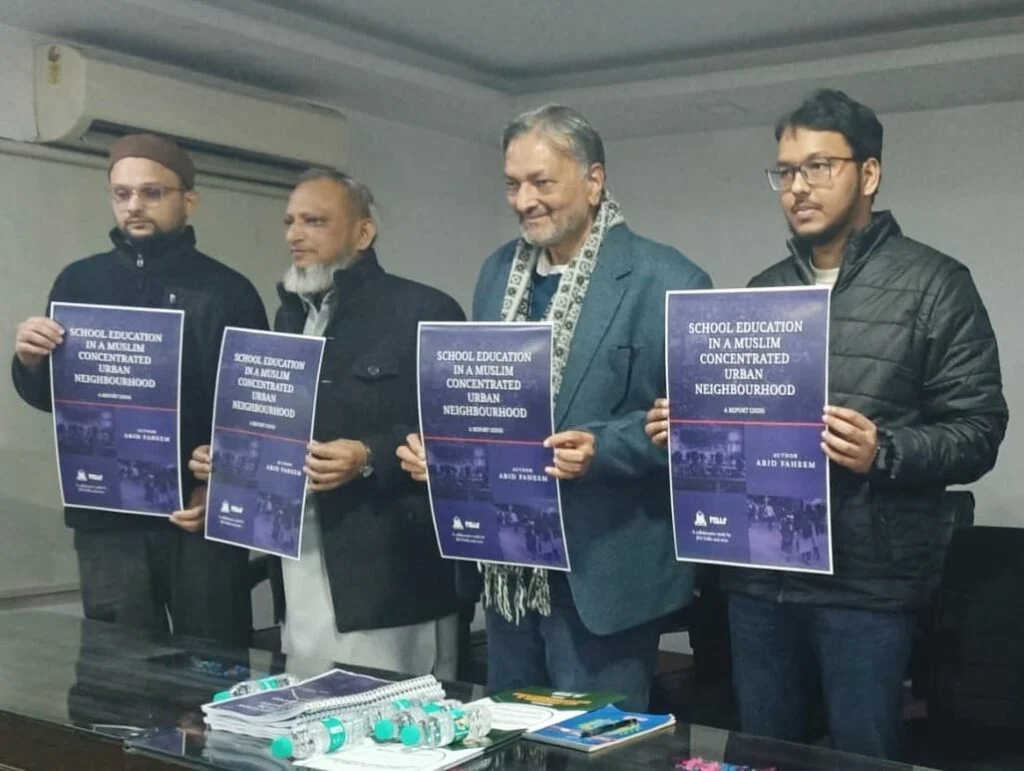
A thought leadership analysis based on: School Education in a Muslim-Concentrated Urban Neighbourhood – Abid Faheem (JIH Delhi Halqa& NOUS, 2026) and Drawing also on: ‘Beyond the Stereotypes’ – Aftab Mohammad, Radiance Viewsweekly, 10–16 May 2026
There is a certain kind of silence that masquerades as consensus. In India’s long debate over Muslim education, that silence is the silence of the state. The question that goes unasked – in television studios, in policy committees, in newspaper columns – is not whether Muslim families value education. The 2026 Jamia Nagar study answers that question so decisively that only the wilfully inattentive could ignore it. The real question, harder and more politically inconvenient, is this: why has a community this aspirational, this invested, this present in schools – why have its children still not learned to read?
The answer is not found in culture. It is not found in religion. It is found in the annual budget of the Delhi government’s school infrastructure programme, in the ward maps of Shaheen Bagh, in the spreadsheets of scholarship disbursements that show year after year that barely one in eight eligible children actually receives what they are constitutionally owed.
This article is an attempt to read the Jamia Nagar study not merely as a neighbourhood report – though it is an excellent one – but as an X-ray of a governance failure that has been two decades in the making, and as a framework for the structural change that two more decades of piecemeal intervention will not produce.
The Central Argument
Educational disadvantage in Jamia Nagar is not a community problem. It is a state problem, a governance problem, and a political problem. Solving it requires not goodwill gestures but a restructured public commitment – backed by law, budget, and accountability – to the children the system has quietly decided do not count.
- A Study That Earns Its Conclusions
Before examining what the Jamia Nagar report finds, it is worth pausing on how it finds it – because the methodology is itself part of the contribution.
The study surveyed 2,648 Muslim households across 12 localities, covering 3,872 children aged 3-18 through structured household interviews. It combined demographic profiling, school mapping of 125 institutions, and learning assessments aligned with ASER methodology in Urdu, English, and Mathematics. Crucially, it disaggregates every finding by gender, caste, wealth quintile, and migration status – enabling the study to see what aggregate data routinely hides.
This is its methodological gift: it makes the invisible visible. National surveys like UDISE+ or AISHE capture institutions, not children. They count enrolment, not learning. They miss the family in Shaheen Bagh whose child walks 3 kilometres each morning because there is no government school within the neighbourhood. They miss the migrant boy who drops out at 17 because his father has fallen ill. They miss the mathematics regression between Class 5 and Class 8 that no school inspection report will ever record.
Aftab Mohammad’s Radiancearticle, published the week this analysis was written, rightly notes that the study ‘offers a closely observed account of one urban Muslim locality and, in doing so, unsettles many of the certainties with which Muslim education is routinely discussed.’ That unsettling is data-driven – which is what gives it authority.
- Dismantling Five Myths – With Evidence
Indian public discourse on Muslim education rests on five convenient assumptions. The Jamia Nagar study does not merely challenge them. It demolishes them.
Myth 1: Muslim Parents Prefer Madrasas Over Mainstream Schools
The data is categorical. 97% of children in Jamia Nagar attend government or private mainstream schools. Only 0.8% attend madrasas. Among surveyed parents, 27.8% of fathers and 27.1% of mothers have no formal schooling – yet they are sending their children to English-medium schools, paying private fees, and arranging coaching, often on incomes of ₹20,000 a month or less.
The madrasa narrative is not a description of reality. It is a political convenience that deflects attention from the state’s failure to build public schools – replacing the question ‘Why did the government not provide?’ with the easier one: ‘Why do they choose differently?’
Myth 2: Muslim Girls Are Kept Out of School by Culture
Enrolment in Jamia Nagar is near-equal by gender: 50.6% boys, 49.4% girls. Among children who have dropped out, 58.1% are boys – not girls. Dropout is concentrated at ages 17 and 18, driven overwhelmingly by economic pressure: the family needs income, and the older son is the first candidate.
As Aftab Mohammad observes, this pattern reveals a painful irony: ‘daughters may remain in school longer precisely because sons are pushed into work sooner.’ This is not a triumph of gender equality. It is a portrait of poverty’s timetable – the way economic distress reshapes adolescent futures before any cultural preference gets a chance to operate.
The implication for policy is significant. Adolescent boys from economically vulnerable households are a systematically neglected group in Indian education policy. They need scholarships, vocational pathways, and financial safety nets – not just programmes aimed at girl-child retention.
Myth 3: High Enrolment Means Educational Progress
This is the subtlest and most dangerous myth, because the data that supports it is real. Enrolment at 94% is genuinely high. But what does that enrolment produce?
| 0% Class 3 students who can read an English sentence | 3.6% Class 3 students reading Urdu at story level | 30.9% Class 8 students proficient in division maths |
In mathematics, the regression is not merely stagnation; it is reversal. Division proficiency rises from 19% in Class 3 to a promising 45.5% in Class 5, and then collapses to 30.9% in Class 8, falling 15 percentage points below the national ASER benchmark of 45.8%. Children are being promoted through grades without consolidating the skills of the previous grade. The school is passing them; the learning is not.
The phrase coined in the report –‘formal inclusion but pedagogical fragility’– deserves to become a standard diagnostic for urban Indian schooling. Enrolment is a floor, not a ceiling. A child can spend nine years in a classroom and emerge functionally illiterate. In Jamia Nagar, a non-trivial number are doing exactly that.
Myth 4: Private Schools Are the Answer to Poor Public Schools
The privatisation of education in Jamia Nagar is striking. 56.7% of children attend private schools – compared to a national average of 28%. And 58.4% of the 125 educational institutions were established after 2013 – driven almost entirely by private actors. This looks like dynamism. It is actually a market signal for state failure.
These are overwhelmingly low-fee, English-medium schools operating from cramped premises, with poorly paid and semi-trained teachers, class sizes of 50–70 students, no science laboratories, and chalkboard-only instruction. The report’s student interviews document this directly: ‘teaching relying almost exclusively on chalkboards… computer and science laboratories were either absent or infrequently used.’
Meanwhile, 52.8% of all institutions offer only primary education. Only 17.6% go up to senior secondary – and of those, 63.6% are privately managed. A child from a poor migrant family in Shaheen Bagh has no publicly funded pathway to Class 12. This is not a market outcome. This is a constitutional violation.
Myth 5: The State Has Done Its Part – Families Must Do More
The final myth is perhaps the most corrosive. Only 12.5% of children receive any scholarship or financial support. Of those, 50.8% receive it from their school – discretionary charity, not state entitlement. Government scholarship schemes reach only 22% of beneficiaries. Shaheen Bagh, home to 18% of Jamia Nagar’s population, has zero government schools.
The Sachar Committee documented precisely these failures in 2006. The Post-Sachar Evaluation Committee in 2014 noted inadequate implementation. The 2026 Jamia Nagar study confirms that 20 years of documented failure have produced no meaningful correction. The state has not done its part. It has barely begun it.
III. The Architecture of Exclusion: How Four Systems Fail Together
What the Jamia Nagar study reveals, when read carefully, is not one failure but the interlocking of four structural failures that together make educational disadvantage nearly self-sustaining.
The Infrastructure Failure
The geographic distribution of government schools in Jamia Nagar is not the result of planning. It is the result of decades of non-planning. Of 19 government schools, many share premises and run in multiple shifts – inflating the apparent count while masking the real scarcity. The absence of a single government school in Shaheen Bagh is not an administrative oversight. It is the cumulative outcome of budget priorities that have repeatedly excluded minority-concentrated localities from the city’s educational infrastructure map.
The Delhi Education Model – celebrated nationally and internationally – has not reached Jamia Nagar in any meaningful way. Its benefits have flowed to localities with stronger middle-class presence and political voice. This is what the report’s authors, citing Gayer and Jaffrelot, call the ‘state retreat’ pattern: the systematic withdrawal of public infrastructure from Muslim-concentrated urban spaces that entrenches spatial marginalisation across generations.
The Learning Failure
Even where children attend school, the school is often failing to teach. The classroom conditions documented in the report – 50 to 70 students per section, textbook-driven and examination-oriented pedagogy, no interactive methods, no use of available laboratories – do not produce learning. They produce attendance.
The mathematics reversal between Class 5 and Class 8 is the most damning indicator. It suggests that the foundational skills acquired in primary school are not being reinforced, extended, or built upon in the upper primary years. Skills deteriorate when they are not practised. A school system in which numeracy goes backwards as children get older is not a school system producing education. It is a system producing the appearance of education.
The Economic Failure
With 40.7% of fathers earning ₹20,000 or less monthly, and 90.6% of mothers as homemakers, the households of Jamia Nagar are living at the intersection of aspiration and financial constraint. The shadow education system – 20.8% of children attending private coaching, 79% of them doing so simply to keep up with regular school – functions as a tax on this aspiration. Families who cannot afford public schooling are forced into private schools, then further forced into coaching to compensate for the inadequacy of those schools. The total annual educational expenditure for a family in the upper wealth quintile exceeds their counterpart in the lowest quintile by multiples.
This is what the report means when it describes the ‘burden of aspiration’: families bearing, individually and privately, the costs of a public good that a functioning state would provide collectively. When aspiration has a price tag, it sorts by income – and the poorest children pay the most.
[Ershad Ahmad is a Strategic Communications and Management Consultant with over 20 years of international experience spanning World Bank, USAID, FCDO, UNDP, and MSF across India, Nepal, Afghanistan, Vietnam, and the Gulf. He has led communications and behaviour change programmes in urban resilience, public health, WASH, and social inclusion – reaching hundreds of millions of citizens through national campaigns and grassroots community work alike. As committed to evidence as to narrative, he brings rare fluency across all levels: from tribal community radio in Jharkhand to global child rights campaigns with a Nobel Laureate.]
Scan to Read
Full Article