

When a democratic state demolishes religious structures, the issue extends beyond bricks and mortar. It becomes a test of constitutional governance, equality before law and adherence to constitutional discipline. The demolition drive carried out in Rajasthan’s border districts of Barmer and Jaisalmer since June 2026 did not begin the debate over demolitions of religious structures in the State. It followed the controversial demolition of Noorani Masjid in Jaipur’s Malviya Nagar earlier that month, reinforcing concerns among civil rights advocates that executive demolition was increasingly being employed in ways that warranted close constitutional scrutiny.
The administration has justified the demolition drive as part of a border security exercise targeting alleged encroachments in villages along the India–Pakistan frontier. According to the government’s stated policy, the border clearance drive is now being implemented across what officials and local stakeholders describe as a 50-kms border belt, although the initial security directive referred to a 15-kms zone. In Rajasthan alone, where the international border with Pakistan stretches for approx. 1,070kms, the expanded scope has potentially brought hundreds of villages and religious institutions within the ambit of the campaign. It is this wider implementation, rather than the objective of border security itself, that has intensified concerns over the scale of the exercise, its impact on long-standing religious structures, and the need for scrupulous adherence to constitutional safeguards and statutory procedure.
Few would dispute the State’s responsibility to safeguard national security or remove illegal encroachments. Yet constitutional democracies are judged not only by the objectives they pursue but also by the means they employ. Security considerations cannot become a licence to bypass the rule of law.
From Notices to Demolitions
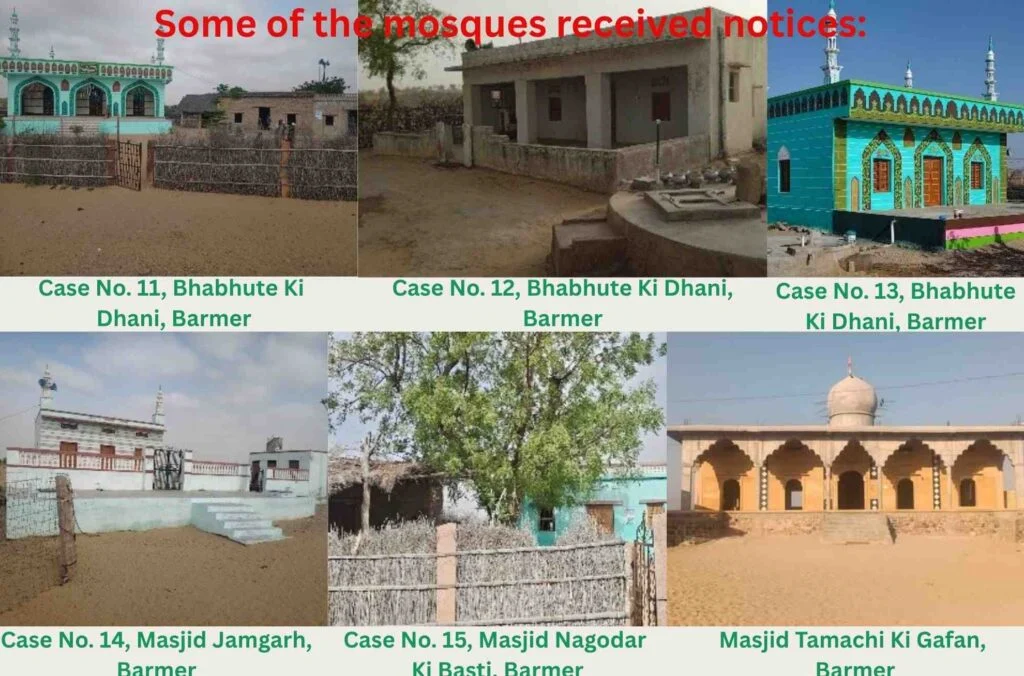
What began as action against a handful of alleged encroachments quickly assumed much larger proportions. According to local residents, community representatives and mosque management committees, more than 100 mosques, madrasas and dargahs in the border districts of Barmer, Jaisalmer, Phalodi, Bikaner and Shri Ganganagar have received demolition or eviction notices, with fresh notices continuing to be issued. As the campaign expanded, what initially appeared to be a local land dispute evolved into a major constitutional and civil rights controversy, prompting coordinated legal challenges and peaceful public protests.
According to APCR Rajasthan’s writ petition before the Rajasthan High Court, revenue authorities began issuing notices under the Rajasthan Land Revenue Act on June 11. However, many recipients allegedly received them only on 16–17 June, despite being required to respond by June18, leaving little time to obtain legal advice or prepare their defence. The petition further alleges that although several affected persons sought additional time, demolition teams arrived on June 18 and razed a number of religious structures before the administrative process had concluded. Similar demolitions in neighbouring villages, it claims, were carried out within one to three days of the notices, denying affected parties any meaningful opportunity to seek judicial relief.
What the Petition Says
Building on these events, the writ petition filed by APCR and the affected residents challenges not merely the question of land ownership but the legality of the administrative process itself. It contends that the authorities denied the petitioners a meaningful hearing, proceeded with demolitions while applications seeking additional time remained pending, and failed to follow the procedural safeguards laid down by the Supreme Court. The petition also argues that the affected parties were deprived of an effective opportunity to seek judicial relief and that the administration overlooked statutory safeguards under the Rajasthan Land Revenue Act, including provisions permitting regularisation or rectification in appropriate cases instead of immediate demolition.
Finding these allegations worthy of examination, the Jodhpur Bench of Rajasthan High Court issued notice to the State Government and sought its response. The matter remains under judicial consideration.
Not an Isolated Controversy
Against this backdrop, the rapid issuance of notices and demolition of mosques and madrasas in Rajasthan’s border districts intensified public scrutiny. What initially appeared to be a local administrative exercise soon evolved into a wider constitutional debate on rule of law, equality before the law and the limits of executive power.
The controversy deepened when the notices in Barmer were swiftly followed by demolitions, prompting legal intervention by APCR and judicial scrutiny by Rajasthan High Court. The issue has since assumed significance far beyond Rajasthan, raising fundamental questions about constitutional governance and the rule of law.
Civil Rights Concerns Reach Public Domain
The legal challenge was accompanied by a wider public-rights campaign. On June 23, APCR held a press conference at the Constitution Club, New Delhi, after a fact-finding mission to affected villages in Barmer and Jaisalmer.
APCR alleged that many mosques, madrasas and shrines received notices with earlier dates but were served just before the deadline to file objections, denying a meaningful chance to defend themselves. It said written replies were often not accepted and demolitions proceeded without proper hearings. In its writ petition before the Rajasthan High Court, APCR argued these actions violated the SC’s principles of procedural fairness governing demolition drives.
According to the petitioners and local residents, the structures demolished so far include Jamgarh Mosque in Chohtan tehsil; Malana Mosque and Kerkori Mosque in Gadra Road tehsil; Siyahi Mosque, near Gagaria, and Kelan Ka Par Mosque in Ramsar tehsil; and Devpura (Rampura) Mosque in Sedwa tehsil. The demolitionsintensified apprehensions among border communities and lent urgency to legal challenges questioning both the procedure adopted and the pace of administrative action.
While acknowledging the State’s authority to remove illegal encroachments, APCR questioned selective implementation and urged transparent, even-handed enforcement free from religious discrimination. It called for a suspension of further demolitions until affected parties receive adequate notice, access to legal remedies and impartial hearings.
APCR also noted that border communities have long cooperated with the administration and the BSF, warning that actions seen as arbitrary or discriminatory could erode public confidence in institutions tasked with security and justice.
The Supreme Court’s Clear Message
The controversy cannot be viewed in isolation from the Supreme Court’s landmark judgment delivered in Nov. 2024 concerning demolition actions across the country.
The Court made it abundantly clear that executive authorities cannot demolish structures merely on administrative discretion. It prescribed detailed safeguards, including adequate notice, proper service of notices, a reasonable opportunity to respond, a speaking order, and sufficient time for affected parties to seek judicial remedies before demolition is carried out.
These directions were intended to ensure that demolitions remain subject to constitutional discipline rather than executive expediency.It is precisely these safeguards that the Rajasthan petitioners arguments were ignored in the present case.
Allegations of Selective Enforcement
Equally troubling are allegations that the drive has disproportionately targeted mosques and madrasas while other allegedly unauthorised constructions in the vicinity have not faced comparable action.Former Rajasthan Chief Minister Ashok Gehlot criticised the campaign, questioning both its timing and apparent selectivity. Several opposition leaders similarly argued that anti-encroachment drives must be implemented uniformly, irrespective of the religious identity associated with any structure.
The State Government, however, maintains that the exercise is part of a broader campaign against unauthorised constructions in sensitive border areas and denies any discriminatory intent.Whether the implementation has in fact been selective remains a matter that deserves independent judicial scrutiny rather than political rhetoric.
The Streets Chose Peace
While the legal battle moved to Rajasthan High Court, an equally significant response unfolded on the streets of Barmer and Jaisalmer. Rather than allowing the issue to descend into communal confrontation, local residents organised peaceful demonstrations under the banners of Sarv Samaj, Sarv Dharm Shanti Sabha and the Sarv Samaj Samanvay Committee, bringing together large numbers of Hindus and Muslims in defence of constitutional procedures and communal harmony.
The movement was notable for its broad civic character rather than organisational affiliation. Local citizens, village leaders, social activists and political representatives jointly participated. Among those addressing the gatherings were Barmer MP Ummedaram Beniwal, Baytu MLA Harish Chaudhary, former MLAs Padmaram Meghwal and Udaram Meghwal, former minister Saleh Mohammad, Ashok Tanwar, who coordinated the Jaisalmer march, and Surtaram Meghwal, the Hindu Sarpanch of Paradiya village. Their common message was that while national security must be protected, administrative action must also respect due process, equality before the law and Rajasthan’s long tradition of communal harmony.
A memorandum submitted to the District Collector echoed these concerns, while Jaisalmer’s silent march was triggered by notices issued to several religious sites, including the nearly 250-year-old Dargah of Hazrat Mahmood Shah Jilani. Significantly, both protests remained entirely peaceful, demonstrating that the affected communities sought constitutional remedies rather than confrontation.
Security and Constitutionalism Need Not Conflict
No responsible citizen disputes the importance of securing India’s international border. Smuggling, infiltration and cross-border crime require robust administrative responses.However, constitutional governance requires that even the most legitimate governmental objectives be pursued through lawful procedures.The Constitution does not create exceptions to equality before law merely because an issue concerns national security. Articles 14, 21, 25 and 300A continue to operate, requiring fairness, non-arbitrariness and adherence to established legal procedure.
The Apex Court’s demolition guidelines were framed precisely to prevent executive actions from becoming instruments of arbitrariness or collective punishment.
The issue is not whether the State has the authority to remove illegal structures. It unquestionably does. The real question is whether that authority is exercised through fair, transparent and non-discriminatory procedures that respect the constitutional guarantees of equality, religious freedom and fair hearing.
The Rajasthan High Court’s intervention has brought these questions under judicial scrutiny. Equally significant has been the response of ordinary citizens. The Sarv Samaj and Sarv Dharm peace marches in Barmer and Jaisalmerdemonstrated that local communities sought not confrontation but constitutional justice and communal harmony.
As APCR observed during its press conference following its fact-finding mission, the controversy is not about placing religious structures beyond the reach of the law; it is about ensuring that the law itself remains above arbitrary executive action. That distinction lies at the heart of constitutional democracy. If a structure is genuinely unauthorised, the law provides a clear process of notice, hearing, adjudication and judicial review. Bypassing those safeguards undermines public confidence in governance and weakens the rule of law itself.
How these cases are ultimately resolved will determine not only the fate of a number of religious institutions in Rajasthan’s border districts, but also public confidence that constitutional guarantees remain meaningful whenever the State exercises its coercive powers.