

Islam is a way of life which comprehensively guides human beings in all aspects of life. Islam guides us with a complete set of laws from basic principles and policies to greater affairs.
Bonding of a male and female in a lawful manner is the cornerstone of human society. We find many verses in the Qur’ān which clarifies the purpose of the Creator behind creating male and female.
O mankind, fear your Lord, who created you from one soul and created from it its mate and dispersed from both of them many men and women. (Quran, 4:1)
It is He who created you from one soul and created from it its mate that he might dwell in security with her. (7:189)
Through these verses we come to understand that creation of two sexes among human beings is to ensure the continuity of human race through procreation to arrange for the mutual pleasure and satisfaction in their spouses.
Marital law is the most important law of human life. The marital law prescribed by the Almighty is the most clear, comprehensive and perfect law. It specifies clearly and equitably the rights of both husband and wife. There arises no question of inequality, inferiority, superiority, domination, injustice or any kind of discrimination.
Nikah in Islam is an act of Sunnah and it is strongly recommended whenever an individual feels ready for it financially, physically and emotionally. The Prophet (peace and blessings of Allah be to him) has also said, “Marriage is my tradition whosoever keeps away therefrom is not from amongst me.” (Ibn-e-Majah)
The first objective of Nikah or Islamic marriage is the preservation of morality. Islamic laws insist both sexes of humanity to confine their relationship to a code of law which protects both man and woman against immodesty, indecency and immorality. Marriage in a lawful way provides satisfaction for the sexual desires and morality and chastity to the physical need of both the sexes. It provides a safe and desirable shelter for a male and a female. It becomes an obstacle for the shaitan in misleading these two sexes to undergoing various immodest and sinful acts.
The second objective of Nikah is the love and compassion between the spouses. We witness that when two sexes bind themselves with the law of marriage, the love and compassion which forms in between them and which binds them together strongly is obviously a miraculous aspect. No other relationship tends to bridge two persons so fast with such strong feelings. Allah says in the Qur’ān that the spouses have been created so that they may enjoy peace in each other’s company.
And of His Signs is that He created for you from yourselves mates that you may find tranquillity in them; and He placed between you affection and mercy. Indeed in that are Signs for a people who give thought (Qur’ān 30:21)
It is He who created you from one soul and created from it its mate that he might dwell in security with her. (Quran, 7:189)
And at one more place Allah describes marital tie as
They are clothing for you and you are clothing for them. (Quran, 2:187)
Allah the Almighty compares spouses with a cloth. Dress is closer to human body than anything else. It not only covers the modesty but also protects one from the changes in weather. Similarly, spouses protect each other from all kinds of evil forces that cause harm to their honour and morals.
This is the real raw material of marriage. And Islam recommends strictly these two qualities in the spouses to be under one roof. When these two qualities bind two souls physically and mentally, there exist harmony, peace and respect towards each other. No evil can harm such bonding.
Islam allows to check for the compatibility of a male and a female before marriage. And this compatibility is not checking for date of birth, place and lineage, etc. Checking of the compatibility is just for the satisfaction in to-be bride or bridegroom so that they cannot regret in the future. That is why it is advisable in Islam that they should take a look at each other before accepting the proposal.
Jaabir ibn ‘Abd- Allah narrates: “The Messenger of Allah (peace and blessings of Allah be upon him) said: ‘If one of you proposes marriage to a woman, if he can look at her to see that which will encourage him to go ahead and marry her, then let him do so.’ I proposed marriage to a young woman, and I used to hide where I could see her, until I saw that which encouraged me to go ahead and marry her, so I did so’.” According to another report he said, ‘A young woman of Bani Salamah. I used to hide from her, until I saw that which encouraged me to go ahead and marry her, so I did so.” (Saheeh Abi Dawood)
Islam does not approve of marriage between two incompatible spouses. When there is compatibility in the views on morality, religiosity and social behaviour there is more chance of strong bond of love and compassion.
In Islam marriage is not a forced bonding between two opposite sexes but it is an aqd’ or contract. And its components are
1) Choosing a right suitable partner
Although beauty or physical or outward attraction which is pleasing can be adopted as a means of choosing a partner as subtly hinted in the Qur’ān:
Marry the women you like (4:3)
But the ultimate criteria and basis should be the religious inclination and practice of an individual.
The Prophet (peace and blessings of Allah be to him) said, “A woman may be married for four things: her wealth, her lineage, her beauty and her religious commitment. Seek the one who is religiously-committed.”(Bukhari)
2) Proposal: Islam encourages sending a proposal to a woman for hand in marriage, or to her parents or guardians. It is an act of showing respect to the dignity of the woman.
3) Mahr: In Islam it is compulsory for a man to give mahr (dower) to the bride before marriage.
In the Qur’ān Allah says,
And give the women [upon marriage] their [bridal] gifts graciously. But if they give up willingly to you anything of it, then take it in satisfaction and ease. (4:4)
It is the right of a woman to which her husband remains in debt. It is a free gift as a symbol of respect and care for a woman from her bridegroom ordained by the Almighty Allah. Woman has the right to demand the mahr according to her to-be-husband’s income.
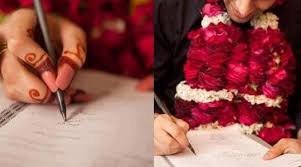
The Nikah ceremony starts with the mutual consent of both the spouses. Nikah ceremony consists of a wali and two witnesses.
To make things easier for the woman, the man is made responsible for the financial needs of the family and both together then focus on grooming the next generation with belief, moral values and a strong positive character. The Nikah opens the door of mutual compassion, love, bonding and care not only between the two who get married but the two families and the general society.
A married life coupled with a good relationship make up the prime objects of Nikah. Islam encourages very simple Nikah with least expenses and least rituals. All kinds of show off and extravagance are prohibited in Islam.
Islam puts a zero burden on the members of bride’s family but encourages walima from bridegroom as an expression of gratitude and pleasure and a great means of publicising the marriage. Anas bin Malik narrates that the Prophet (peace and blessings of Allah be to him) saw a yellow trace on the face of Abdur Rahman. The Prophet asked him whether he had got married. When he replied in the affirmative, the Prophet said to him: “Give walima (wedding banquet) even if with one sheep.”
A relationship between two people is not just supposed to be a short, action-packed romance story from the studios of Bollywood, but it is supposed to be a serious, long-term relationship in which both individuals are content and comfortable with each other. Islamic Shari’ah provides greater and easier laws for the spouses to fulfil the rights and duties of each. There is no discrimination at all. The law provided by Allah the Almighty is surely incomparable.
Nikah helps the man and woman fulfil, complete and complement each other by playing supportive role towards each other. The bonding based on the faith in Allah and His natural Shari’ah laws helps ease the hurdles faced in understanding and sharing the journey of fulfilling the duties towards each other, children, each other’s parents and the society.