

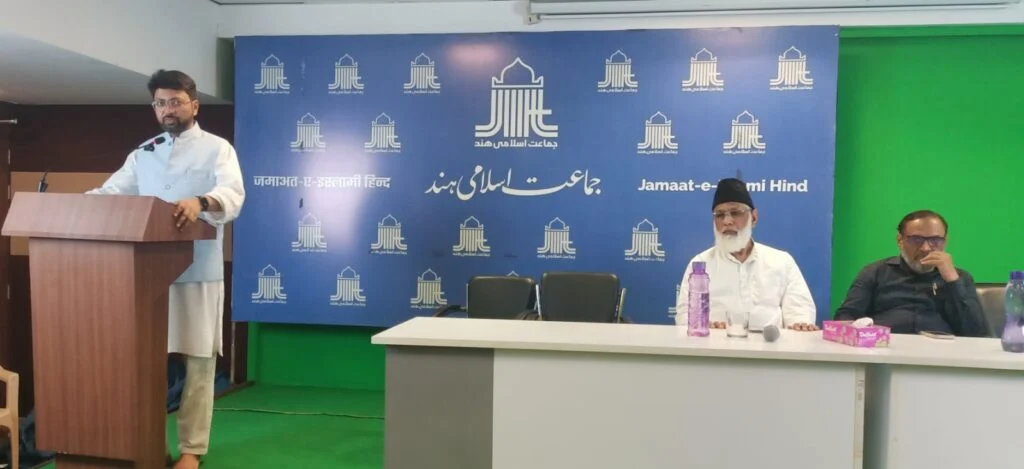
Nadeem Khan, National Secretary of Association for Protection of Civil Rights (APCR), on May 9 alleged that the 2026 Assembly elections in West Bengal and Assam were heavily influenced by Special Intensive Revision (SIR), delimitation exercises, and electoral management practices that diluted Muslim representation and altered electoral outcomes. Addressing a programme at the headquarters of Jamaat-e-Islami Hind, Khan presented a detailed analysis of election trends in several states, with particular focus on Assam and West Bengal.
Beginning with a brief reference to Puducherry and Tamil Nadu, Khan said the real impact of SIR and delimitation was visible in Assam and West Bengal. He claimed that while southern states such as Tamil Nadu and Kerala were expected to be less affected due to higher levels of documentation among voters, Tamil Nadu still witnessed largescale deletions under SIR.
According to Khan, around 92 lakh names were identified for deletion in Tamil Nadu. He pointed to constituencies where major reductions in voter numbers allegedly influenced electoral outcomes. Referring to a constituency contested by M.K. Stalin, he said votes declined from 2,81,128 in the previous election to 1,86,848 this time, meaning “1,03,800 votes were deleted because of SIR.” He claimed Stalin secured around 74,000 votes, while his rival received 82,000 votes.
Khan also discussed the rise of Vijay and his party TVK in Tamil Nadu, saying the party emerged as the single-largest party with 108 seats, while DMK won 59 seats and AIADMK secured 47 seats. He said TVK performed strongly among youth and women voters, especially in urban areas such as Chennai.
However, the core of Khan’s presentation focused on Assam and West Bengal, where he alleged systematic use of delimitation and SIR to reduce Muslim political influence.
Discussing Assam, Khan said the BJP’s victory had been anticipated even before the campaign began. He noted that the BJP won 82 seats on its own, while the NDA alliance secured 102 seats in total. He added that Chief Ministerial candidate Himanta Biswa Sarma won by 89,000 votes.
Khan argued that the BJP’s success was not primarily due to a dramatic increase in vote share, but because of delimitation and electoral restructuring. He said the BJP secured around 37% votes, while Congress obtained 29.8%. According to him, Congress had received 29.6% votes in the 2021 election, indicating that its vote share had remained nearly unchanged despite a steep decline in seats.
He alleged that delimitation in Assam concentrated Muslim voters into fewer constituencies, thereby reducing their broader electoral impact. Referring to the Dhubri and Barpeta Lok Sabha constituencies, Khan said three Muslim-majority assembly segments were added to Dhubri while two less-Muslim dominated segments were removed. As a result, Dhubri became India’s largest constituency with around 28 lakh voters.
He said Barpeta, which earlier had a Muslim population above 50%, saw its Muslim percentage reduced by nearly 30% after delimitation. “Now whether you win Dhubri by 10 lakh votes or 15 lakh votes, you still get only one seat,” he remarked.
Khan further claimed that before delimitation there were 36 Assembly seats where Muslims had significant electoral influence, but after delimitation the effective number was reduced to 22 seats. He alleged that Muslim-concentration constituencies were enlarged to nearly 3.5 lakh voters each, while constituencies in Upper Assam with low Muslim populations remained below 2 lakh voters.
Citing examples from Hailakandi and Algapur, Khan said Muslim voters were reorganised in a manner that eliminated Muslim representation from certain seats while concentrating them into others. He claimed BJP candidate Milandas won Hailakandi by 55,000 votes, while Congress leader Zubair Mazumdar won Algapur by 1,05,000 votes after the constituency size was increased to 1,45,000 voters.
Khan said the All India United Democratic Front (AIUDF), which had won 16 seats in 2021, was reduced to just two seats this time despite a marginal increase of 0.5% in vote share. He argued that “delimitation reduced Muslim influence by 12 seats.”
He also referred to the NRC process, claiming that 19,66,000 people were excluded and about 3.5 lakh people had been categorised as doubtful citizens by Border Police, rendering them unable to vote.
According to Khan, Congress failed to counter the BJP’s narrative in Upper Assam and also lost opportunities for alliances. He claimed that an alliance with Jharkhand Mukti Morcha could have yielded 7-8 seats in Upper Assam, but negotiations failed because of seat-sharing commitments.
“The difference in vote share is only 4.5%, but the seat difference is huge because of delimitation,” Khan said, adding that “strong election management” played a decisive role in Assam.
Turning to West Bengal, Khan said SIR had a major impact on the Assembly elections. He claimed that 91 lakh names were removed during the SIR process, with the largest number of deletions occurring in Muslim-majority districts such as Murshidabad, Malda and Basirhat.
According to Khan, among the 91 lakh affected people, 58 lakh could not participate in the process, while 27 lakh people allegedly submitted all required documents but still found their names excluded. He said only 1,88,000 new voters were added during the revision.
Khan claimed that authorities used software-based scrutiny to identify discrepancies. He alleged that if a family had more than six siblings, the seventh name would automatically receive a notice for verification.
He further alleged that SIR affected around 150 Assembly seats in West Bengal. In those constituencies, he said, the Trinamool Congress had won 131 seats in the previous election while BJP had secured 19. This time, according to his figures, BJP won 100 of those seats while TMC was reduced to 48.
Khan also highlighted the impact on low-margin seats. He said that in the previous election, there were 192 constituencies decided by margins below 15%, with TMC winning 119 and BJP 73. In the 2026 election, he claimed BJP’s tally in such seats rose to 173 while TMC’s count sharply declined.
Referring to reserved constituencies, Khan noted that out of 84 SC/ST reserved seats, BJP won 67. He also said Muslim votes were more divided this time compared to previous elections. According to him, around 71% Muslim votes went to TMC, 8-10% to Congress, and 5-7% to Left parties, while a new party led by Humayun Kabir also cut into the vote share.
Khan alleged irregularities in counting as well. He claimed counting in West Bengal was unusually slow, stating that by 2 pm only an average of three rounds had been completed in several constituencies. Even by 5 pm, he said, constituencies with 20 rounds of counting had completed only seven rounds.
“The actual results in many low-margin seats came at 11 pm, 11.30 pm and even 1 am,” he alleged, claiming that by then many TMC workers and candidates had already left counting centres believing the contests were over.
Khan concluded by alleging that in Assam, Muslim political influence was weakened through “policy-based delimitation,” while in West Bengal, both SIR and counting practices affected the outcome. He said the elections reflected “organised election management” rather than major shifts in public opinion.