

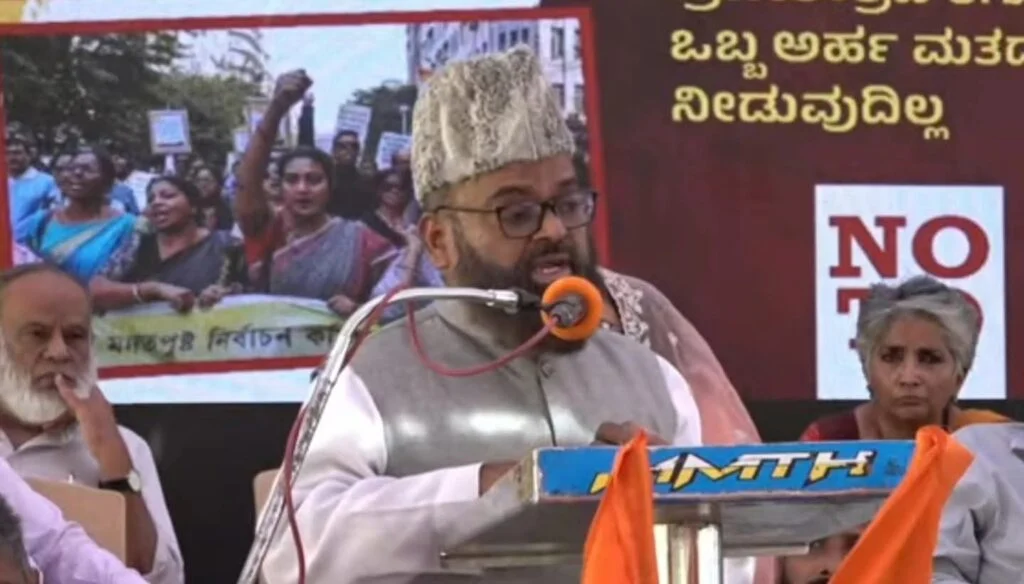
As concerns over the Special Intensive Revision (SIR) of electoral rolls intensify across the country, Karnataka on April 23 witnessed what observers described as a formidable convergence of democratic forces, bringing together political parties, farmers’ movements, student organisations, minority platforms, and civil society groups in a rare and coordinated mobilisation.
Held at Freedom Park in Bengaluru, the gathering was framed as a solidarity and protest convention, signalling a shift from isolated demonstrations to a more structured, deliberative response. Placards and banners – most notably “Karnataka Stands with West Bengal” – highlighted the theme of solidarity, as participants warned that the ongoing voter list revision, if not conducted with transparency and safeguards, could undermine electoral integrity and democratic participation.
The mobilisation comes in the backdrop of developments in West Bengal, where reports of largescale deletions from electoral rolls have triggered widespread political debate and legal scrutiny. Speakers referred to these developments as a warning signal, cautioning that similar patterns, if replicated elsewhere, could affect millions of voters across states.
A Broad-Based Civic Assertion
What set the Karnataka convention apart was not merely the scale of participation, but its cross-sectional character. Leaders from diverse ideological backgrounds shared the stage, united by a common concern over voter rights.
Presiding over the convention, Mohammed Yousuf Kanni, Secretary of Jamaat-e-Islami Hind Karnataka, underscored the need for a peaceful, constitutional, and inclusive response. He emphasised that democratic rights must be defended through lawful means, collective vigilance, and sustained civic engagement.
“This is not about one party or one community,” he noted, “but about ensuring that every eligible citizen retains the right to participate in the democratic process.”
The convention thus functioned not merely as a protest, but as a deliberative forum, where concerns were examined, strategies discussed, and a collective roadmap articulated.
Farmers, Workers, and the Question of Inclusion
Welcoming the gathering, senior farmer leader Veer Sangayya set the tone by framing the event as a collective defence of democratic rights rather than a routine political protest. He pointed out that farmers, rural workers, and economically weaker sections often face the greatest hurdles in navigating documentation processes.
“The right to vote is not just a legal entitlement,” he said, “it is a matter of dignity and recognition for ordinary citizens.”
A sharper intervention came from Karnataka Janashakti president Noor Sridhar, who warned that the SIR process, if not closely monitored, could become a systematic instrument of exclusion. In strong terms, he cautioned that even the removal of a small percentage of voters from marginalised sections could significantly alter electoral outcomes, calling it a “dangerous precedent” for democracy.
Farmer leader Badagalapura Nagendra echoed these concerns, alleging that the credibility of institutions must be preserved at all costs. He called for judicial oversight, noting that in a democracy, the responsibility to safeguard constitutional values ultimately rests with both institutions and the public.
Data, Mandate, and Representation
Adding a political dimension to the discussion, a senior Congress leader highlighted reports suggesting that over 6.5 crore voters across 13 states could be affected by ongoing revisions. Referring to Karnataka’s recent electoral outcome, where the ruling party secured 136 Assembly seats, he noted that the mandate was built on the participation of Dalits, minorities, women, and backward communities.
He cautioned that any process leading to the exclusion of such sections would distort the representative character of democracy. Calling for immediate action, he urged political workers and civil society groups to strengthen Booth Level Agent (BLA) networks and assist voters in securing necessary documentation.
A Convergence of Voices
The convention witnessed participation from a wide spectrum of organisations, reflecting the breadth of concern across society.
Among the prominent speakers were:
Welfare Party of India (WPI) state president Tahir Hussain, who called for united resistance to protect democratic participation.
Social Democratic Party of India (SDPI) leader Apsar Kodlipete, who stressed grassroots mobilisation and awareness.
Muslim Vakkuta leader Yasin Malpe, who highlighted the vulnerability of communities facing documentation challenges.
CPI leader Dr. Siddanagouda Patil, who emphasised institutional accountability.
KPCC working president G.C. Chandrashekhar, who called for coordinated political action.
Former minister B.T. Lalitha Naik, who spoke on the broader social implications of voter exclusion.
Sahitya Akademi president L.N. Mukundaraj and social activist Mallige Sirimane, who brought in civil society perspectives.
Dalit Sangharsha Samiti leader N. Venkatesh, who underscored the potential impact on historically marginalised communities.
Leaders from platforms such as Muslim Muttahida Mahaz also participated, reinforcing the message that the issue transcends community and organisational boundaries.
Minority and Civil Society Concerns
Speaking on behalf of minority organisations, Yasin Malpe emphasised that voter identity must be treated as a fundamental democratic guarantee, not merely an administrative formality. He cautioned that communities already facing socio-economic challenges could be disproportionately affected by stringent documentation requirements.
Civil society representatives reiterated that the issue must not be reduced to partisan contestation, but seen as a broader question of constitutional rights, equal participation, and institutional trust.
Legal Scrutiny and Demand for Transparency
A key demand emerging from the convention was the need to pause the SIR process until ongoing legal scrutiny is completed. Participants argued that proceeding with revisions while related issues are under judicial consideration could undermine public confidence.
Speakers called for greater transparency in the methodology of voter list revisions, urging authorities to ensure that due process is followed at every stage. The role of institutions, particularly the Election Commission, was highlighted, with emphasis on maintaining independence and credibility.
Resolutions for Safeguarding Voter Rights
The convention adopted a set of practical measures aimed at protecting voter rights:
- Establishment of voter assistance centres at Gram Panchayat and ward levels
- Provision of expedited documentation support for those lacking required papers
- Public presentation of draft voter lists through Gram Sabha and ward meetings
- Transparent verification and correction processes before finalisation
- Participants also urged the state government to engage with authorities to ensure that revisions are conducted in a manner that prioritises inclusion, accuracy, and accountability.
Karnataka as a Template for Coordinated Civic Response
Observers note that Karnataka’s mobilisation reflects the state’s tradition of active civil society engagement and coalition politics. The convergence seen in Bengaluru is being viewed as a potential template for coordinated civic action across the country.
Unlike fragmented protests, the Karnataka convention demonstrated a structured, inclusive, and issue-focused approach, bringing together diverse voices under a common democratic concern.
Sustained Vigilance Ahead
As the convention concluded, participants emphasised that the mobilisation would not remain a one-time event. Calls were made for continued vigilance, grassroots awareness, and sustained engagement in the coming weeks.
With debates around electoral processes gaining momentum nationwide, the developments in Karnataka signal that the question of voter rights is likely to remain central to public discourse.
Whether this emerging coalition sustains its momentum across states may well shape the future trajectory of discussions on democratic participation and electoral integrity in India.