

As concerns over the Election Commission of India’s ongoing SIR continue to rise, legal experts, economists, and affected citizens are warning that the hurried and error-ridden process could trigger largescale exclusion from voting rights and essential welfare schemes.
At a recent public discussion, former Supreme Court judge Justice Madan Lokur, after hearing testimonies, presentations by activists and citizens from various states, said, he realised that there was “a lot of confusion” surrounding the ongoing SIR of electoral rolls and that the Election Commission of India (ECI) appeared to be acting with unusual haste, though the reason was unclear.
Justice Lokur highlighted three key concerns. First, problems differed sharply across states, what was happening in Gujarat was not the same as in Madhya Pradesh, Goa, Tamil Nadu, or Assam. A uniform, “one size fits all” approach to revising voter lists, he said, was inappropriate; each state required context-specific solutions. Citizens were also struggling with issues like missing forms, inaccessible BLOs, migration for work, and administrative inconsistencies. The diversity of challenges, he said, made the centrally imposed speed of the SIR process particularly troubling.
Second, he criticised widespread “blind mistakes” by BLOs, wrong forms, failure to provide forms, and refusal to correct errors, while expecting citizens to run from one office to another to fix mistakes not of their making. These errors, occurring at scale, indicate systemic weaknesses that the SIR’s hurried timeline seems to aggravate rather than address.
Third, he warned of serious consequences when names are wrongly deleted from voter lists, such as Aadhaar deactivation and loss of pensions, citing a case where a living woman was declared dead. He urged the ECI to slow down, engage directly with people, build trust, and ensure that the voter, not the system, remains at the centre of the process.
These concerns were echoed by economist and social activist Jean Drèze, who, during a discussion on the issue of “No SIR”, highlighted serious concerns about the ECI’s ongoing process of identifying and deactivating Aadhaar numbers linked to deceased individuals. Drèze, citing reliable sources, said the ECI is sharing such lists so Aadhaar-linked records can be deactivated. However, he warned that these lists often contain errors, with many living individuals mistakenly marked as deceased due to bureaucratic lapses or convenience-driven classification.
Drèze stressed that if the Aadhaar numbers of living people are incorrectly deactivated, the consequences would be severe, they would immediately lose access to essential entitlements such as pensions, rations, and other welfare benefits that rely on Aadhaar authentication. When he raised this concern with officials, he was told that such individuals could be reinstated upon request. But Drèze implied that this reactive approach does not address the hardship, exclusion, and delays that affected individuals, often poor and vulnerable, would face in the meantime. Such errors, he suggested, amount to state-induced deprivation, especially when the administrative machinery functions with opacity and little accountability.
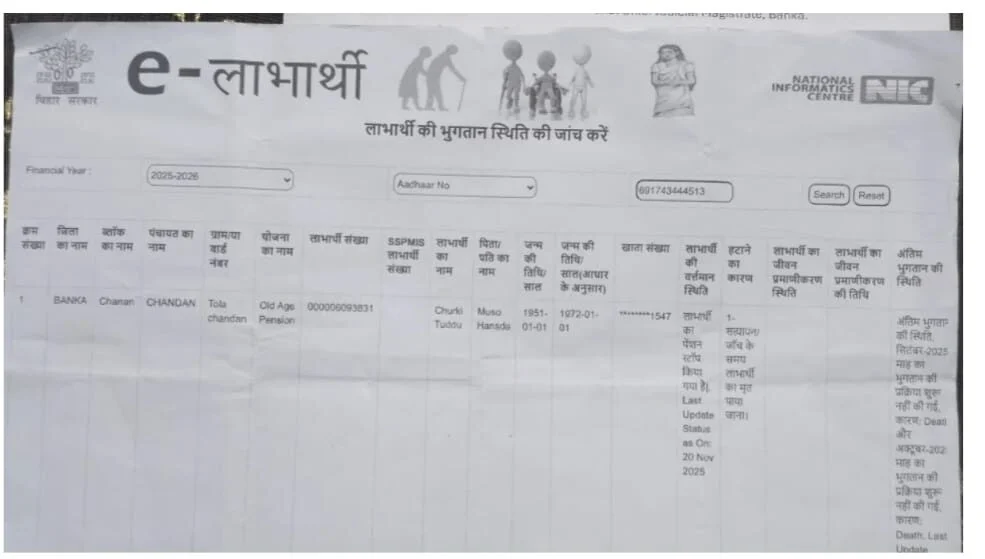
A case from Bihar illustrates exactly what Drèze and Justice Lokur warned about. A woman in Chandan, Banka district of Bihar, ChudkiTudu was wrongly declared dead in official records, causing her pension and ration benefits to be stopped. Holding a computer-generated document stating she had “died” during verification, she pleaded before BDOAnjesh Kumar, saying, “Sir, we are alive… what will we eat?”
Chudki, who has no source of income apart from her pension and ration, said even the local ration dealer told her she was “dead,” leaving her devastated and without basic support. The incident raises serious questions about the quality of official investigations that can render a living person “dead” on paper, pushing vulnerable individuals toward hunger and distress.
BDOAnjesh Kumar assured that the matter will be investigated to identify the error, and all her benefits will be restored soon. However, Chudki’s experience is not an isolated aberration but a symptom of the broader vulnerabilities exposed by the SIR process. As the ECI intensifies its data-matching exercises, linking electoral rolls with Aadhaar, death registers, and field reports, the risk of wrongful deletions and bureaucratic errors has escalated. For millions of citizens who depend on welfare entitlements authenticated through Aadhaar, a mistaken “deceased” classification is not merely a clerical error; it is a direct assault on their right to food, livelihood, and dignity.
For many, especially migrant workers, elderly citizens, and historically marginalised communities, dealing with the aftermath of such mistakes is nearly impossible. Access to BLOs is inconsistent, form availability irregular, and grievance redressal mechanisms slow and opaque. While officials claim that wrongful deletions can be reversed, the process often requires repeated visits to government offices, documentation that the poor struggle to provide, and an understanding of bureaucratic procedures that many do not possess.
The convergence of electoral revision, Aadhaar-linked verification, and welfare entitlement systems has thus created a dangerous cycle: errors in one database now trigger exclusion across multiple essential services. With the SIR continuing at high speed across several states, activists fear that thousands, not just a few, may face consequences similar to those of ChudkiTudu.
As public confidence wavers, experts are calling for the ECI to pause, review its methods, standardise safeguards, and prioritise citizen-centric processes. Without transparency, accountability, and community engagement, the SIR risks undermining not just the integrity of electoral rolls but the fundamental rights of those who depend on the state for basic survival.