

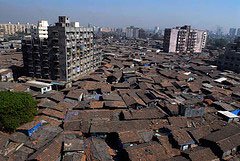
Amidst the euphoria and acclaim over the film Slumdog millionaire winning as many as eight Oscar awards, there was widespread criticism from a few sections of the society. While some social activists had a reason to get offended by the title “Slumdog”, a derogatory reference to the slum-dwellers, the neo-rich class felt that the film did not depict the ‘real’ India…with skyscrapers, I.T. parks, SEZs, share market et al. It was also argued by the pro-reforms economists and some political pundits that ‘poverty porn’ (sic) – the portrayal of squalor and denigration of the slums in Mumbai was a deliberate attempt to malign the image of ‘Rising India’ in the international arena.
Criticism is not a new trend to such type of films, as the legendary director Satyajit Ray too was not spared of its wrath. He was charged by the actress turned politician Ms. Nargis Dutt for ‘selling’ Indian poverty abroad. There is however, a major difference between Satyajit Ray’s films like Aparajito, Pather Panchali and Pratidwandi and the British director Danny Boyle’s Slumdog millionaire. Ray’s films were thought provoking, logically giving the viewers a recipe to overcome poverty in the villages of Bengal. In contrast, the film Slumdog millionaire has neither the relieving formula, nor does it spur the affluent Indians to allay the suffering of the slum-dwellers.
Despite its failure to deliver the social message, Slumdog millionaire has opened the Pandora’s Box, brilliantly showcasing the other side of ‘Shining India’. It has exploded the fallacy that India is on the threshold of becoming an economic superpower. The film flies in the face of Dr. Manmohan Singh government which has tirelessly trumpeted about the GDP growth rate, even as it could hardly bring any cheer in the lives of 77 per cent Indians who are living under Rs.20 per day. Although on one side of the coin Mumbai represents the shiny face of India with the world’s richest person living in it and a rising number of billionaires and millionaires…on the other side, we see the gloomy face of India with over a million people crammed in Asia’s largest slum ‘Dharavi’ where the story of the film Slumdog millionaire is based. While on one side, Maharashtra has doled out thousands of acres of land to the rich and powerful in the name of SEZs, on the other side, the state carries the dubious distinction for the highest number of farmers’ suicides.
To understand as to how the neo-liberal policies pursued during the past 18 years have brought misery to a vast majority of Indians, one should examine the survey reports given by various national and international organisations. The U.S. based International Food Policy Research Institute (IFPRI) has recently released the Global Hunger Index (GHI) for the year 2008. In the list of 88 countries in the Global Hunger Index, India has been ranked as 66th. Higher the number in the GHI, the worse is the hunger situation in that country. In South Asia, countries like Myanmar, Sri Lanka, Nepal and Pakistan have fared better than India in their drive against hunger. Even Sub-Saharan nations like Uganda, Gambia, Botswana and Nigeria have been ranked higher than India. Haiti, which became notorious as the country where people eat mud-cakes to overcome hunger has ranked 69th in the index…too close to India. According to a World Bank report, the prevalence of underweight children in India is among the highest in the world, and is nearly double that of Sub-Saharan Africa.
The ‘food policies’ pursued by the NDA and UPA governments have driven India to such an alarming situation. The policy of cutting back on government procurement of food grains and encouraging procurement by big agribusinesses (both foreign and Indian) has resulted in speculative trade of food items. While the government was stubborn to give a reasonable price to the Indian farmer, it was generous in case of the imports. In 2006-2007, the government imported 6 million tones of wheat at prices higher than what it has paid the Indian farmer. A farmer in Punjab or Haryana was paid Rs.7 a kg while the corporate exporting to India was paid Rs.9.26 a kg. Last year, the government imported about one million tonne wheat by paying the companies Rs.14.82 a kg compared with Rs.8.50 a kg to the Indian farmer. The prices on food commodities shot up tremendously during the recent years as they are now in the hands of the private players. The low-income group which was hitherto getting ration at subsidized prices from government stores has become a vulnerable lot – thanks to dismantling of procurement of grains and Public Distribution System (PDS).
As a result of agriculture being given the raw deal, farmers have stopped to evince interest in farming and started migrating to urban areas to work as construction labourers and other menial jobs. The difference in wages earned in urban and rural regions is the other major cause which drives millions of the rural poor to migrate towards towns and cities. This has been highlighted in the National Sample Survey Organisation report on employment situation in the country. Data released under the 62nd round of the NSS for 2005-06 shows that on an average, a male labourer working on casual basis in rural areas earns only Rs.59.29 per day, whereas in case of females it is less at Rs.37.97. But at the same time, in urban areas, the same male casual labourer can earn Rs.80.70 per day and a female person can earn Rs.44.57. The survey says that only 10 percent of males and just 4 percent of females in rural areas are engaged in activities which provide them regular employment and remuneration. In urban areas, the percentage of regular wage employees is 42 for male and 40 for female.
There is an urgent need to reverse the neoliberal policies to reduce the gap between the ‘haves’ and ‘have-nots’ and also to end the urban-rural divide on income parameters. This is possible only when domestic agriculture is encouraged, rural employment is created, PDS is restored and privatization in health and education is reversed. The Congress party is gleefully using the ‘Jai Ho’ song of Slumdog millionaire to promote its electoral campaign…but on the question of addressing poverty shown in the same film, the architect of neoliberalism Dr. Manmohan Singh would bury the proverbial ostrich’s head in the sand.