

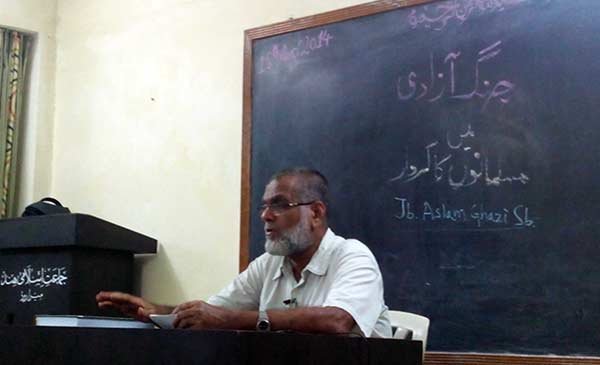
Muhammad Aslam Gazi delivered a lecture on Jang-e-Azadi me Musalmano ka Kirdaar (The Role of Muslims in the Freedom Struggle) at the Islamic Centre, Jamaate Islami Hind, Mira Road on 16 August 2014. Here are excerpts from the lecture:
I Bet You Were Never Told that…
1. It was Emperor Aurangzeb who first asked the East India Company to quit India in 1686!
2. The first war against the British was fought almost 200 years before the Independence…. The Battle of Plassey, wherein Nawab Sirajuddawla of Bengal was treacherously defeated by the British in 1757!
3. The first signs of victory against the British were seen in Mysore where Nawab Hyder Ali first waged a war against the British in 1782. He was succeeded by his son, Tipu Sultan who again fought them in 1791 and was eventually treacherously defeated and martyred in 1799. Tipu Sultan was the first General to use missiles in warfare!
4. The Mujahid Movement was active during 1824 and 1831 under the leadership of Syed Ahmad Shaheed and his two disciples and they were successful in liberating the North-west province from British authority. Syed Ahmad Shaheed was nominated Khalifa, but the freedom was short-lived and he was martyred in 1831!
5. The last Mughal Emperor, Bahadur Shah Zafar was to lead the War of Independence in 1857. A country-wide war was to begin simultaneously on 31 May 1857, but the Indians among the British army revolted before that on 10 May 1857!
6. A startling 5,00,000 Muslims were martyred following the events of 1857, of which 5000 were Ulema (religious scholars). It is said that there was not a single tree on the Grand Trunk Road from Delhi to Calcutta (now Kolkata) on which an alim’s body was not found hanging for days together!
7. Indian Ulema called for Jihad against the British and declared India as Darul Harb (Territory under Enemy control). This call found resonance all over the country with Muslims rising up against the British!
8. To liberate the countrymen from the Cultural and Educational bondages of the colonial empire, towering centres of learning like Darul Uloom Deoband, Darul Uloom Nadwa and the Aligarh Muslim University were established in the late 19th century, which are still counted among the leading Indian seminaries!
9. The Reshmi Rumaal Tehreeq was launched in 1905 by Shaikhul Islam Maulana Mehmood Hasan and Maulana Ubaidullah Sindhi to unite all the Indian states against the British. Maulana Mehmood was imprisoned in Malta and Kalapani for the same where he breathed his last!
10. The Indian National Congress, from the time of its inception to Independence has seen nine Presidents who were Muslims!
11. Barrister M. K. Gandhi served in a law firm in South Africa owned by a Muslim, who on his own expenses brought Gandhiji to India in 1916. Here, he started his agitation under the Ali Biradran (Ali Brothers)!
12. The Mopla movement saw 3000 Muslims being martyred in a single battle!
13. The Non-cooperation Movement and the Swadeshi Movement saw overwhelming Muslim participation. Janab Sabusiddiq who was the Sugar-king of that time gave up his business as a form of boycott. The Khoja and Memon communities owned the biggest business houses of that time and they parted with their treasured industries to support the boycott!
14. The 1942 Quit India Movement was actually planned by Maulana Abul Kalam Azad. He was imprisoned on 8 August and sent to Ahmadnagar, because of which Gandhiji had to lead the movement on 9 August!
15. Jyotiba Phule was sponsored by his neighbour, Usman Bagban in his educational activities, so much so that the school in which he taught was owned by Mr. Usman. His daughter, Fatima was the first girl student there and joined as a teacher thereafter!
16. Muslim leaders always supported the Dalit cause. In the Round Table Conference held in London, Maulana Muhammad Ali Johar was lured into abandoning the Dalit cause in lieu of accepting all other demands of the Muslims. But Maulana Johar refused to forsake the Dalits!
17. When Dr. B.R. Ambedkar could not win the 1946 Central Elections, the Bengal Muslim League vacated one of its own seats and offered it to Dr. Ambedkar, who won it in the bypoll. This gesture by the Muslim League paved the way for his entry into the Constituent Assembly and the rest as they say, is history!
18. Muslim freedom fighters were active in the field of journalism as well. Maulana Azad used his pen against the British despite being prevented by the colonial powers a number of times. In fact, the first journalist to be martyred in the cause of India’s Freedom Struggle was also a Muslim – Maulana Baqar Ali.
So why have these points, and many many such similar ones, been relegated to the dustbin by our historians? Why are these events of history not taught in our history classes? Why are our children’s textbooks bereft of these historical facts? Why this prejudice?
This is a deliberate attempt to discredit the Muslim leadership and indeed the Muslim masses, in order to spread in the Muslim community a sense of inferiority complex and to push them on a defensive stand. ‘What have you done for this nation to deserve the benefits of its independence?’ we are asked! The Muslim community has played a pivotal role in India’s Freedom Struggle and it is high time we Indians are made aware of this untold and hidden aspect of history.
India is again being enslaved by our politicians. It is time to liberate her again from domestic and international neo-colonialism and it is the Muslims of this land who will have to rise to the occasion once again! Are we ready?