

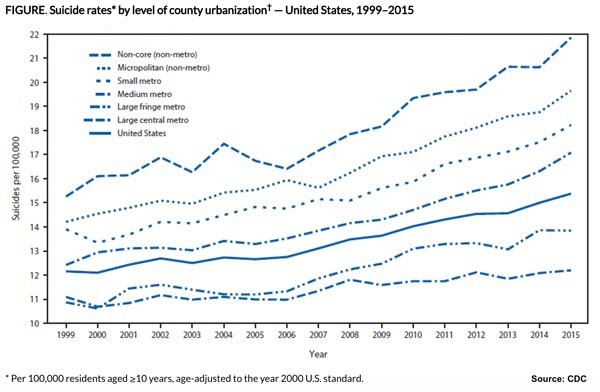
Suicides keep happening. There is no community or family that is not touched by this kind of tragedy. Frequently, I hear from patients about their young son or daughter ending their life and changing others’ lives forever or elderly adults frustrated with their chronic illness or depression and opting to end their suffering. No matter what the circumstances, the outcome is the same. Suicide affects all of us.
According to latest statistics, there are 121 suicides a day in the United States. It is considered a public health crisis, whose incidents are rising rapidly everywhere. There are 16 out of every 100,000 Americans who took their life which was nearly 45,000 Americans in 2016 alone.
Suicide is the 10th leading cause of death in the United States. The cost associated with Suicide exceeds $51 billion dollars annually. People attempt many different methods of ending their life but most common is by the use of firearms according to BBC News; Ritu Prasad Report of June 8, 2018. There is no one single reason for suicide. Financial and mental health issues seem to top the list. It is noted that 54 per cent of all Americans who commit suicide do not have any diagnosed mental health illness. Other deciding factors may include poor health, job instability, and legal troubles.
Recognising the risk factors or warning signs are an important factor in suicide prevention. Indicators include feelings of hopelessness, impulsive and aggressive tendencies, history of trauma or abuse, major physical illnesses, alcohol, opioid or other substance abuse, loss of relationship, lack of social support, isolation and lack of mental health and substance abuse treatment.
Warning signs also include mention of wanting to die or to kill themselves, feeling hopeless or having no reason to live, feeling trapped or experiencing unbearable pain, concerned that they are a burden to others, acting anxious or agitated, or behaving recklessly.
Every community has a suicide prevention hotline (1-800-273-8255 for Clinton) which can be approached to seek help. Trained counsellors are waiting to help those in need. People need moral support during periods of grief or difficult times in order to cope with the situation. Recognising the warning signs can be of vital importance in order to alleviate this growing preventable epidemic.
[ANIS ANSARI, MD, FASN, is President Elect, Medical Staff, Mercy Medical Centre, Clinton, Iowa, United States.]