

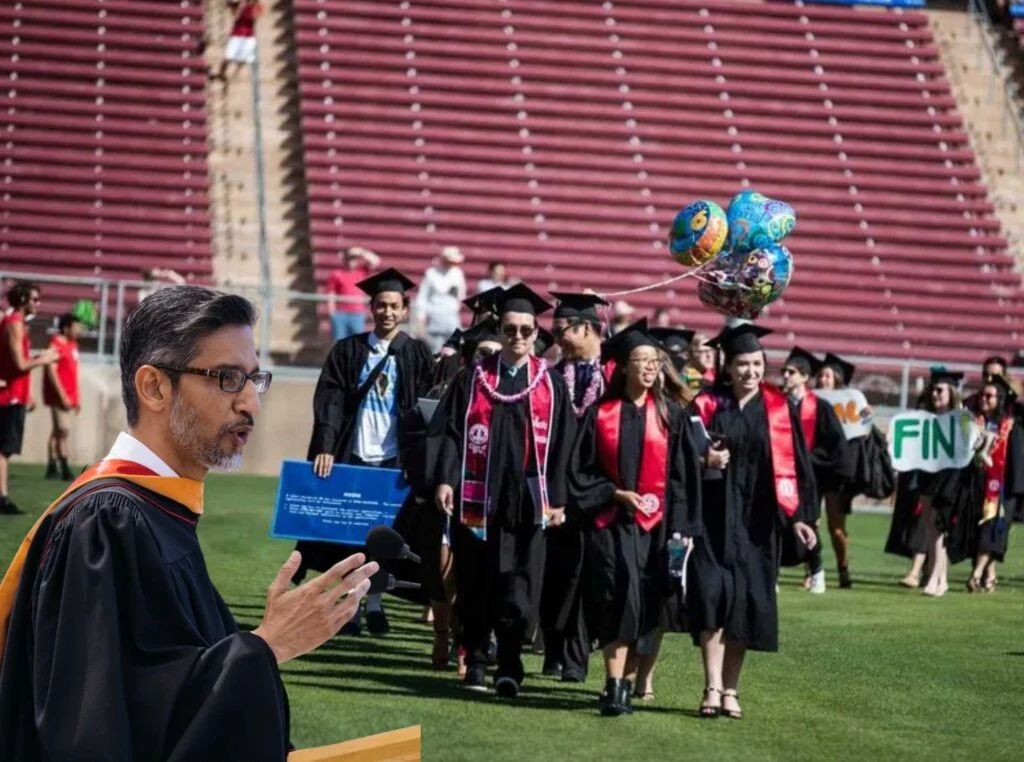
The applause had barely settled inside Stanford University’s 135th commencement ceremony when celebration gave way to protest. As Alphabet and Google CEO Sundar Pichai approached the podium to address the graduating class on June 14, 2026, clusters of students rose from their seats. Dressed in graduation gowns, many wrapped in black-and-white keffiyehs and carrying Palestinian flags, they quietly filed out of the venue in protest at Google’s Gaza policies, turning what was meant to be a celebration of academic achievement into a statement of political conscience.
The protest, involving around 200 students, was organised by Students for Justice in Palestine and No Tech for Apartheid. Their target was not merely the commencement speaker. Pichai, an India-born graduate of the IIT Kharagpur who rose to lead one of the world’s most influential technology companies, represents a modern success story celebrated far beyond Silicon Valley. Yet for the protesters, the issue was larger than the individual. Their concern was what Google represents in an era when technology, politics, and conflict increasingly intersect, and supports Israel’s mindless war on Gaza.
The Symbols of a Global Campus Issue
The imagery of the protest was striking. The keffiyeh, long associated with Palestinian identity and resistance, and the Palestinian flag have become globally recognised symbols of solidarity with Gaza. For students, the walkout reflected concern over a war that has devastated entire communities, caused immense civilian suffering, and generated allegations of war crimes and crimes against humanity by international human rights organisations, UN experts, and legal bodies.
In recent months, the Palestinian cause has found a particularly strong resonance on university campuses. For students, Gaza has become a defining moral issue of their generation. Images of widespread destruction, mass displacement, and civilian casualties have fuelled protests across continents. Activists view Israel’s military campaign as disproportionate and point to allegations of war crimes and violations of international humanitarian law raised by human rights organisations, UN experts, and legal proceedings before international courts. Supporters of Israel reject many of these accusations, but the debate has transformed Palestine from a regional conflict into a global campus issue.
The Stanford protest must be understood within this broader context. To the students who walked out, Gaza was not a distant conflict taking place thousands of kilometres away. It was a moral issue demanding a response. The commencement ceremony simply provided a highly visible stage.
Project Nimbus and the Ethics of Big Tech
Google has consistently maintained that Project Nimbus provides standard cloud-computing services to government agencies and is not designed for weapons or intelligence operations. The company says it offers comparable cloud services to governments in many countries and rejects claims that the contract, by itself, establishes involvement in military operations. Israeli supporters argue that the current military campaign is part of the country’s response to security threats. Critics, however, contend that the humanitarian crisis in Gaza cannot be understood in isolation from the longer history of the Israeli-Palestinian conflict and argue that technology companies should assess how their products and services may be used in conflict zones. They maintain that multinational corporations have ethical responsibilities that extend beyond commercial contracts.
That question has become harder to ignore as technology companies expand their influence far beyond search engines, smartphones, and social media platforms. AI, cloud computing, facial recognition systems, and largescale data analytics now play growing roles in governance, security, and public administration. As a result, technology firms increasingly face the same ethical questions once directed primarily at governments and defence contractors.
The Stanford walkout highlighted another important shift. Student activists today are not limiting their demands to political leaders alone. Increasingly, they are challenging universities, corporations, investors, and technology companies, arguing that power in the modern world is exercised through many institutions, not just governments.
A Legacy of Student Activism
History offers numerous examples of students shaping public debate. American campuses became centres of anti-war activism during the Vietnam War. Student campaigns helped sustain international pressure against apartheid in South Africa. India’s own freedom movement witnessed significant student participation. More recently, students have played visible roles in debates surrounding citizenship, democracy, and civil liberties. The issues differ, but the belief that young people can influence public discourse remains remarkably consistent.
Graduating students chose to publicly challenge a technology giant they may one day seek to work for. For many observers, this reflected a generation increasingly willing to act according to its conscience, placing concerns about human rights alongside, and at times above, immediate career considerations.
The demonstrations also suggested that, for participants, support for Palestinians transcended religious identity; many of those joining campus protests across the US have not been Muslims but students who frame the issue primarily in terms of human rights, humanitarian law, and civilian protection. Their message extended beyond opposition to a single contract: multinational corporations should be guided not only by innovation and commercial success but also by internationally recognised ethical and human rights standards.
A Broader Shift in Global Opinion
Across continents, younger generations are increasingly asking difficult questions about power, accountability, and the ethical consequences of political and corporate decisions.
Analysts argue that the Stanford walkout reflects a broader shift in international opinion. They point to increasing criticism from international organisations, proceedings before international courts, debates at the UN, growing calls for boycotts and divestment, and sustained campus protests as indicators that Israel faces mounting diplomatic, legal and public scrutiny. The long-term impact of these competing trends remains uncertain.
On campuses like Stanford, questions once confined to international relations are now being debated in classrooms, graduation ceremonies and among a generation that increasingly views human rights and corporate ethics as inseparable. Whether these protests ultimately influence government policy or corporate decision-making remains to be seen, but they demonstrate that the conversation over Gaza now extends far beyond the Middle East into universities, boardrooms and civil society across the world.
A Statement of Political Conscience
Graduation ceremonies traditionally celebrate accomplishment, hope, and the promise of the future. Yet for the students who chose to walk out, the future could not be separated from the moral questions of the present. They used one of the most important moments of their academic lives to make that point.
Sundar Pichai did not publicly respond to the demonstration and largely avoided political controversy in his address, focusing instead on personal experiences, optimism, and the lessons he had learned throughout his journey. Yet the walkout ensured that another conversation unfolded alongside his speech – one about Gaza, corporate responsibility, and the growing determination of students to make their voices heard.
On a day dedicated to celebrating success, their protest was directed at Google, but the questions it raised about Gaza, technology, corporate ethics and accountability reached far beyond Stanford’s campus and far beyond Silicon Valley.