

 A political storm is gathering over India’s proposed trade understanding with the United States, with the Congress party seeking to galvanise farmers and opposition forces by reviving memories of the mass agrarian resistance that forced the Modi government to repeal the controversial farm laws in 2021.
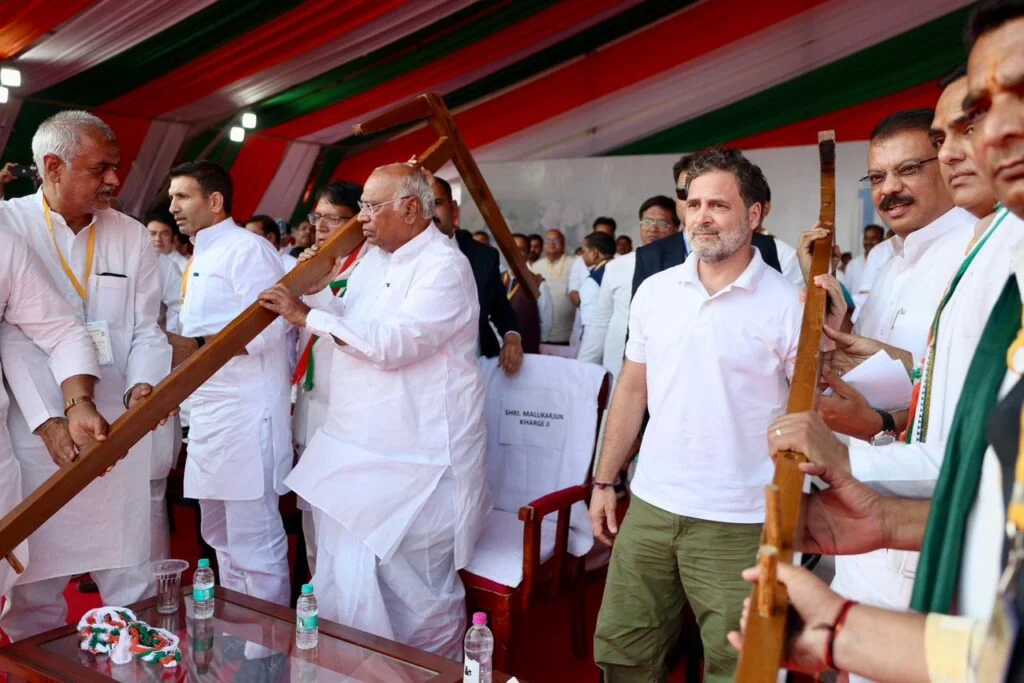
The first salvo in what Congress leaders describe as a nationwide campaign was fired in Bhopal, where tens of thousands of farmers and party workers converged at Jawahar Chowk for a massive KisanMahaChaupal, transforming the Madhya Pradesh capital into a stage for political confrontation. The rally, marked by thunderous slogans of “Narendra Modi, Surrender Modi,” signalled the Opposition’s determination to frame the Indo-US trade deal not merely as an economic agreement, but as a question of sovereignty, farmers’ survival, and national self-respect.
With memories of the historic farmers’ agitation still fresh, Congress appears intent on placing the trade deal at the centre of national political discourse, hoping to recreate a groundswell that can challenge the government both on the streets and in Parliament.
Farmers at the Heart of Political Battle
Party leaders described the gathering as the first in a series of mobilisations planned across the country, aimed at building sustained resistance to what they termed a “one-sided” agreement that threatens farmers, small industries, and India’s economic autonomy.
Congress president Mallikarjun Kharge, addressing the rally amid repeated applause and slogans, launched a scathing attack on Prime Minister Narendra Modi.
“In sixty years of my political life, I have never seen such a cowardly Prime Minister,” Kharge declared, accusing Modi of surrendering national interests under American pressure. “He has compromised the self-respect and self-reliance of this country and pushed farmers toward economic slavery.”
Kharge alleged that the agreement would allow American agricultural and industrial products to flood Indian markets, undermining domestic producers. He warned that key sectors such as textiles, leather, and soybean cultivation could face severe disruption.
“He has become Trump’s yes man,” Kharge said. “He cannot face the Opposition in Parliament, cannot hold a press conference, and cannot defend his decisions before the people.”
Gandhi’s Direct Challenge to Modi
Leader of Opposition Rahul Gandhi, increasingly emerging as the political spearhead of resistance to the Modi government, used the rally to issue a direct challenge to the Prime Minister.
“If Narendra Modi truly stands for India’s interests, and in view of the US Supreme Court decision invalidating tariffs, he should cancel this trade deal,” Gandhi said, drawing loud cheers from the crowd.
He argued that other countries had reconsidered similar arrangements but alleged that Modi was unable to do so due to external pressure and political vulnerability.
According to Gandhi, the agreement poses a grave threat not only to farmers but also to India’s strategic autonomy and data sovereignty.
“This deal hands over farmers, industry, and India’s most valuable resource – its data – to the United States,” he said.
Gandhi further alleged that geopolitical and legal pressures were influencing the government’s decisions. He cited two factors behind what he described as Modi’s “surrender”: the yet-to-be-released Epstein files and the criminal case pending against industrialist Gautam Adani in the US.
“There are lakhs of Epstein-related files containing emails, messages, and videos that have not yet been released,” Gandhi claimed. “Names are being selectively revealed as a warning.”
He alleged that the case against Adani was not merely about an individual businessman but targeted the broader financial structure linked to the ruling establishment.
“These pressures have compromised the Prime Minister,” he said. “That is why he cannot stand up for India’s farmers.”
Congress Seeks to Revive Agrarian Resistance
Congress strategists see the farmers’ issue as a potent political lever, recalling how sustained protests forced the Modi government to repeal three farm laws after a year-long agitation that drew global attention.By foregrounding farmers once again, the party hopes to build a broad coalition of agrarian communities, youth, and opposition forces.
Kharge praised Youth Congress workers, calling them “true patriots” who had courageously raised their voices against the agreement.“They showed the government the reality – unemployed youth, distressed farmers, and a nation unwilling to surrender its interests,” he said.
He accused the government of branding dissent as anti-national while itself compromising national dignity.
“The real insult to the nation is surrendering its self-respect before foreign powers,” Kharge said.
Data Sovereignty and Strategic Stakes
Beyond agriculture, Gandhi emphasised what he described as the strategic implications of the agreement, particularly concerning data sovereignty.“India possesses one of the world’s most valuable data reserves,” he said. “This data is central to the global technological race, and handing it over undermines India’s future.”
He suggested that the agreement could weaken India’s strategic leverage while strengthening America’s position in global technological competition. He also accused the government of suppressing democratic debate, alleging that he was prevented from raising critical issues in Parliament.
“This is the first time in India’s parliamentary history that a Leader of Opposition was not allowed to speak during the President’s Address debate,” he said.
The rally also featured sharp ideological messaging, with Kharge invoking Congress’s legacy in India’s freedom struggle.
“They may have Godse, but we have Gandhi,” Kharge said, presenting Congress as the inheritor of India’s freedom movement and moral legacy. He positioned Rahul Gandhi as the leader of the current political struggle.“To fight for the youth and the country’s future, we have Gandhi,” he said.
Farmers Voice Ground-Level Distress
Speaking with Radiance at the rally, several farmers accused the BJP government in Madhya Pradesh of “cheating” cultivators on Minimum Support Price (MSP). They said farmers were enduring severe distress due to what they described as government apathy toward their concerns.
Madhya Pradesh, one of India’s largest producers of wheat, rice, soybean, and cotton, represents a crucial agricultural belt, making the discontent among its farmers politically significant.Their participation underscored the Congress’s attempt to transform economic grievances into a broader political movement.
Congress leaders said similar KisanMahaChaupal events would soon be organised across multiple states, signalling a coordinated effort to turn the trade deal into a national political flashpoint.They believe rising farmer anxiety, economic uncertainties, and concerns over sovereignty could create fertile ground for sustained political mobilisation.
A Defining Political Moment
The Indo-US trade understanding has now moved beyond the realm of economic policy into the centre of India’s political battlefield.For the Modi government, the agreement represents a cornerstone of its global economic strategy and strategic partnership with Washington.For Congress and the broader Opposition, it offers an opportunity to challenge the government’s “nationalist” narrative by portraying it as compromising India’s sovereignty and farmers’ interests.
Whether the issue evolves into a mass movement comparable to the farm law protests remains uncertain. But the scale of the Bhopal rally and the intensity of political rhetoric suggest that the trade deal could become one of the defining political flashpoints in India in the months ahead.
As the rally concluded and farmers began their journeys back to their villages, one message rang clear across Bhopal’s charged political landscape: the battle over India’s economic sovereignty and its political consequences has only just begun.