

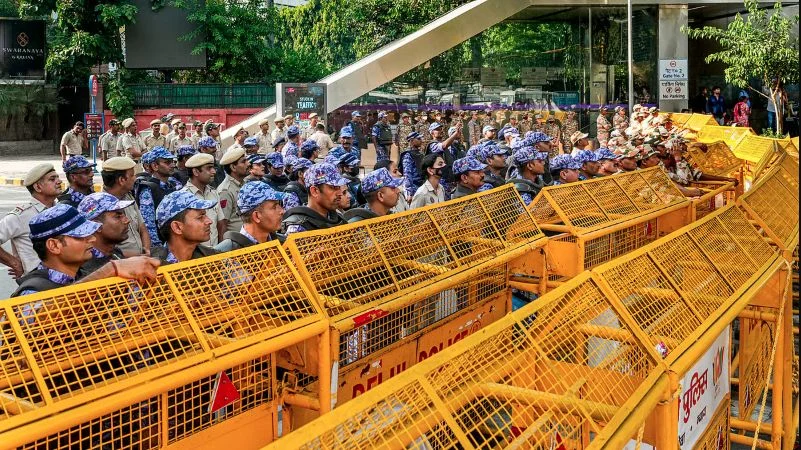
The national capital witnessed a sweeping crackdown on dissent worse than the 1975 Emergency.Besidesturning the city into a fortress, Delhi police detained thousands of protesters who were on the streetsdemanding removal of Chief Election Commissioner Gyanesh Kumar over allegations of vote fraud and SIR.
The October 10 operation, marked by barricaded roads, mass detentions and allegations of police brutality, has further intensified attacks on Prime Minister Narendra Modi, and Union Home Minister Amit Shah.
Opposition leaders, students, lawyers, journalists and civil society activists described the police action as an assault on constitutional freedoms, alleging that the government was using state power to silence dissent.
Independent journalists and digital media platforms documented scenes of protesters being dragged away, activists allegedly manhandled and young demonstrators detained as the capital was turned into a security zone.Reports say more than 7,000 protesters were detained.
The agitation, driven by allegations surrounding the SIR of electoral rolls, has become an overriding political issue. For the Opposition, the slogan ‘Vote Chori’ represents a fight to protect the right to vote; for the authorities, the immediate challenge is to justify their actions.
On Oct. 10, New Delhi and its surrounding areas were transformed into a heavily fortified zone, with metal spikes, yellow barricades and concrete barriers blocking access to key locations. In addition, right-wing goons allegedly affiliated with RSS were given free hand to unleash terror on young protestors and independent journalists.
Right Wings Goons
In order to disrupt the protest at the various entry points,over 150 Hindutvaactivists were allegedly beating and harassing protestersand raising slogans in favour of Delhi Police, Modi and election commission.They got full protection from the police despite implementation of 144.
Packed buses transporting detainees away from protest sites became a defining image of the confrontation. The international attention generated by the events, including a live blog by The New York Times, underlined the seriousness of the questions facing the world’s largest democracy.
The protest slogan, “Jab-jab Modi darta hai, police ko aage karta hai” (Whenever Modi is afraid, he deploys the police), captured the Opposition’s central allegation. Protesters argue that instead of addressing allegations surrounding SIR, the government has chosen to restrict demonstrations and prevent political representatives from reaching the Election Commission.
CPI(M) general secretary M.A. Baby described the crackdown as a blatant assault on the right to peaceful protest and constitutional freedoms. Left parties and the Cockroach Janta Party (CJP) announced that demonstrations would continue despite the restrictions.
Police Excesses
The CPI(M) alleged that hundreds of political leaders, civil society representatives, students and youth activists were detained.And several senior leaders were manhandled, leaving some injured, including Rajya Sabha MP V. Sivadasan.The CPI(M) further allegedthat senior leaderswere kept inside a police vehicle for hours without food or water and were denied access to essential medication. The party also said police confiscated the mobile phones of several leaders, including MP A.A. Rahim.
Former chief ministers Pinarayi Vijayan, Mamata Banerjee, Arvind Kejriwal and Manik Sarkar were among the prominent political figures detained during the protests. Opposition leaders said that despite severe restrictions, people continued to assemble at several locations, including ITO, the Safdarjung flyover and Dilli Haat.
The police response reportedly included denial of permission for demonstrations, closure of 45 Metro stations, detention of student leaders and restrictions affecting transport and access to protest sites. Opposition parties alleged that these measures were designed not merely to maintain public order but to prevent the protests from gathering momentum.
The SFI circulated videos that it said showed police personnel assaulting students and detaining them in small groups, sometimes taking them away from locations where their removal could be filmed.
The detention of CJP founders Abhijeet Dipke, Saurav Das and Ashutosh Ranka after they had boarded an Air India flight from Mumbai to New Delhi added another dimension to the controversy. According to reports, police personnel boarded the aircraft after it landed at Indira Gandhi International Airport and took the three men away. Dipke reportedly went live during the incident, describing the action as worse than the Emergency. The Hindu reported that Air India subsequently sought clarification from the Bureau of Civil Aviation Security regarding the circumstances in which police personnel had boarded the aircraft, the applicable guidelines and the apparent lack of advance coordination with the airline.
The CJP legal cell head, Ratna Singh, was also reportedly surrounded by more than 25 police personnel while inside a car, without being told the grounds for the action. A court subsequently rejected her plea seeking registration of an FIR against the policemen and relief from alleged wrongful confinement, holding the plea not maintainable.
Reports also said that YouTuber Dhruv Rathee was picked up from his Gurugram residence. He posted a video on X in which he was seen as saying that he was actually ‘kidnapped’ by 20 plainclothes persons from his bedroom when he was sleeping.
Former Delhi CM Arvind Kejriwal was seen being carried by police personnel towards a bus outside his residence, while videos showed CPI(M) leader M.A. Baby being manhandled as he was pushed into a police vehicle. AISA national president Neha Bora, advocate Prashant Bhushan and activist Yogendra Yadav were among those detained while marching towards Dilli Haat after Jantar Mantar was sealed. More than 400 SFI members were reportedly detained after they began marching, alongside other student leaders.
Crackdown on Journalists and Lawyers
One of the most troubling aspects of the police excesses was the alleged targeting of journalists covering the protests. Reporterswere obstructed, threatened, manhandled or detained despite displaying press identification.Newslaundry reporters Ashwine, Astha and Anmol were reportedly detained along with their official phones and reporting equipment. When they identified themselves as journalists, police personnel allegedly responded, “Koi media nahin hai” (There is no media here).
Scroll investigative reporter Ayush Tiwari was detained near ITO despite displaying his press card and was reportedly released after the bus carrying him caught fire. Its political editor, Shoaib Daniyal, was allegedly picked up while waiting for a taxi on a South Delhi street, away from the main protest venues. The Wire journalists Jahnavi Sen and Sravasti Das were reportedly helped by press photographers when police personnel attempted to detain them near their office.
Lawyers were also caught in the crackdown. Videos reportedly showed senior advocate Shadan Farasat being manhandled near the Supreme Court and dragged towards a police van, with his shirt torn in the process. Advocate-on-Record Sumita Hazarika described the alleged manhandling of women lawyers by police personnel whose identification details were not visible. Around 100 lawyers from the Supreme Court and Delhi courts were reportedly detained and taken to the Yamuna Sports Complex.
Opposition Leaders’ Challenge
The confrontation intensified after Opposition MPs attempted to march from Parliament towards the Election Commission’s headquarters to demand a meeting with CEC Gyanesh Kumar and submit their objections to the SIR process.
On Oct. 6, Delhi Police stopped the INDIA bloc march near the All India Radio building adjacent to Nirvachan Sadan. Multiple layers of barricades and a substantial police deployment prevented the MPs from proceeding further.
Leader of the Opposition in the Lok Sabha Rahul Gandhi, Congress president and Leader of the Opposition in the Rajya Sabha Mallikarjun Kharge, Congress MP Priyanka Gandhi and other Opposition leaders subsequently staged a sit-in. The demonstration continued for hours before police personnel detained several participants.
Priyanka Gandhi accused the authorities of violating constitutional rights by detaining MPs and protesters, sealing parts of the capital and restricting movement.
However, the poll panel offered a different account. In a statement issued on Oct. 6, it said it learnt about the proposed march through Delhi Police at around 4 pm and had not received a prior appointment request from any political party.The ECI respected democratic and parliamentary processes while maintaining its established protocols for meetings, the statement added.
Rahul Gandhi said MPs represented the people and that denying them a meeting amounted to an insult to their democratic mandate.“You cannot ask an MP to go to his house. It is my democratic right to protest,” Gandhi reportedly told a police officer during the confrontation.
‘Vote Chori’ Allegations
At a Congress-led sit-in at Rajghat on Oct. 8, Rahul Gandhi accused Modi, Amit Shah, RSS chief Mohan Bhagwat and CEC Gyanesh Kumar of conspiring to undermine the Constitution and ‘steal votes’.He said the Opposition would continue its campaign and that those responsible would eventually be held accountable. Kharge, meanwhile, said INDIA bloc MPs had gathered at Rajghat to protest peacefully and pray for wisdom among the country’s political leadership.
Gandhi also referred to the detention and alleged manhandling of Opposition MPs, saying that approximately 300 MPs had sought to stage a peaceful protest but were prevented from reaching their intended destination.
On Oct. 10, the reported scale of the police operation expanded dramatically, drawing further condemnation from political parties and civil society groups.
Congress president said the deployment of nearly 32,000 police and 7,500 CRP personnel demonstrated the government’s apprehension about the youth-led agitation. The Opposition described the situation as an undeclared Emergency and vowed to continue its protests.
Opposition Seeks Presidential Intervention
With the confrontation escalating, a delegation of INDIA bloc MPs led by Kharge approached President Droupadi Murmu, seeking intervention over the SIR exercise and the conduct of the Election Commission.
The delegation demanded Gyanesh Kumar’s resignation, immediate suspension of the SIR process and restoration of what it alleged were 13.30 crore voters illegally deleted from electoral rolls. It also called for a return to paper ballots, repeal of the 2023 law that it said granted permanentimmunity to the CEC and Election Commissioners, and annulment of Assembly elections held over the preceding two years where it claimed evidence of electoral manipulation existed.The memorandum alleged that electoral processes had been subverted in several states, including Haryana, Maharashtra, Madhya Pradesh, Chhattisgarh, Bihar, Delhi and West Bengal.
According to the Opposition, the President asked the delegation to present evidence of its allegations. Rahul Gandhi said the INDIA bloc was prepared to provide its evidence when the President was ready to consider it, adding that he had expected an unequivocal assurance about the integrity of the electoral system.
Brute Use of Force
The Opposition parties argue that the crackdown reflects a broader tendency to treat political opposition as a security threat rather than a legitimate part of democratic life.They also alleged that police personnel had visited student hostels, mosques and public spaces to discourage people from joining demonstrations. Reports of internet restrictions around protest locations, alongside the detention of activists before they could reach demonstration sites, further fuelled concerns about preventive measures being used to discourage mobilisation.
Rahul Gandhi, in a message to protesters, said he had spent more than a decade opposing Modi and the RSS and urged young people not to retreat in the face of arrests. He named Modi, Shah, Bhagwat, Kumar and National Security Adviser Ajit Doval among those he accused of being central to the political controversy.
Meanwhile, the UN Office of High Commissioner for Human Rights expressed concern over reports of mass detentions in India involving demonstrators, protest leaders, civil society representatives, lawyers and journalists.This brought an international dimension to the controversy.