

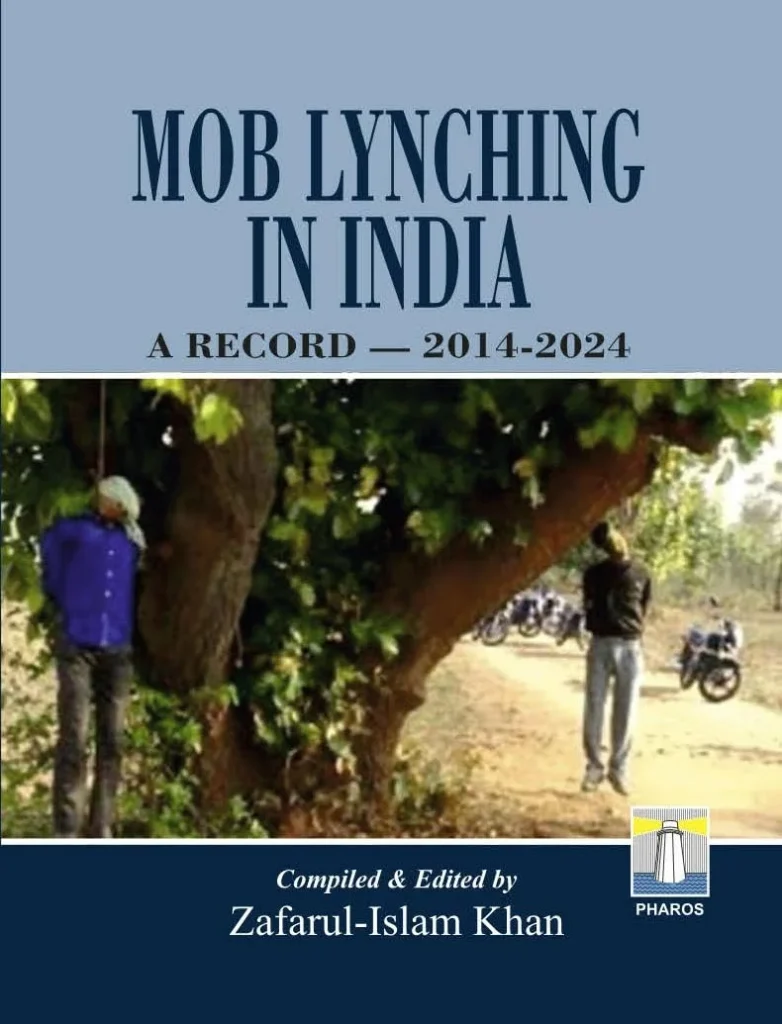
Title: Mob Lynching in India: A Record – 2014-2024
Compiled and edited by: Zafarul-Islam Khan
Year of Publication: 2026
Publisher: Pharos Media
Pages: 748
Reviewed by: Dr. Khan Yasir
A single human life is not a mere statistic, nor a fleeting moment in the vastness of time. It is a universe of its own – a tapestry woven with memories and experiences, dreams and aspirations, feelings and emotions; a heartbeat that carries the weight of countless hopes, the warmth of relationships, and the quiet dignity of existence itself. To be human is to feel, to love, to care, to suffer, to heal, to strive, to hope and in this sacred capacity lies a worth that defies measurement. No calculus can quantify the depth of a single soul; no ledger can account for the laughter that brightens a home, the wisdom that shapes a generation, or the gentle touch that heals a wounded heart. Every life is a story, irreplaceable and unrepeatable, a spark of the divine that illuminates the world in ways no other can. To value a human life is to recognise that the world itself is diminished when even one light is extinguished. And hence the Qur’ān says, “…that he who slays a soul unless it be (in punishment) for murder or for spreading mischief on earth shall be as if he had slain all mankind; and he who saves a life shall be as if he had given life to all mankind.”
Yes, death is the order of nature but murder isn’t. Murder is a choice. With a deliberate and conscious exercise of free will, a murderer decides ‘to end’ what only the Author of life has the prerogative to close. And among the many forms of murder, the most disturbing, the most incomprehensible, and the most outlandish is lynching. It is the madness of the mob, the cowardice of the many against the one, the profane theatre of collective cruelty.
It is against this backdrop of moral darkness that one must confront the reality of our times meticulously documented in the sprawling 748-page study, Mob Lynching in India, compiled and edited by Zafarul-Islam Khan, with a team of editors and researchers comprising M. Zeyaul Haque, Shaheen Nazar, Talha Chowdhry, Salman Naqvi, GhufranAsdi, and Zillur Rahman Haidar.
Tracing the long history and prevalence of mob violence in India, the study identifies nearly 20 distinct triggers ranging from rumours and dowry disputes to temple entry of lower castes, witch killings, human sacrifice, and communal riots. It also examines high-profile pre-2014 incidents, such as the killings of Safdar Hashmi, Graham Staines, and Professor H.S. Sabharwal (pp. 18-25). The study asserts that, “The practice of mob justice never stopped in India” remaining common, prevalent, and successfully deployed in “riots after riots” since independence, and yet “Lynching has acquired a new meaning and acceptance under the current BJP government” (p. 21). Covering a decade of violence from May 2014 to May 2024, the volume serves as a harrowing archive of 1,743 incidents, exposing what the editor terms a “unique form of terrorism” (p. 7) and “a new form of communal riots” (p. 8) that has tragically become the “new normal”.
The study reveals a chilling culture of impunity. “State-protected encounters, custodial killings and illegal bulldozing of thousands of madrasas, mosques, graveyards, houses and shops of people before they are found guilty by a court of law also convinced the lynchers that they can get away with their crimes” (p. 9). Moreover, it is observed that perpetrators are so emboldened that “they make it a point to make video recordings of their crimes and then circulate it on social media in real time, garland criminals, storm court rooms to show support to the criminals, take the criminals out in processions and even field them in elections” (p. 25).
While the study deliberately excludes “cases of state-sponsored encounters and custodial killings in police stations and in prisons” (p. 8), reserving them for a future volume, its focus remains firmly on the streets. Drawing upon the historical insights of Ida B. Wells-Barnett, the study argues that such violence is not merely an attack on individuals but on their “peoplehood.” The purpose, it asserts, is “to marginalise Muslims, instil fear in the community and emphasise the limits of their freedoms and rights” (p. 9). The terror is meant to force Muslims to “accept their political and economic marginalisation and life as second-class citizens as fait-accompli.” (p. 21)
The book is structured in two distinct parts: the first hundred pages offer a rigorous analytical framework encompassing the foreword, introduction, and two chapters entitled “Lynching: the New Normal in India” and “Indian Civil Society, States and Union Laws on Mob Lynching” followed by a comparative table of civil society draft laws, state laws, and the BNS law; statistical charts mapping victims and causes; and finally 21 substantial recommendations for stakeholders ranging from victims and their relatives to civil society, state administrations and international community. Two appendices further add value: a fact-finding report on the Dadri lynching and a compilation of newspaper editorials on lynchings. However, the bulk of the volume (pp. 101-731) is dedicated to the grim, exhaustive documentation of the incidents. The incidents have been compiled primarily from Delhi-based newspapers, news portals, and social media, the editor readily admits the limitations of this archive: “The actual lynching cases must be much more than reported here. If we had the wherewithal to reach every police station and scan local newspapers and news portals in various areas and languages across the country, the numbers could have been many times higher” (p. 8). Even so, the sheer weight of the evidence presented is enough to shatter any illusion of sab changa si (everything is fine).
It has been argued throughout the volume that this terror does not operate in a vacuum; it is sustained by a systemic numbness and complicity of state institutions. The study meticulously documents how impunity is not an accident but a structural feature of the governance. At the highest levels, the state has remained largely indifferent to the ordeal of the victims unless, of course, the victims happen to be Umesh Kolhe and Kanhaiya Lal Teli, whose cases were taken seriously and immediately handed over to the NIA (p. 52). It is a twisted Orwellian logic where, in the eyes of the state, some victims are deemed “more equal” than others.
Turning these pages, the eyes widen in disbelief, and one cannot help but wonder: is there no limit to this brazenness? The central government refuses to maintain a database on lynchings (p. 76). The Chief of Defence Staff openly declared in a live interview that locals will lynch terrorists in Kashmir “which is a positive sign,” adding, “If they are terrorists, there’s no harm in lynching them” (p. 27). Political patronage is doled out with alarming alacrity. In Gujarat alone, 7.5 million rupees in cash rewards were distributed to 1,394 cow vigilantes between 2011 and 2014 (pp. 44–45). VHP and Bajrang Dal openly celebrate those accused of brutal killings as “freedom fighters” (p. 56).
At the grassroots, the police are often hand-in-glove with the perpetrators. The machinery of justice is systematically weaponised against the marginalised through a variety of tactics: police delay or simply refuse to file FIRs; they file weak charges under bailable sections, or file vague FIRs against mobs and unknown assailants; and they frequently file “cross cases” against victims to force them to withdraw their complaints (pp. 31, 52, 72). In Jharkhand, a lynching victim’s widow was denied compensation after police refused a death certificate on the ludicrous pretext that the death occurred in a moving vehicle, rendering the place of death unascertainable (pp. 51–52). The institutional response has been so weak that the Supreme Court, despite initial efforts to show spine, and the NHRC, have proven as ineffective as the rest of the state apparatus. (for details see pp. 53–61)
The study historicises the beef issue, dismantling the myth that beef-eating was brought to India by Muslim invaders. Citing reputed historians like H.H. Wilson and D.N. Jha, and drawing on texts like the Rigveda, it concludes that “quite contrary to the perception… beef has been a staple of all Hindu sacrificial ceremonies”. The study further highlights that the framers of the Constitution were clear that prohibiting beef for religious sentiment was repugnant to the ideals of secularism – a view echoed by Gandhi, who stated, “The Hindu religion prohibited cow slaughter for the Hindus, not for the world”. Yet, paradoxically, stringent cow slaughter bans were implemented by state governments under dubious economic pretences, creating the perfect backdrop for lynchings to become the “new normal.” (pp. 37–42)
The problem is further compounded by a perverse socio-economic utility of lynching. It has been argued that beneath the veneer of religious vigilantism lies a more sordid reality: extortion. A 2017 report notes that gaurakshaks looted cattle worth at least 7,600 million rupees from Muslims (p. 63). The violence is often accompanied by brazen robbery, such as the incident where four Muslims were stripped, tied, and beaten up before being robbed of 68,000 rupees on February 21, 2020. (p. 231) As the editor of the volume asserts, “Organising violent groups solves the joblessness problem of some youth at the lower strata of society and keeping Hindus of lower castes busy in business is one aim of this terrorism.” (p. 7)
The statistics coalesce into a heart-wrenching human tragedy, revealing a spectrum of cruelty that defies comprehension. To mention just a few: in one horrific incident, a 10-member Muslim family was assaulted on a train, where the men were beaten into unconsciousness and the women molested (p. 129). In another, 25 people were tied, thrashed, and marched for two kilometres (p. 209). In yet another incident, seven tribal Christians were beaten on the suspicion of cow slaughter, garlanded with shoes, and paraded with partially tonsured heads, forced to chant Jai Shri Ram (p. 259). Even the children are not spared. Albine Topno was only five years old when he was axed to death along with his family (p. 283). A 12-year-old Dalit boy was dangled down a well for the alleged theft of a mobile phone (p. 416). A 10-year-old child was tied to a pole and beaten for three hours; when he begged for water, chilli powder was thrust into his mouth (p. 417). In yet another instance of unfathomable brutality, two minors were tied to a truck and dragged on the mere suspicion of theft (pp. 420–421).
If the methods of these killings are chilling, the excuses for them are utterly absurd. The cruelty of the lynch mob is matched only by the staggering triviality of its triggers. 12-year-old Deepak Kumar was drowned for plucking a few litchi fruits (p. 509); 12-year-old Akash lost his life for pricking a balloon during a Janmashtami festival at a Mandir (p. 155); and Liyaqat was beaten to death simply for asking for extra raita at a restaurant (p. 626). Bigotry and superstitions too caused lynchings as Mohammad Israr was lynched for eating prasad at a temple (p. 634); 12-year-old Shubham Sapkal was murdered over the suspicion that his family performed black magic that caused a buffalo to die (p. 277); Dalit teenager Neeraj Jatav was beaten to death merely for objecting to loud music (p. 135); and an elderly Bucchi Devi (65) was beaten to death when she tried to stop people from applying colours to her son (p. 459). Many more lose their lives over petty, everyday disputes: Afroz Alam and the last victim recorded in the study, Gopal Khandelwal, were killed over parking disputes (pp. 337, 731); Sameer and Fardeen were stabbed to death over an argument about cigarettes (p. 710); and Aman Kasana was killed at a CNG pump over whose vehicle would be refuelled first (pp. 719–720).
The victims span the entire spectrum of age and life. 8-year-old Mohammad Azeem was lynched while playing (pp. 162–163) and 84-year-old Abdul Qadir, a muezzin, was beaten to death by a village Pradhan and his coteries (p. 284). Many were made to chant Hindu slogans. Some refused like Abdul Khaliq, Maulana Momin and Mohammad Salim. 16-year-old Abdul Khaliq was then burnt to death (p.212); Maulana Momin was hit with a car (p. 205); Elderly Mohammad Salim was hit 26 times but continued to say “Parvardigarsabsebadahai” (p. 133).
The violence also consumes those simply doing their duty, such as Shamim Ansari and Chalamala Srinivas Rao, killed for protesting the illegal felling of trees (pp. 371, 425). Even the police are not safe, as evidenced by the lynchings of DSP Ayub Pandit (p. 126), Inspector Ashwani Kumar (p. 296), Inspector Subodh Kumar Singh (p. 170), ASI Dev Chand Nagle (p. 151), and Constable Devendra (p. 279). DSP Mohammad Mashluddin was nearly lynched by 400 trainee constables (p. 163).
The bitterest irony of this reign of terror is that it is a Frankenstein’s monster, utterly indiscriminate and capable of devouring its own architects and foot soldiers. In a macabre twist of fate, the very forces that unleashed the vigilantes have found themselves in the crosshairs: Praveen Poojary, a BJP member, was lynched by cow vigilantes on 8 Aug. 2016 (p. 117). Khetaram Bheel, brother of a local BJP leader, was beaten to death by a mob on 24 July 2018 (p. 151). Babar Ali was lynched for participating in the BJP’s election campaign and celebrating its victory in the UP state polls (p. 364).
The study records that Sub-Inspector Gagandeep Singh risked his life to protect a Muslim youth from an agitated mob (p. 140). However, such moments of genuine courage are rare exceptions that only serve to highlight the overwhelming norm of police complicity and callousness. In one case, Bajrang Dal goons attacked a Christian pastor inside court premises, yet the police booked the injured pastor and sent him to jail (p. 143). In another chilling incident at Dehradun, when 20 Kashmiri girls locked themselves in a hostel surrounded by a mob, the police were coldly asking them “to face the mob and apologise” (p. 179). The police’s callousness reached its nadir during the February 2020 North East Delhi riots, where they mercilessly thrashed Muslim youths and forced them to sing Vande Mataram – an ordeal that claimed at least one life (Faizan, 24). The Delhi High Court reprimanded the police for this conduct, stating that “the SHO and other unknown police officials cannot be shielded under the garb of sanction, as their actions were not part of their official duty but rather acts of hate.” (pp. 232–233)
The study meticulously dismantles the state’s narrative of “spontaneous mob anger.” As Professor Apoorvanand notes, “…the spate of violent attacks are in no way spontaneous expression of mob anger. They are the product of systematic incitement to violence by Hindu nationalists.” (pp. 43–44). The study corroborates this observation and reveals a chilling truth: lynching incidents suddenly stopped in March 2019, right before the general elections, and renewed immediately after, it says, “This shows that there is some central coordinating body which controls the timings of lynchings.” (p. 71) On the other hand, Professor Irfan Ahmad draws haunting parallels between this vigilante violence and White Supremacist terrorism, arguing that “fear is central to terrorism. Muslims feel fear when they open their lunch boxes in a train.” The ultimate goal of Hindutva activists, he argues, is to establish a “uniform, majoritarian, monolithic, visual – as well as smell – in public places.” (pp. 67–71) Against this backdrop, Brinda Karat’s designation of today’s India as “Lynchistan” no longer feels like hyperbole!
The scale, ambition, and timeliness of this project are deeply commendable, serving as an urgent intervention at a critical moment in our history. However, a work of this magnitude inevitably contains editorial lapses that must be ironed out in future editions. There are minor typographical slips such as “May 2024 – May 2024” (p. 7), “impurity” for “impunity” (p. 79), “Ralul” for “Rahul” (p. 56), “moth” for “mouth” (p. 417), and the dating of the IPC to 1960 instead of 1860 (p. 76) etc. There are also serious factual errors that need urgent correction: the text claims that Pehlu Khan’s son Arif and neighbour Azmat were “shot at and killed” in 2018 (pp. 52–53) – a claim that is factually inaccurate; while they were indeed shot at in a ghastly act of intimidation, they survived. Similarly, the heading on p. 475 “SSB soldier Shahbaz (28) beaten to death” appears to be misleading, as the text prima facie indicates that he was a civilian assaulted by SSB jawans. Furthermore, the volume suffers from verbatim repetitions: for instance, the sections under the headings “Lionising criminals” (pp. 26–27) and “A disturbing trend” (p. 62) contain four identical paragraphs. The work also double-counts at least one incident: the lynching of Zaheer Khan, which is recorded twice (Entries 1020 and 1022). Such lapses do not detract from the research and hard work that went into the volume; nevertheless, they underscore the critical need for rigorous vetting and meticulous editing, given the work’s profound importance.
Despite these editorial quibbles, Mob Lynching in India: A Record 2014–2024 stands as an indispensable, undeniable document. More than a compilation of data, it is a mirror, rather a distressing nama-e-a’mal (record of deeds) of our society that cannot be ignored! The study makes it abundantly clear that the crisis we face is not merely one of legislative lacunae, but of profound state complicity and institutional rot. As senior journalist G. Sampath points out, lynching thrives because the “law enforcement machinery [is] taking the side of the lynch mobs.” (p. 79) Consequently, he insists: “…the demand for an anti-lynching law needs to be buttressed by a parallel campaign for police reforms. All said and done, even the best of laws can achieve little in the face of a law-enforcement machinery primed to do the bidding of its political masters.” (p. 8)
This document is a warning siren. The growing numbness of the state and ordinary citizens over these wanton aggressions must end. We must remember the haunting truth of Niemöller’s confession:
First they came for the socialists, and I did not speak out – because I was not a socialist.
Then they came for the trade unionists, and I did not speak out – because I was not a trade unionist.
Then they came for the Jews, and I did not speak out – because I was not a Jew.
Then they came for me – and there was no one left to speak for me.
The lynchers are already coming for the marginalised, the minorities, and the vulnerable. If our collective conscience remains numb and our voices remain silent, who will be left to speak for us when the mob finally arrives at our own doorstep?