

 There are moments when a protest acquires a life of its own. The slogans may have been written by someone. The microphone may belong to an organiser. The barricades may have been erected by the police. But once ordinary people begin arriving – carrying food, water, poetry, questions and anger – the protest ceases to belong exclusively to its organisers.That is what happened during the Gen-Z protests in Delhi and elsewhere.
Among the most striking faces to emerge were not established politicians or professional activists. They were 13-year-old Zain Haider, Mohammed Irfan, an ice-cream seller; Mohammad Junaid, a volunteer who turned feeding protesters into his mission; and the young protesters of Jharkhand, whose agitation demonstrated that the Delhi phenomenon was not confined to the national capital.Their stories are different. Their social backgrounds are different. Their methods are different. But they share one conviction: India’s young generation wants to be heard.
Zain Haider
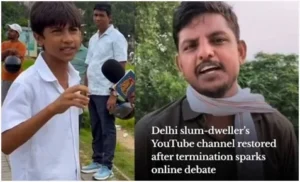
Thirteen and already asking uncomfortable questions.The image that stayed with many viewers was that of a slight 13-year-old standing before a crowd and speaking with a confidence that belied his age. His name was Zain Haider.
He was not a seasoned politician. He was not a student leader with years of organisational experience. He was a school-going child who had come to a protest and, when given an opportunity to speak, spoke with remarkable force.His speech travelled far beyond the protest site.What made Zain extraordinary was not merely his command of words. It was the absence of fear in his voice. He spoke as someone who believed that citizenship was not something to be postponed until adulthood. That is the real significance of Zain.
India’s political culture has traditionally treated children as spectators. Politics is supposed to be something adult’s conduct while young people study, prepare for examinations and wait for their turn.Zain appeared to reject that script. His presence raises a larger question: what today’s children are learning about democracy?
They see elections. They see Parliament. They see television debates. But they also see unemployment, examination controversies, institutional failures and angry young people demanding accountability.
The fact that a 13-year-old felt compelled to stand up and speak should make policymakers uncomfortable. It should also make them listen.
Mohammed Irfan
Then came Mohammed Irfan: The ice-cream seller who became the voice of conscience. His story is perhaps the most extraordinary of all. Irfan is not a politician. He is not a celebrity. He earns his livelihood through daily-wage work and selling ice-cream.
Yet at Jantar Mantar, in the middle of the night, he became something else – a poet and a voice of protest.The Indian Express reported how, around 2.30 a.m., Irfan sat cross-legged on the road with a plate of matar biryani beside him and asked whether he could recite a poem. The gathering quietened. He then recited Urdu poet Ahmad Farhad’s defiant poem, beginning with Kafir hun, sar-phirahun, mujhe maar dijiye.
It was an extraordinary image. The man who sells ice-cream by day was reciting poetry in the dead of night to protesters. There was no stagecraft in it. No carefully rehearsed political speech. Just a working man expressing what he felt.
And perhaps that is precisely why the moment resonated. Political consciousness is often imagined as the property of the educated middle class. Irfan shattered that stereotype.He demonstrated that the ability to recognise injustice does not require a university degree. Sometimes it comes from life itself. The poetry of protest, in his hands, was not literary decoration. It was lived experience.
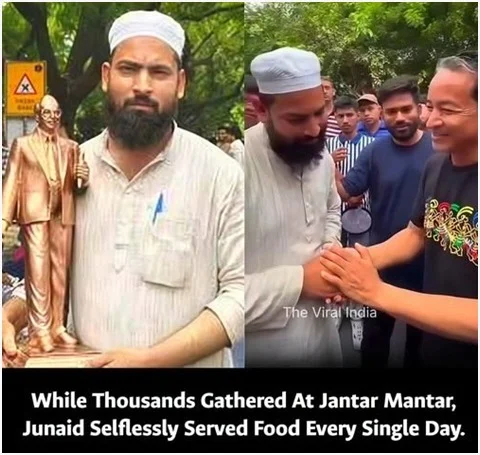
MohammadJunaid
His weapon was a bottle of water.If Zain supplied the voice and Irfan supplied the poetry, Mohammad Junaid supplied something more basic: food and water.He arrived at Jantar Mantar and noticed that protesters were struggling for basic necessities. So, he began distributing drinking water. Then came biscuits and snacks. Then cooked food.
What began as a handful of people helping protesters gradually became a community effort. Junaid said that around 25–30 volunteers eventually became involved in organising food and water, with supplies coming from people who simply wanted to contribute.
Junaid did not need a slogan to make his point. His slogan was a plate of food. His banner was a bottle of water. His politics was service. That made him one of the most recognisable faces of the protest.
His story subsequently took a more serious turn when he alleged that police had detained him and that members of his family had faced police action because of his role in the agitation. Police authorities disputed aspects of those allegations, and the claims remain contested.
But the controversy only amplified the larger question surrounding his participation: Can feeding protesters become an act of dissent? Junaid’s answer seems to be yes.He reportedly told India Today that if giving somebody food or water was considered a crime, he was prepared to repeat that ‘crime’ again and again.That sentence captures something profound about the new protest culture. Not everyone wants to lead. Some simply want to help. He travelled to Ranchi too to feed the protestors.
Three Faces, One Message
Zain, Irfan, Junaid and the young people represent three different dimensions of the same phenomenon.Zain represents courage. A 13-year-old refusing to believe that citizenship begins at 18.Irfan represents awakening. A working man discovering that his voice can carry farther than he imagined.
Junaid represents solidarity, a volunteer proving that a movement survives not merely on speeches but on human beings caring for one another.Together they challenge the conventional image of an Indian protest. It is no longer necessarily a politician on a stage and a crowd behind him. It may be a child with a microphone, a daily-wage worker with a poem and a volunteer with food packets.
The Real GenZ Question
The authorities may eventually negotiate. Political parties may attempt to appropriate the movement. Social-media attention may move elsewhere. But something deeper has already happened. A generation has discovered the power of collective presence.
And perhaps the most important lesson is that these young protesters are not asking merely for political power. They are asking for a future. They want examinations they can trust. Jobs they can compete for fairly. Institutions that answer questions. A government that listens. A democracy in which dissent is not automatically treated as disloyalty.
When children begin asking adults uncomfortable questions about democracy, the right response is not to silence the children. It is to ask why they felt compelled to speak a new language of resistance.
The Delhi protests have produced no single hero. And perhaps that is their most interesting feature. There is no Gandhi waiting to be discovered, no charismatic leader around whom everything revolves. Instead, there is a collection of ordinary citizens: a child, an ice-cream seller, a volunteer, a student and a job aspirant. Their strength lies precisely in their ordinariness. They remind us that democracy is not sustained only by institutions. It is sustained by citizens who care enough to stand up.
We are here. We are watching. And we will not remain silent.That may ultimately prove to be the real story of India’s GenZ protests.