

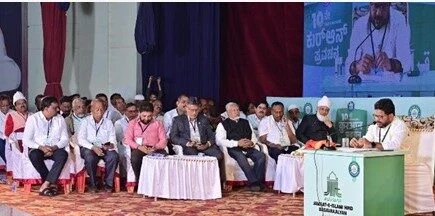
As the winter mist rolls across the weathered fort walls of Basavakalyan in Karnataka’s Bidar district, a unique harmony fills the air. It is not merely the sound of a town waking up, but the rhythmic flow of the local idiom, the language of the land, unspooling the ancient nuances of the Qur’an. For ten consecutive years, this historic city has played host to an event that defies the modern narrative of social fragmentation. What began as a three-day Qur’an Pravachana event, consistently held each December, has now matured and grown into a massive annual socio-cultural phenomenon known as the Qur’an Mela, organised by the JIH Basavakalyan. Basavakalyan is no ordinary site for such a gathering. This is the land of Basavanna, the 12th-century social reformer who established the AnubhavaMantapa, the world’s first religious parliament of experience. A millennium later, the Qur’an Mela is being seen as a modern-day revival of that ancient tradition of open, pluralistic dialogue, creating a deep intellectual awakening in the region.
The Anatomy of a Movement: From Villages to the Podium
The success of the 10th anniversary was not an overnight miracle; it was the result of a meticulously crafted grassroots campaign that turned the entire district into a theatre of anticipation. For an entire month leading up to the December chill, the message travelled where modern digital algorithms often fail to reach.
Autorickshaws, the lifelines of rural Karnataka, crisscrossed the city and over a hundred surrounding villages. Their loudspeakers carried the sampled vibrations of Mohammed Kunhi’s previous discourses, turning dusty village squares into impromptu classrooms. Massive hoardings and vibrant banners draped the landscape, ensuring that the invitation reached every farmer, labourer, and student. This saturation of the public space ensured that when the Mela finally opened, it wasn’t just an audience that arrived; it was a community that had already been part of the conversation for weeks.
The Architect of the Message: Mohammed Kunhi’s Three-Day Odyssey
At the centre of this movement is Mohammed Kunhi, a man who has achieved a rare “celebrity” status. Kunhi is a bridge-builder, a public intellectual who delivers his addresses in a chaste, sophisticated Kannada that strikes a profound chord with the local population.
Day One: The Foundation of Justice. Kunhi opened with “Justice and Equality,” arguing that global peace is not the absence of war, but the presence of fairness. He linked the Islamic concept of Adl (Justice) to daily life, from resource conservation to mental equilibrium.
Day Two: The Search for Peace. Addressing “Peace of Mind,” he cited World Health Organisation (WHO) statistics on the global anxiety epidemic. His solution was rooted in spiritual “anchoring”, a connection with the Creator providing a psychological shield against modern chaos.
Day Three: The Sanctity of Human Relations. On the final day, Kunhi reached his oratorical peak. He spoke on “Religion and Human Relations,” asserting that the highest form of faith is the honouring of humanity. He challenged the crowd to find the “divine in the neighbour,” arguing that a person’s faith is incomplete if their presence does not bring security and kindness to those around them, regardless of their creed.
The Mammoth Gathering: A Symphony of Silence
The sheer scale of the attendance at the Sabha Bhavan Ther Ground was breathtaking. Tens of thousands of people packed the venue, spilling out into the adjacent streets. Yet, the most remarkable feature was not the size of the crowd, but its behaviour.
In an age of digital distraction, the “pin-drop silence” that descended during the Pravachans was almost supernatural. As Kunhi’s voice rose and fell, the mammoth gathering sat in a meditative trance. There were no interruptions, no restless movements – only the collective breath of a people hungry for a message of hope.
“I have been to political rallies where thousands scream, but I have never seen thousands stay this quiet,” remarked Shri Santosh Bapu, an attendee from Kalburagi. “It felt like the words were being written directly onto our hearts. In that silence, you could feel the barriers between us simply dissolving.”
The Zenith of Affection: Selfies and Shawls
The most striking visual occurs after the speeches. As the final prayer concludes, the “pin-drop silence” shatters into a joyous surge toward the stage.
The scene is reminiscent of a major cultural festival. Hundreds of well-wishers rush forward in a ritual of respect that has grown in intensity over the decade. This is the “Selfie and Shawl” culture of Basavakalyan. Young men hold up smartphones for a digital memento, while elders wrap Kunhi in traditional honorary shawls. This year, the outpouring reached its summit, proving that the message of universal love has found a permanent home in the hearts of the people.
The Qur’an Expo: Where Children Lead the Way
Side-by-side with the theological discussions was the Qur’an Expo, where the next generation took the mantle of leadership. Students from diverse schools across the district constructed elaborate, hand-crafted models that tackled the most pressing issues of modern life.
The exhibits were as varied as they were insightful. One section focused on Environmental Stewardship, illustrating the Qur’anic mandate of balance in nature. Another showcased the mechanics of an Interest-Free Economy, with children explaining how a society built on mutual cooperation rather than debt could alleviate poverty. Further down, models on Social Equality challenged age-old prejudices, presenting a vision of a society where dignity is a birth right for all.
The enthusiasm was infectious. These children explained complex ideas with remarkable fluency, switching effortlessly between Kannada, Urdu, and English.
“Seeing these children explain the rights of a neighbour in my mother tongue, Kannada, gave me goosebumps,” said a local school teacher, ShrimatiRajyogini. “This isn’t just an exhibition; it’s a blueprint for how we should live together.
The Cultural Awakening: A Sanctuary for the Mother Tongue
In a state where the struggle to preserve and promote the Kannada language in daily life is a deeply emotional and ongoing movement, the Qur’an Pravachana has been embraced as a significant cultural milestone. Kannada lovers and activists across the region have welcomed the event, noting that it brings a sacred, global text into the intimate rhythm of the local idiom. This linguistic bridge is fortified by the work of Shanti Prakashana, the publishing house that serves as the engine for this rebirth of local Islamic literature. Their stall at the Mela was more than just a bookstore; it was a hive of intellectual exchange, attracting hundreds of readers, many from non-Muslim backgrounds, who were eager to explore philosophy in their own tongue. By dedicating themselves to this cause, JIH Karnataka and Shanti Prakashana are stripping away the “foreignness” often associated with religious discourse. They are proving that when the Qur’an is spoken in Kannada, it does not just reach the ears; it finds a permanent home in the cultural heart of Karnataka.
Mufti Iftikhar Ahmed Qasmi, President of Jamiat Ulama-e-Karnataka, lauded JIH Karnataka for its leadership.
[Read more on Radiancenews.com]