

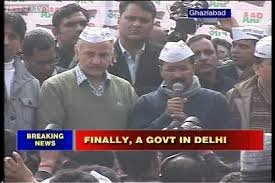
The fall of the AAP government in Delhi is a bolt out of the blue for Indian electorate in general and for common people in particular. It has shattered their dreams and demolished all their hopes for betterment. The people of Delhi voted AAP to power as it associated itself with the problems, desideratum and aspirations of the so-called common people and promised to ease the burdens of day-to-day life. The party took measures to fulfil some of the promises it had made to the electorate and initiated some drastic steps for others. People were happy with their decision to bring the party into power and pinned more hopes and aspirations to it. However, all of a sudden the chief architect of the party, Arvind Kejriwal decided to enact ‘Janlokpal Bill’ and put it at the floor of the house, without following the required procedure, knowing that the party had no sufficient strength to pass the bill and its supporter was against it. Obviously, the bill was rejected due to the lack of required votes, and the Chief Minister had to resign. This episode shocked the people and led them to draw different impressions of the situation.
The general impression is that the AAP’s foremost leader Arvind Kejriwal wanted to be a martyr for the cause and interest of the common people, and he achieved this objective by resigning from the position of Chief Minister. He promised to provide many things and pledged to give many concessions to people during his election campaign but he faced difficulties in fulfilling those promises. As he has failed to fulfil his promises and had not lived up to the expectations of common people, his image as a saviour of people’s interest and champion of their cause has been tarnished.
The show of grand privileges in the form of the parliamentary election of 2014 is only a few months away, and it will surely be affected if the performance of AAP and its leaders is not up to the mark and expectations of the people. Thus, the safest move is to withdraw from the administrative arena and face the opposition in the big political battle of 2014 general elections. Mr. Kejriwal wants to retain his image as a fighter of public cause by resigning from the present post and showing his disinterest in position and power. He is confident that he will get its reward in the upcoming parliamentary elections. This is the reason why he recommended the dissolution of the assembly and holding of fresh elections.
Another idea is that AAP men have no experience in the administration and running of the government. They are unable to overcome problematic situations and deal with the opposition. In a parliamentary form of government it is very common for the opposition to always create problems and try to embarrass the ruling party. It depends on the ruling party to tackle and deal with the opposition. It is not the proper way to step down and help the opposition succeed. The ruling party should not be too rigid to compromise with the opposition. In the present case, there is no hurry to introduce the controversial bill to the legislative assembly, knowing that it will not be accepted due to the lack of required strength and the attitude of the opposition. It should have waited for the proper time and proper situation. It shows that AAP itself wants to withdraw from the government as a political strategy.
Any party which forms the government has to follow the laws, rules, regulations and procedures prescribed and meant for performing specified acts, duties and works, whether it likes them or not. In a civilized society, it is essential to follow the rules irrespective of their good or bad nature. As a matter of principle, rules, procedures and laws are valid and considered good if they are made by the proper authority entrusted to do so. If a person or group does not like them, they should try to amend them rather than break them. It is said that the leader of the party is only loyal to the Constitution and not to other rules and laws. The Constitution is the broad framework; it lays down the principles and procedures as to how laws are enacted, how rules and regulations are made and who are the proper authorities to do so. Many laws, rules and regulations are not mentioned in the Constitution, but they are implemented and followed because they are made by prescribed authority and through the prescribed procedure.
It is also thought that the Chief Minister wanted to run away from the responsibility and burden of running the government. He faced great hurdle and opposition in implementing his plans and fulfilling his promises. There was also a ‘revolt’ within the party. He thought that by being the Chief Minister all his plans and orders will be implemented and followed irrespective of rules, regulations, laws and superior authority. He had public mandate; as such he thought he was above all and wanted even the central government to accede to his demands. The reality was quite different and he failed to do what he wanted. He could not tackle the situation with acumen and wisdom and found it difficult to overcome the odd and difficult situation. Instead of facing the situation boldly with political strategy and plan, he preferred to resign. His party members were of the opinion that he should not have resigned but remain in power and gradually try to work on the agenda, clean the administration and fulfil the promises.
There are voices from some quarters that AAP leadership is skilled in organising agitations, strikes and midnight raids and not in administering the affairs of the state. It lacks competency. This is the reason that it remained in power for 49 days only, and during this short span of time opened many fronts and invited unnecessary troubles amidst which it was difficult to survive. The most serious problem was the disgraced position of the Chief Minister and those who were part of the power structure. These persons are responsible to protect and safeguard the law of the land and not to break it. If they themselves violate the law, how can they check others? This is the first incident in the political history of India that a Chief Minister had gone on strike, violating the law, holding office outside the premise meant for this position and disposing of necessary files there.
AAP and its leaders are more concerned with combating corruption. Without any shadow of a doubt it is a vital problem and has disrupted the entire system of our lives, but it is not the only problem. There are many other vital problems that are corroding the bases of our socio-political life. They are insecurity, atrocity, disparity, exploitation, suppression, injustice and overall communal conflict, which are intentionally created and spread to obtain socio-political and economic gains. However, if they concentrate only on corruption, that too cannot be eradicated in one or two days. It requires time and concentrated efforts to root them out of society. If we look into the matter sincerely and honestly, we find that in a democratic system, corruption automatically exists and grows if not checked.
In a vast country like India, a political party requires millions and billions of Rupees to meet the expenses of the election campaign. Where do political parties get such amounts of money? Big establishments and businessmen donate such money not only to the ruling party but also to the opposition. Sometimes they donate such money to save income, property and wealth taxes. Obviously, they give money away to get some undue advantages in the form of concessions, reliefs and privileges which political parties are obliged to give. Is this not corruption? Had the capitalists not donated such money to political parties that would have gone to treasury and spent in public welfare? It is said that the government is run by capitalists; the statement is not without truth.
Corruption can be eradicated by the change of the heart and mind, and it should begin from grassroots level. In schools and colleges, special courses should be designed to train young generations and create a distinct mindset that can understand the disastrous effect of corruption on people and nation.
These diverse impressions which common people develop about the present political situations frustrate them and compel them to think that politicians are not really interested in the welfare of the common and poor people, but they use their name to get political gain. They are, in fact, in doldrums. How can their situation be improved, and allow them to lead a comfortable and dignified life? Their frustration gives birth to apathy among them and that adversely affects the political system. Now the time has come to modify the system so that sincere, honest and dedicated persons can get access to the system and serve the nation with utmost dedication and thus change the fate of the poor and weaker sections of our country.