

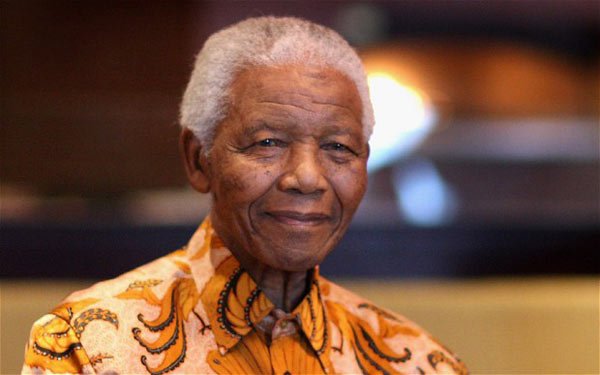
Nelson Mandela, a Nobel Peace laureate, who became South Africa’s first black president after spending 27 years as a political prisoner, breathed his last at 8.50 PM on 5 December, at his Johannesburg home after a long battle against lung infection. He was 95. Mandela will be remembered as the chief architect that transformed South Africa from racial despotism to liberal democracy.
Mandela, through his struggle, became the symbol and synonym of world peace and Mahatma of South Africa. Rolihlahla Mandela, son of a chief of the Thembu clan of the Xhosa people, was named Nelson by a British teacher as his name was difficult to pronounce. When Mandela was 80 years old, he married Graca Machel, the former first lady of Mozambique. He is survived by his wife Machel, daughter Maki, from his first marriage and two daughters from his marriage to Madikizela-Mandela, Zindzi and Zenani. Mandela married three times and was father of six children and 20 grandchildren.
Nelson Mandela, anti-apartheid hero, was born in Transkei, South Africa on 18 July, 1918. His father was Chief Henry Mandela of the Tembu Tribe. After completing his education at University College of Fort Hare and the University of Witwatersrand with a law degree, he joined the African National Congress (ANC) in 1943 and later formed the Youth League of the ANC. He joined the African National Congress in 1944. The symbol of anti-apartheid in his lifetime won him more than 200 honours, including the 1993 Nobel Peace Prize, the US Presidential Medal of Freedom, the Soviet Order of Lenin and the Bharat Ratna. Notably, 18 July, which happens to be the birthday of Mandela, was declared an annual international Mandela Day in 2009 by the UN to mark his struggle for social justice.
What was most surprising that when the world recognised him as the father of South Africa, Mandela was put on the US terror list until 2008. It was only on his birthday in 2008 that he and his party were removed from the US terror watch list.
The entire world has mourned the death of Nelson Mandela, including Tunisia which declared 6 December as day of mourning for Mandela. According to Fr. Cedric Prakash sj, the point however remains that Mandela despite revered as an icon and inspiration for millions across the world, several parts of the world continue to witness violence and hatred.
Among Mandela’s notable sayings is what he had said on the Palestinian cause, “We know too well that our freedom is incomplete without the freedom of the Palestinians.”
Mandela will be laid to rest at his ancestral village of Qunu in the Eastern Cape on 15 December.