

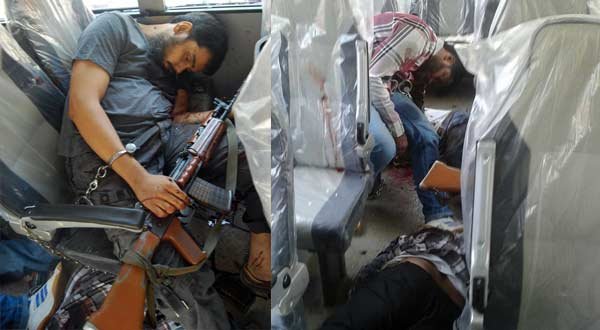
On 2 April two young men, now alleged to be operatives of the banned Students Islamic Movement of India (SIMI) were frisked from a Hyderabad-Vijayawada bus at Suryapet (Nalgonda district of Telangana) and ordered to submit to a police check. Suddenly they pulled out guns, killed two policemen, injured three others, snatched a carbine from one of them and fled into the night. Some 18 police teams were put in their pursuit over the next 72 hours and after gunfights at three places, the outlaws were shot dead on 4 April. One more police officer involved in the operation died later in hospital besides an SI and a CI was also critically injured.
RETALIATION OR SELF DEFENCE
Within a couple of days after the Suryapet encounter the Telangana Police shot dead five alleged terrorists who were being driven with an escort of some 15 armed guards from the Warangal prison to a court in Hyderabad to face proceedings in a terror case. The five men were Viqaruddin, Amjad Ali alias Suleman, Dr Hanif, Zakir Ali and Izhar Khan. Police authorities said Viqaruddin asked for a toilet break as the bus passed Aler and lunged for a policeman’s rifle as he was being freed of his handcuffs. The other undertrials did likewise in unison, the police said, and were all shot dead by a machine-gun wielding guard in self-defence. However, what was really disconcerting were the photographs of the bus encounter showing the five militants slumped in their seats, still handcuffed to the steel frame of the seating. The body of Viqaruddin lay against a window with a rifle cradled in his lap.
CRYING FOUL
AIMIM President and Hyderabad MP Asaduddin Owaisi strongly condemned the killing of five undertrial prisoners. “The Suryapet incident was a terrorist act and everyone condemned it and expressed solidarity with the police. But the police seemed to be on a retaliatory killing spree by gunning down undertrials to avenge the Suryapet incident. When the undertrial prisoners were facing terror charges, it was for the courts to decide. However, the police cannot take over the powers of judiciary and resort to extra-judicial killings,” he said.
Video footage given to Amnesty International India by a journalist appears to show the five undertrials inside the police van after they were killed. All five appear to be handcuffed, it said. “Impunity for extrajudicial executions is a serious issue in India,” said Abhirr V P, Campaigner at Amnesty International India. Nusrat Ali, Secretary General of Jamaat-e-Islami Hind, has demanded swift arrest of the guilty policemen, registration of cases to punish them and immediate compensation of Rs one crore each to families of the deceased.
TRIGGER HAPPY COPS
Twenty woodcutters from Tamil Nadu, found felling red sanders, were killed in an alleged encounter in the Seshachalam forest at the foot of the Tirumala hills on 7 April. The Andhra government’s newly established Red-Sanders Anti-Smuggling Taskforce was on a combing operation on the Seshachalam hill ranges when they spotted footprints. On finding over 100 woodcutters felling trees and carrying logs, the officials asked them to surrender. However, the woodcutters allegedly rained stones and hurled sickles at the team, injuring some of the security forces who then fired random shots in self-defence, according to a taskforce member killing 20 smugglers in cold blood.
Distance between the bodies found at the encounter spots was not more than 10 feet raising serious doubts on the encounter theory. Blood stains were seen only at the spot where the bodies were lying and nowhere else at both the encounter spots. If the police version that they opened fire in self-protection is true, then there should have been blood that spilled out from the injured at various spots in the area. No tree at the encounter spot bore bullet marks. There are no stones available at the encounter site which goes against the police version that the coolies had hurled stones on the armed forces.
UMPTEEN SIMILAR CASES
In May 2010 Khalid Mujahid, the 2007 serial blasts accused, was being driven to Lucknow jail in a police van with four other accused, when he fell unconscious and later died. The postmortem failed to establish the cause of his death. Khalid was among the two terror accused against whom the government had sought to withdraw the cases on grounds that these were false. His arrest, along with that of Tariq Qasmi from outside the Barabanki railway station in 2007, had triggered a storm after their families accused the police of torturing them in illegal detention for a confession.
Then Mayawati government had even ordered a judicial commission to probe their arrest which found the allegations of illegal detention true. The government of UP referred the probe into Khalid’s death to CBI on the demand of his uncle Zaheer, who refused to accept Khalid’s body until his demand was met.
In August 2012, Maharashtra CID said that the murder of suspected Indian Mujahideen operative Qateel Mohammed Siddiqui inside Pune’s Yerwada Central Jail on June 8 was planned. Qateel was found murdered inside his cell, allegedly by fellow inmates who later confessed having killed Qateel because of his involvement in anti-national activities. These are hundreds of similar cases in which undertrials have been exterminated under suspicious circumstances with the needle of suspicion pointing towards a sinister plot by some well entrenched powers to terrorise the Muslim community by incarcerating their youth and creating a fear psychosis.
SHINING INDIA GETS A DENT
The above gruesome incidents in the space of a few days don’t exactly put India on a glorious pedestal by any stretch of imagination. In fact, India’s image as a thriving democracy and upholder of human rights has received a deep gash which will take a lot of time and efforts to heal. Is the problem with the law-enforcement agencies alone or is it a bigger problem that touches their political masters. The UN Principles on the Effective Prevention and Investigation of Extra-legal, Arbitrary and Summary Executions require that “there shall be thorough, prompt and impartial investigation of all suspected cases of extra-legal, arbitrary and summary executions, including cases where…reliable reports suggest unnatural death in the above circumstances.”
If India can live up to these principles, conduct an independent investigation and award the guilty officers exemplary punishment then these encounters will not take place so frequently and with such impunity. It is often said that the true test of a democracy is how well it treats its minorities. On that test, India is currently failing rather miserably.