

Gross Domestic Product (GDP), expressed as GDP = C + I + G + (X − M), is an economic measure used to assess a country’s economic growth and well-being. The question of who developed the concept of GDP is an academic discussion that will be addressed later; however, GDP is widely used as a tool to measure economic activity. A chapter on GDP is included in almost every Class 12 economics textbook in the country, irrespective of the education board. Most commerce students are familiar with GDP. GDP has been used by almost every country for more than half a century.
The purpose of measuring GDP is to determine the pace of growth and development in an economy. Generally, governments study GDP to evaluate their economic policies and expenditures made a few years earlier. Governments formulate public policies to induce autonomous investment. They make plans and allocate funds to implement them in the economy, thereby strengthening its weaker sectors. GDP is a powerful tool for measuring economic activity. It is used to identify shortfalls in the economy and diagnose economic problems.
The concept of GDP was developed by the famous British economist John Maynard Keynes and Richard Stone before the World War II. After the World War II, the economies of many countries were ruined, creating a need for a powerful tool to measure economic growth and development. The concept was subsequently refined and developed further. This significant work was undertaken by Simon Kuznets, a Russian-American economist. GDP is used to measure a country’s performance in terms of employment, investment, expenditure, income, consumption, and the level of exports. GDP is used across the globe to measure economic growth.
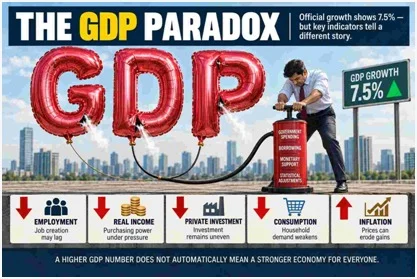
It is a kind of indicator, and it is used as such throughout the world, except in India. GDP is an indicator, but when it reaches India, it becomes a dogma and a cause for celebration. The government celebrates GDP growth and,in most cases, manipulates GDP figures to fool the public. The government’s magicians celebrate 7.8% GDP growth while the poor and middle classes suffer from poverty and hunger. The pattern of GDP reflects the correlation among its variables: it increases when the independent variables increase. For instance, when consumption increases, GDP increases. Likewise, when investment, income, and employment increase, GDP also increases. Thus, the levels of income, consumption, employment, investment, and expenditure are the drivers of GDP. Our GDP depends on these factors. Sadly, these sectors are deteriorating in the country, yet GDP continues to increase. This is truly beyond understanding. Economists around the world are scratching their heads over this prediction.
The International Monetary Fund (IMF) has expressed doubts about Indian data. It has downgraded the Indian data to Grade C. If the data are doubtful, the results will obviously be doubtful and dubious.
Subhas Chandra, a former government secretary, has alleged that the government manipulated the GDP data. He claimed that the government reduced GDP at current prices from 86 lakh crore to 80 lakh crore. He argued that the government manipulated the base year used in calculating GDP. If the base year had not been manipulated, nominal GDP would have been around 2.6% instead of 10.3%. Furthermore, a former Governor of the Reserve Bank of India has expressed serious concern about the current GDP figures. He stated that the current GDP growth does not translate into real growth. If GDP has grown by 7.8%, why has this growth not resulted in increases in employment, income, consumption, and foreign direct investment (FDI)?
If the government understands that GDP is an important parameter for economic growth, why does it not seek to increase it through organic means rather than manipulating the base year and deceiving the public?
If the concept or idea was not widely understood, it could be assumed that the government could fool people; however, the current Gen Z is not gullible. Therefore, the propaganda surrounding the celebration of GDP is nothing more than an attempt to grind its own axe. Rather than celebrating, the government should work towards strengthening the parameters of GDP.