

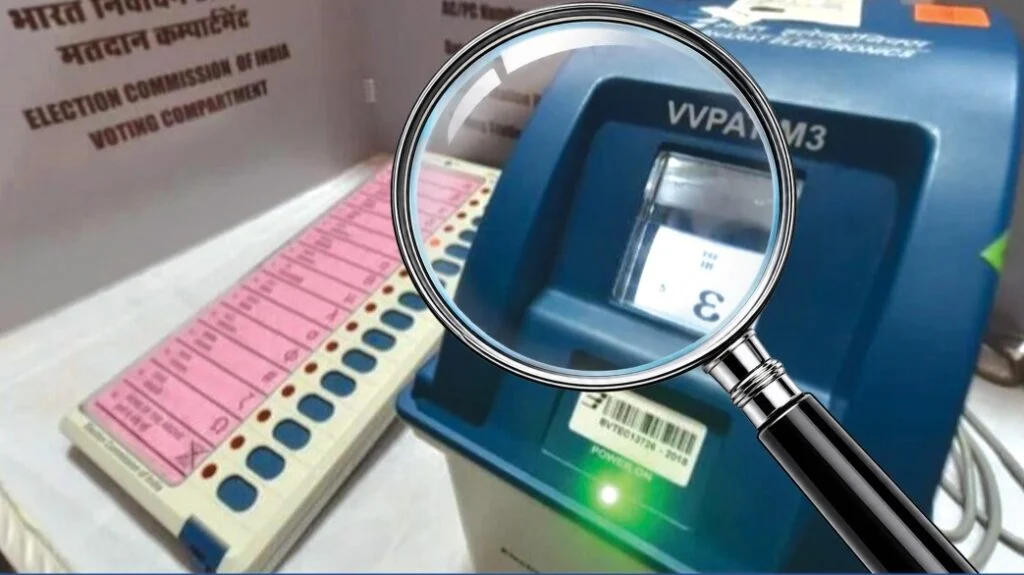
An election’s credibility rests on more than the announcement of a winner. It depends on evidence that votes have been recorded faithfully, counted accurately and protected against interference.This principle should guide India’s debate over electronic voting machines (EVMs) and paper ballots. The central question is not simply which system is faster or easier to administer. It is which enables independent verification of the result and provides an effective remedy when discrepancies arise. An official result declares an outcome; independent verification helps establish its reliability. Calls for transparency are not, by themselves, allegations of fraud. Scrutiny is part of how electoral institutions earn credibility.
Recent disputes over electoral-roll revisions, the Election Commission of India’s (ECI) digital platforms and EVM verification have brought this issue into sharper focus. How much of the electoral process can citizens examine for themselves, and how much must they accept on official assurance?
EVMs, VVPAT and Electoral Software: Efficiency Without Full Auditability
India introduced EVMs to address problems associated with paper ballots, including invalid votes, slow counting and booth capturing. They offer clear administrative advantages in a country with an enormous electorate.
The ECI says the machines are standalone devices, disconnected from the internet, and protected by safeguards such as mock polls, sealing, secure storage and the presence of candidates’ representatives at designated stages. Those safeguards matter. But internet isolation alone cannot answer every question about design, manufacture, software integrity, candidate-symbol configuration, custody, access controls or counting procedures.
There is an important distinction between alleging that manipulation occurred and asking whether the safeguards would reliably detect it if it did. The first claim requires specific evidence; the second is a basic question of electoral design. EVMs should not be presumed compromised because they are electronic, but neither should official assurances substitute for independent testing. Their credibility depends on demonstrable reliability, verifiable results and effective ways to detect and correct errors.
Voter Verifiable Paper Audit Trail (VVPAT) provides a physical record of an electronic vote. After the voter presses the button, a slip showing the candidate’s serial number, name and symbol appears behind a window for about seven seconds before dropping into a sealed compartment. Under the current procedure described by the ECI, slips from five randomly selected polling stations in each Assembly constituency, or Assembly segment of a parliamentary constituency, are counted and matched against the electronic result.
A paper record, however, is not automatically a comprehensive audit. The public deserves a clear account of the statistical assurance this sample provides and how well it can detect different kinds of discrepancy. An independent assessment could compare the current sample with a larger, statistically designed sample that expands when discrepancies appear, as well as with a full count of VVPAT slips. Universal counting would take more time and personnel and could introduce human error; those costs should be weighed against the benefit of checking the complete electronic tally against the paper record.
The same standard applies to the ECI’s digital infrastructure and its role in managing electoral rolls. In September 2026, The Indian Express reported that Election Commissioners Sukhbir Singh Sandhu and Vivek Joshi had raised concerns about electoral-roll software, including whether its design constrained EROs’ statutory discretion and centralised database access. The ECI later announced a review of ECINET involving a senior Deputy Election Commissioner and an independent expert from an IIT or IIIT.The concern is not merely technical. The law assigns EROs responsibility for electoral rolls, while software can shape which records are flagged, scrutinised or routed through particular procedures. Formal human authority may offer limited protection if the systems guiding decisions cannot be meaningfully examined.
On October 26, reports said the ECI had declined to disclose the name and version of the software used to flag discrepancies during the Special Intensive Revision (SIR), citing commercial confidence and intellectual-property protections. The Commission said no new software had been procured specifically for the SIR and that EROs retained final authority over additions and deletions.
Cybersecurity concerns add to the case for scrutiny. On October 6, CERT-In reportedly confirmed that a hardcoded encryption-key vulnerability in ECINET had been fixed, while other reported vulnerabilities remained under investigation. On October 28, the Supreme Court agreed to examine records relating to allegations about the ECI’s internal SIR decision-making. The Commission denied that key decisions had been taken unilaterally; the proceedings had not established wrongdoing.
From voter-list software to EVMs and VVPAT, the principle is the same: when technology mediates constitutional rights, official assurances need to be matched by meaningful independent scrutiny. Citizens need not presume manipulation to ask for systems that are transparent, auditable and accountable. If electronic results cannot be independently verified to a level that commands public confidence, retaining existing arrangements without further examination becomes difficult to justify.
The Supreme Court’s Judgment and the Questions It Leaves Open
On 26 April 2024, a Supreme Court bench comprising Justices Sanjiv Khanna and Dipankar Datta rejected petitions seeking 100 per cent cross-verification of EVM results with VVPAT slips or a return to paper ballots. Citing practical difficulties and the risk of human error in manual counting, the Court declined to order universal VVPAT counting and set out additional safeguards.
The directions included sealing and securely storing Symbol Loading Units (SLUs) for at least 45 days after the results, and allowing candidates who finished second or third to request verification of the burnt memory or microcontroller of 5 per cent of EVMs in an Assembly constituency or parliamentary constituency segment. Requests must be made within seven days. Engineers from the manufacturers conduct the examination; candidates initially bear the cost, which is refundable if tampering is established.
These directions address concerns about post-election verification, but they also invite questions. Access depends on a candidate’s finishing position, leaving other candidates and voters without a direct route to request scrutiny. The seven-day window may be enough to preserve equipment, but whether it gives sufficient time to identify and document a credible discrepancy is less clear.
The arrangement also raises questions of institutional design. Should candidates bear the initial cost of a technical examination intended to support confidence in a constitutional process? Should findings be made public, subject to legitimate security limits? And should verification remain confined to a fixed percentage of machines, or should checks expand under a statistically defensible rule when anomalies appear?
These questions neither dispute the Court’s authority nor assert that manipulation occurred. They ask whether the safeguards turn official assurances into evidence that can be independently assessed. Even a system that is secure in practice can face a crisis of confidence if its verification procedures are narrow or opaque.
In November 2024, the Court dismissed another petition seeking a return to paper ballots, observing that allegations of EVM tampering often surface after electoral defeats. The concern about politically selective complaints is understandable. Yet the timing of a complaint cannot settle whether a technical concern is valid. Evidence must decide that question; the absence of proven manipulation does not, on its own, establish that existing verification is adequate.
The Court’s rulings do not establish that EVMs have been manipulated, and they do not place the system beyond examination. A judicial decision resolves the legal challenge before the Court; the broader democratic question – whether citizens can independently verify electoral outcomes – remains open.
What Other Democracies’ Experience Can and Cannot Tell Us
India is not alone in reconsidering electronic voting. In 2009, Germany’s Federal Constitutional Court ruled that essential stages of an election must be publicly verifiable without specialised technical knowledge, challenging voting computers that did not provide adequate public transparency. The Netherlands stopped using electronic voting machines in 2007 after security concerns and public campaigning. Ireland abandoned its planned introduction of the machines in 2006 amid concerns about security, reliability and cost.
The United States has taken a different path. Voting arrangements vary by state and locality, but paper records are widespread. In May 2025, the U.S. Election Assistance Commission announced a policy supporting paper-based, auditable and software-independent voting systems. It reported that more than 98 per cent of U.S. election jurisdictions used systems producing a paper record of every vote.
These examples do not show that every developed country has returned to traditional paper ballots. Some use electronic equipment that produces paper records; others have discontinued particular systems. They do show that electoral technology can be reassessed when questions of transparency, security or public confidence arise.
India’s scale and administrative challenges are real, but they should not rule out scrutiny. Voting systems should be assessed for accuracy, transparency, accessibility, security and independent auditability, as well as speed.
Paper Ballots Remain an Alternative Worth Examining
Paper ballots have an important advantage: each vote exists as a physical document that can be inspected and recounted without relying exclusively on an electronic tally. They are not immune to malpractice. Ballots can be stuffed, stolen, destroyed or miscounted, and manual counting demands time, labour, secure transport and careful storage. The choice is therefore not between a perfect paper system and a defective electronic one. Each system has different risks and safeguards.
Still, if electronic results cannot be independently verified to a level that commands public confidence, existing arrangements should remain open to serious reconsideration. A return to paper ballots, or a redesigned paper-based system, should be assessed on evidence rather than dismissed in advance.
The ECI should commission an independent comparison of EVMs with VVPAT, enhanced paper-audit arrangements and traditional ballots. The assessment should consider accuracy, the prevention and detection of manipulation, preservation of evidence, resolution of discrepancies and the ability of citizens and candidates to verify results. Its purpose should be to determine which system offers the most credible and independently verifiable expression of the people’s mandate.
Trust Has to Be Earned
India need not presume that EVMs have been manipulated to recognise the need for stronger safeguards. Nor should it assume that paper ballots would eliminate malpractice.It needs independently audited electoral software, traceable changes to voter lists, transparent VVPAT verification, secure preservation of voting records and clear procedures for investigating credible discrepancies. Alternative voting systems should also remain open to impartial public assessment.
The right to vote is not fulfilled simply when a citizen presses a button or deposits a ballot. It is fulfilled when that choice is accurately recorded, faithfully counted and protected by effective accountability.
A democracy cannot demand blind faith in its electoral machinery. It must give citizens reasons to trust the system, and the means to verify that their trust is justified.Democracy requires more than the announcement of election results. It requires a voting system whose integrity citizens can independently verify. That is not an allegation of wrongdoing or a partisan demand; it is a democratic standard for every electoral institution.