

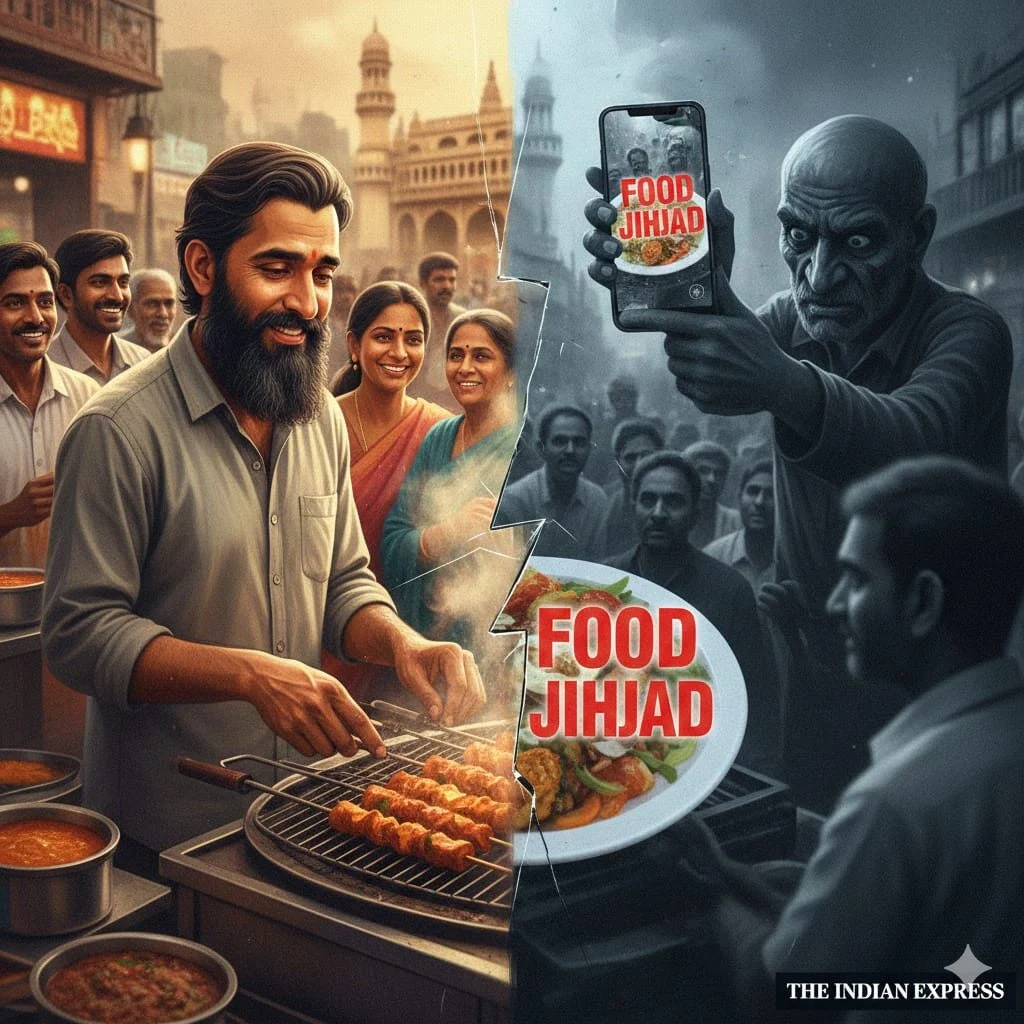
In the labyrinthine lanes of Telangana’s towns, where the aroma of Irani chai usually mingles with the sizzle of street-side kebabs, a new and corrosive ingredient is being stirred into the pot: communal anxiety. A cluster of Telugu YouTube channels, operating under the thin veil of ‘consumer activism,’ has begun a targeted campaign against Muslim street vendors, branding their trade with the inflammatory label of ‘Food Jihad.’
The script is as predictable as it is perilous. A ‘reporter’ armed with a smartphone and a pre-packaged bias accosts a pushcart vendor. The questions are rarely about FSSAI licences or procurement chains; they are interrogations of identity. By weaving stray instances of alleged un-hygiene into a grand tapestry of religious conspiracy, these digital platforms are not merely reporting; they are radicalising the mundane act of eating.
To term a hygiene grievance as ‘Jihad’ is a calculated linguistic heist. It elevates a civic matter to a communal battlefield, stripping the vendor of his citizenship and re-casting him as a conspirator.
The rise of these channels points to a systemic failure on two fronts. First, the Food Safety departments have often been reactive rather than proactive, leaving a vacuum that self-appointed ‘vigilantes’ are all too eager to fill. Second, the long arm of the law seems to shorten when it comes to digital hate-mongering.
When a viral video leads to the instant economic boycott of a family-run stall, it isn’t just a business that closes; it is the constitutional right to ‘Practise any Profession’ (Article 19) that is being shuttered. The state’s silence in the face of such blatant economic profiling is a worrying departure from its role as a neutral arbiter.
Telangana has long prided itself on its Ganga-Jamuni Tehzeeb – a syncretic culture where food was the ultimate bridge. From the Haleem of Hyderabad to the village fairs, the plate was a neutral territory. By poisoning this shared space with the venom of ‘Food Jihad,’ these provocateurs are attempting to map the ‘Ghetto’ onto the dinner table.
Hygiene is a non-negotiable public health standard. It must be enforced with an iron hand but that hand must be the State’s, not a mob’s. To allow YouTubers to use ‘cleanliness’ as a proxy for communal cleansing is to invite anarchy into our kitchens.
As a society, we must ask: Is the stomach truly the next frontier for communal division? If we allow the salt of suspicion to be rubbed into every meal, the aftertaste will be a bitterness that no policy or prayer can easily wash away.