

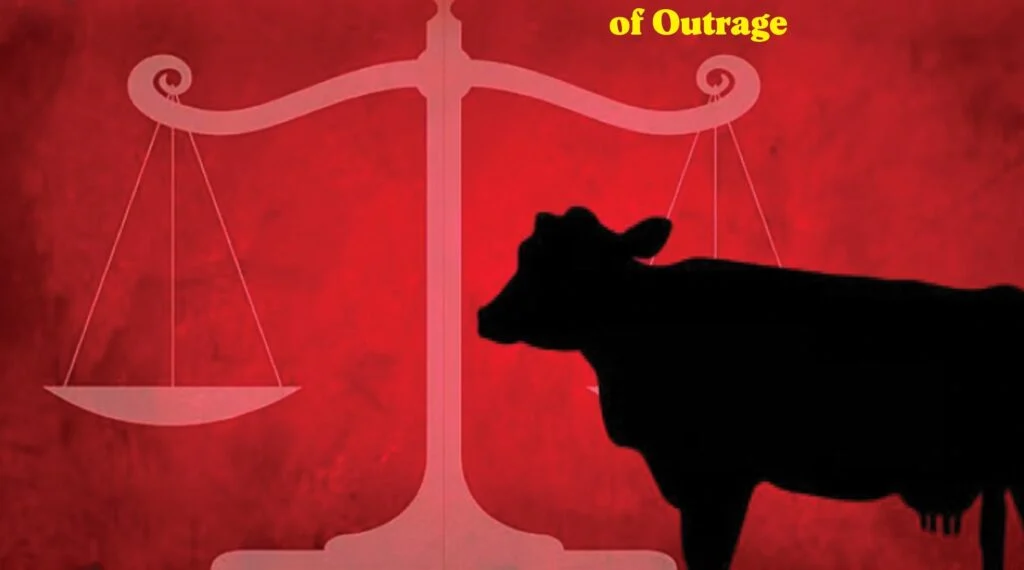
In the weeks preceding Eid al-Adha, a familiar spectacle once again unfolded across India. Television studios hosted heated debates, social media overflowed with inflammatory videos and messages, politicians issued warnings, and self-styled cow-protection groups became unusually active. At some places, an even more disturbing trend emerged. In Mumbai’s Mira Road, some miscreants reportedly sought to bring a pig into a Muslim housing complex as a counter-protest to Eid sacrifice. In Delhi’s Tri Nagar, pigs and Varaha imagery were allegedly deployed in a new form of communal signalling.
The incident reflected a troubling new reality. The politics surrounding the cow is no longer confined to debates over animal welfare, slaughter laws or religious sentiment. Increasingly, it has become part of a broader culture of symbolic confrontation in which identities are publicly performed, amplified and weaponised.
Yet only weeks earlier, reports of neglected cattle, overcrowded gaushalas and hundreds of dead cows had attracted little national attention. The contrast was striking. The cow, largely absent from public discourse for much of the year, had once again become the centre of political and media attention.
This recurring pattern raises an uncomfortable question: Is the contemporary politics of the cow primarily about reverence for an animal, or has the cow become one of the most effective instruments of political mobilisation in modern India?
This question is not intended to mock faith. Millions of Hindus genuinely revere the cow, and that sentiment deserves respect. The issue is whether a deeply held religious belief has gradually been transformed into a political resource, invoked selectively and amplified strategically whenever it serves larger ideological or electoral objectives.
The Myth of an Unchanging Past
Contemporary political discourse often presents the cow’s sacred status as an unquestioned fact stretching back to the dawn of Indian civilisation. History, however, tells a more complex story.
The earliest Vedic texts reveal a society in which cattle represented wealth, status and economic power. Cows were highly valued, yet historical and textual evidence also suggests that cattle sacrifice and beef consumption existed in certain contexts. Several historians, including D.N. Jha, Romila Thapar and R.S. Sharma, have challenged the claim that the cow enjoyed an identical and universally sacred status throughout all periods of Indian history.
This does not mean that the cow was not respected. It means that reverence evolved over time rather than emerging fully formed from antiquity. The rise of settled agriculture, growing dependence on cattle for farming, and the influence of Buddhist and Jain traditions contributed to changing attitudes towards animal slaughter. By the early medieval period, the cow had acquired an increasingly elevated place in religious imagination.
Significantly, even some of the figures frequently invoked in contemporary cultural debates held views that sit uneasily with modern political rhetoric. Swami Vivekananda acknowledged that beef consumption had existed in ancient India and cautioned against romanticised readings of the past. V.D. Savarkar, often regarded as the principal ideologue of Hindutva, rejected the notion of cow worship and viewed cattle protection primarily in terms of economic utility rather than divine status. He wrote,“When you worship the cow, you lower the standing of mankind. God is the highest, then comes man, and below man is the animal kingdom. The cow is an animal,” and “गायहाहिंदुराष्ट्राचाएकदुग्धबिंदु! मानबिंदुनव्हेचनव्हे” (The cow is but a milch symbol of the Hindu nation! By no means should it be considered its emblem of honour/dignity).
The historical record, therefore, reveals not an unchanging truth but a long and uneven process of social, economic and religious transformation.
How the Cow Became Political
While reverence for the cow developed over centuries, its transformation into a mass political symbol is comparatively recent.
The modern cow-protection movement emerged during the late 19th century. Organisations dedicated to cow protection proliferated across North India, and public campaigns increasingly made the issue a marker of communal identity. Colonial records document a rise in cow-related disturbances during this period as the issue became intertwined with broader struggles over representation, identity and political power.The cow was no longer merely an animal. It had become a political symbol.
This distinction is important. Reverence for the cow may be ancient; organised cow politics is largely modern.
The Constitution’s Different Vision
The framers of the Indian Constitution approached the issue from a markedly different perspective.During the Constituent Assembly debates, some members sought an explicit constitutional ban on cow slaughter, while others opposed incorporating religious beliefs into state policy. The compromise eventually emerged in the form of Article 48, which directs the State to organise agriculture and animal husbandry on scientific lines and preserve useful breeds of cattle.Significantly, Article 48 does not describe the cow as sacred. It invokes neither theology nor scripture. Its rationale is economic and agricultural rather than religious.
India’s founders sought to accommodate cultural sentiment while creating a republic grounded in citizenship rather than religious identity. Yet contemporary politics often blurs this distinction, presenting constitutional provisions as extensions of religious imperatives.
Sacred During Festivals, Forgotten Thereafter
If public rhetoric reflected reality, cattle across India would enjoy exceptional care and protection. Yet the lived reality often tells a different story.
Across large parts of rural India, stray cattle damage crops, cause road accidents and impose serious burdens on farmers. Gaushalas frequently struggle with inadequate funding, overcrowding and poor infrastructure.
The contradiction became impossible to ignore when reports emerged from Jaisalmer in 2026 that more than 500 dead cow carcasses had been found dumped in the open. Similar reports of cattle deaths and neglect surfaced from gaushalas in Rajkot, Meerut and elsewhere.
These incidents expose a troubling paradox. The cow often receives greater protection as a symbol than as a living creature. Public passion appears strongest when outrage can be mobilised, but far less visible when sustained care, expenditure and institutional responsibility are required.If the cow is truly revered as “Gau Mata”, why do such scenes recur with alarming regularity?
The Geography of Political Convenience
Perhaps the most revealing aspect of contemporary cow politics is its remarkable flexibility.In several northern states, the cow is projected as a civilisational issue demanding uncompromising positions. Yet in parts of the Northeast, where beef consumption forms part of local dietary traditions, political leaders have repeatedly assured voters that their food habits will not be disturbed. Former Goa Chief Minister Manohar Parrikar publicly intervened to ensure beef availability when shortages arose, while Kiren Rijiju and other leaders have openly acknowledged India’s diverse food cultures.
These examples reveal an important truth. The intensity of cow politics often changes according to electoral geography. What is presented as a non-negotiable moral principle in one region frequently becomes a matter of accommodation in another.Such flexibility is difficult to reconcile with claims of absolute conviction. It is easier to explain as political pragmatism.
When Sentiment Replaces Law
One of the most troubling consequences of cow politics has been the emergence of vigilantism.Groups claiming to protect the cow have, at times, assumed powers that belong exclusively to the state. Suspicion has too often replaced evidence, and accusation has too often replaced due process. In several instances, individuals have faced intimidation, violence and even death on the basis of allegations alone.
Whenever private groups claim authority to investigate, punish or intimidate citizens, the rule of law suffers. The Constitution protects religious belief, but it also protects liberty, dignity and legal process.Respect for faith must never become a licence for lawlessness.
A New Language of Provocation
The recurring appearance of cow-related controversies around Eid al-Adha suggests that the issue extends beyond animal welfare or religious sentiment. The cow evokes emotion, reinforces identity and lends itself to political mobilisation. Increasingly, communal tensions are expressed through symbolic acts in which animals themselves become instruments of identity and provocation.
Ahead of Eid al-Adha this year, tensions flared in Mumbai’s Mira Road after protests over goats kept for sacrifice reportedly led to attempts by activists to bring a pig into a residential complex where Muslim families lived. Around the same time, reports from Delhi’s Tri Nagar described Hindu households near a Muslim locality keeping pigs in cages outside their homes alongside prominently displayed images of ‘Lord Varaha’ – the boar incarnation of Vishnu. Reports further alleged that the animals were given Muslim-sounding names and called out when Muslims passed by.
Whatever the motivations of those involved, such incidents mark a departure from earlier patterns of communal politics. Animals are no longer merely objects of reverence or controversy; they are increasingly deployed as markers of identity and instruments of provocation.
These developments point to a new politics in which religious symbols are publicly staged to communicate power, difference and exclusion. The cow, the pig and other religiously charged symbols cease to be merely matters of belief and become participants in larger contests over identity and belonging.Such spectacles would have been almost unimaginable in mainstream public life a generation ago. Their emergence reflects a broader transformation in the language of political mobilisation.
Democracy, Citizenship and the Politics of Symbols
Respect for religious sentiment is an essential feature of a plural society. Equally, every community is entitled to practise its faith within the framework of law and constitutional values.Yet democracy requires a distinction between personal faith and public politics.
The framers of India’s Constitution envisioned a republic based on equal rights, constitutional morality and the rule of law – not on the competitive assertion of religious identities. The real issue before India is therefore not whether the cow should be respected. It is whether religious symbols should be transformed into tools of political competition, communal signalling and cultural intimidation.
The recent emergence of symbolic provocations involving not only cows but also pigs and other religiously charged imagery suggests that the debate has moved far beyond animal welfare. Animals, deities, dietary practices and sacred symbols are increasingly being drawn into contests over power and political dominance.This development should concern all citizens.
The cow’s place in Indian civilisation may indeed be ancient. Its role in contemporary politics, however, belongs largely to a modern age of identity mobilisation. The question confronting India today is not whether faith deserves respect, but whether politics can resist the temptation to exploit faith for its own purposes.
For if religious symbols become sacred only when they are politically useful, and neglected when responsibility, care and constitutional values are required, then what is being defended is not faith itself. It is power clothed in the language of faith.And few challenges are more consequential for the future of Indian democracy.