

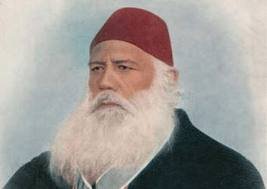
DR. SHAKEEL A. SAMDANI underlines the achievements of the founder of Aligarh Muslim University, Sir Syed Ahmad Khan, and calls upon the community to achieve a respected place in the Indian society by 2017 when the 200th birth anniversary is to be celebrated.
Though we are preparing to celebrate the 200th birth anniversary of Sir Syed Ahmad Khan, founder of Aligarh Muslim University in 2017, there are moves to belittle his invaluable contribution. There is no denying the fact that Sir Syed contributed immensely to the fields of education, agriculture, legislation and journalism but to many his main mission represented by the Aligarh Movement has not achieved the desired result. If so, it means that somewhere we have gone wrong. Sir Syed had not founded MAO College, the flag bearer of the AMU, only for imparting education but for taking up the community and social work. Another factor was to produce leaders who may take the community forward. If the AMU continues to be a mere university, his mission remains unfulfilled.
Sir Syed was the first Indian educationist who had visited England and keenly studied Oxford and Cambridge Universities before he established MAO College. He was the first to make education globalised in India. Moreover, he was the first educationist who introduced the residential system at MAO College. Sir Syed was also the first educationist who not only allowed but established first Students Club in the country on the lines of Oxford and Cambridge Universities in shape of Syddons Club where the students used to debate their problems and issues concerning the community and the country. It shows that Sir Syed was a democrat in the true sense and a believer in justice and peace.
To understand the educational policies of Sir Syed, we have to rivet onto the failure of the First War of Independence (popularly known as Indian Mutiny) – 1857. After its failure, Sir Syed did not give up hope but embarked upon a definite mission. He decided to empower the community with education to fight back and recover the lost ground. He executed this holy task in a manner that has no example in history. He not only devoted himself to this mission but successfully mobilised a vast majority of Muslims and Hindus alike to realise it. He did succeed in preparing a generation of Muslims who not only fought with the British during the pre-Independence days but also participated in nation building in the post-Independent India.
The education policy of Sir Syed had two main concerns. One was to educate the shattered Muslim masses in western scientific education and the other, to produce law abiding good citizens. It is due to that fact that Sir Syed emphasised moral character, truth, honesty and hard work. It is due to that Sir Syed had always opposed flattery, lethargy and dishonesty. In fact, the residential system was made compulsory to ensure that the students adopt finer manners and move in the society in a responsible way with pride compounded by knowledge. Not much time passed when an Aligarh boy could be identified anywhere.
Another aim of Sir Syed’s education policy was to produce such citizens as may be aware of their rights and of the ways to achieve those rights. This is very important in the present socio-political scenario. We are all aware that India is a democratic nation and we have been bestowed upon certain rights. Hence to get those rights we must know them. We should also know how to achieve them.
Presently the Muslims remain the most economically depressed section of the Indian society and it has been confirmed by the Sachar Committee Report itself. Isolated by the prejudice of the majority, deprived of their fair share in educational and employment opportunities, a majority of Muslims live in a ghetto-like situation. The days of communalism are not over but in fact more than that the socio – economic deprivation has become more important. The Indian Muslims need a leadership which will rouse them not just on religious issues but organise them for educational and socio-economic progress so that they are in a better position to improve their lot. And that was the glorious aim of Sir Syed also in the changed circumstances after the collapse of First War of Independence (1857). Hence we can say that the present scenario is the same as was after 1857.
After the independence we adopted the Constitution which ensures justice and equality. The Constitution declares that India is a secular state. It has Article 29 which gives the right to conserve language, script or culture of any section of citizens residing in the territory of India or any part thereof. It also expressly forbids discrimination on grounds of race, religion, caste and language in admission in the educational institutions run by the government or aided by it. Further, Article 30 is vital to the protection and preservation of rights of the minorities to establish their educational institutions. Article 16 guarantees that no discrimination will be made in matters of public employment on grounds of religion, caste or creed. Likewise, Article 25 guarantees freedom of religion to every individual. It also assures the citizens to enjoy the unhindered right to practise and propagate their religion.
I wish to draw the attention of the readers towards the fact that it is the duty of every citizen to know the law. Ignorance of law is not innocence at all. Knowledge of Constitutional provisions and laws are also necessary to enjoy the rights or to fight back injustices in a dignified and lawful manner. We have to realise that the legal education is imperative to produce good citizens who may follow human values and rights. And to realise it was the dream mission of Sir Syed Ahmad Khan.
Let’s take a look at the legal contributions of Sir Syed. Though not much attention has been paid to bring forth Sir Syed’s legal and legislative contributions yet we have some points which indicate that Sir Syed had not forgotten this important aspect of civil society. Just remember, Sir Syed said, “To permit liberty of the press is the part of a wise government. To preserve it is the part of a free people.” In those days perhaps there was no conception of freedom of expression and this great doyen was talking about it. Just imagine the flight of his mind and commitment. Not many people are aware that Sir Syed was instrumental in the enactment of Act No: 10, Stamp Act, 1882, Act No: 14 (Limitation) Act – 1859 – 1864, Act No: 16 (Registration of Documents), 1864 and the Kazis Act, 1880, in British India. The Kazis Act empowers the state government to appoint Kazis for the purpose of desiring local Muslims to solemnise marriages, etc. The Government in British India inherited the power to appoint Kazis from the Mughal rulers but had abdicated it in 1864. On the demand of Muslim leadership led by Sir Syed Ahmad Khan, the power was resumed by enacting the Kazis Act 1880.
Sir Syed himself was from legal background. It was due to that reason he understood the importance of legal education at that time when in fact nobody had given much importance to it. Sir Syed had established Law Department in MAO College in 1891 and the Law Department of MAO College or say AMU is one of the oldest. He also sent his son Justice Syed Mahmood to receive legal education; Syed Mahmood later emerged as the illustrious judge of the Allahabad High Court. It may be noted that even today the Supreme Court of India quotes his judgements.
Sir Syed pointed out in his Asbab-e-Baghawat-e-Hind that one of the big reasons behind the revolt was that Indians were not involved in the administration and judiciary. That impressed the British and in 1862 for the first time an Indian, Shambhu Nath, was appointed judge in the High Court.
This fact indicates that Sir Syed had much interest in legislation and enactment of laws. It is due to this fact that Sir Syed fought to regain respect and rights and powers in British India within legal and Constitutional parameters. Today we need the same strategy. We cannot achieve our goals and rights by shouting on streets but by adopting legal and Constitutional ways.
Let’s take the Sachar Committee Report again with a specific purpose. Justice Rajinder Sachar Committee was appointed by UPA-1 and no doubt it is an authentic document on the backwardness and deprivation of the Muslims. But see another aspect. It has political angle too. The Report convinces the Muslims that without government patronage, meaning political class, the Muslims are doomed. But have the Muslims, or their leadership, realised that the best way to turn Muslims dysfunctional and rob their initiative is to make them lose confidence and ask for government (or say political class) patronage?
The patronage of government or political class means their management. And remember that the best business enterprises when managed by the government went sick. How can then the government assume the responsibility of developing a community – a far more complex composition than an enterprise? Government patronage makes a community government dependent and robs of its honour and initiatives.
Here we have to look at how some communities, far more disadvantaged than Muslims, have developed without any government patronage. Just go through the rise of Gounders and Naidues of western Tamil Nadu, Ezhavas of Kerala, Patels of Gujarat and Ramgarhias of Punjab. They were all socially and economically deprived in more than one sense but they progressed in industrial and business activities. Studies of these communities show that they have moved ahead because they did not seek any government patronage or allowed the government to patronise them. They turned their community linkage into social capital instead of vote banks to serve the interest of political class. We have to stand on our own. And that was also the message of Sir Syed.
In this connection, it should be pointed out that the present Vice Chancellor of AMU, Lt. Gen (Rtd) Zameer Uddin Shah has tried his best to achieve wider mission of Sir Syed. After assuming office, he first turned AMU campus into a disciplined academic forum and then paid attention to beautification of campus. One may recall that Sir Syed was an environmentalist and lover of greenery. The present VC also launched a Green campaign in the campus and urged the students to use cycles for maintaining eco balance and clean environment. Upkeep of university buildings and smooth roads became his priority. The change is visible in campus.
During his tenure, the campus is very peaceful and academic atmosphere is prevailing. Many marvellous buildings have been constructed and stone laying ceremonies have been organised for some. The medical college building has been extended and a big medical enclosure equipped with latest medical facilities is already there. Girls Hostel for 1500 P.G. students will be ready by March 2016.
Sir Syed was a sports lover and he always encouraged the students to practise and participate in sports events. Likewise, the present Vice Chancellor also took it up and an Astroturf of Hockey costing 4 crore rupees is complete in front of Aftab Hall. A modern swimming pool is under construction. Due to paying attention to the importance of sports, the AMU students have been selected in various state and national level teams. The Vice Chancellor Mr. Shah and Pro Vice Chancellor Brig (Rtd) Syed Ahmad Ali themselves visit sports grounds and due to that the students get moral encouragement.
The Vice Chancellor has also given a new direction to the AMU Centres established at Murshidabad and Mallapuram and has introduced B.Ed. course there. Adequate teachers have been appointed. Modern facilities have been introduced. He has also started Kishanganj (Bihar) Centre and the academic activities have commenced there.
Legal education, which is part of wider education, not only produces effective lawyers but also awaken citizens and community leaders. It is time that we concentrate on the legal education due to certain facts and compulsions. Muslims need good lawyers to plead their cases but more than that Muslims need legal education to know their rights. It is my humble plea that we encourage our children to take up legal education in a more impressive way. Legal education is the most effective tool by which Muslims can achieve dignified status in the Indian society and take legal remedies of the injustices heaped upon them.
As said earlier that Sir Syed had not founded this institution just for education but for wider community welfare. If we have to celebrate the 200th birth anniversary of Sir Syed in 2017 then we have to achieve a respected place in the Indian society by that time. In addition to focusing on implementation of the recommendations of the Sachar Committee Report, we will have to focus on taking up challenges and initiatives for empowering us with legal education in a big way.
[The writer is a senior member of Law Faculty, Aligarh Muslim University, Aligarh. He can be reached at drshakeelsamdani@gmail.com]