

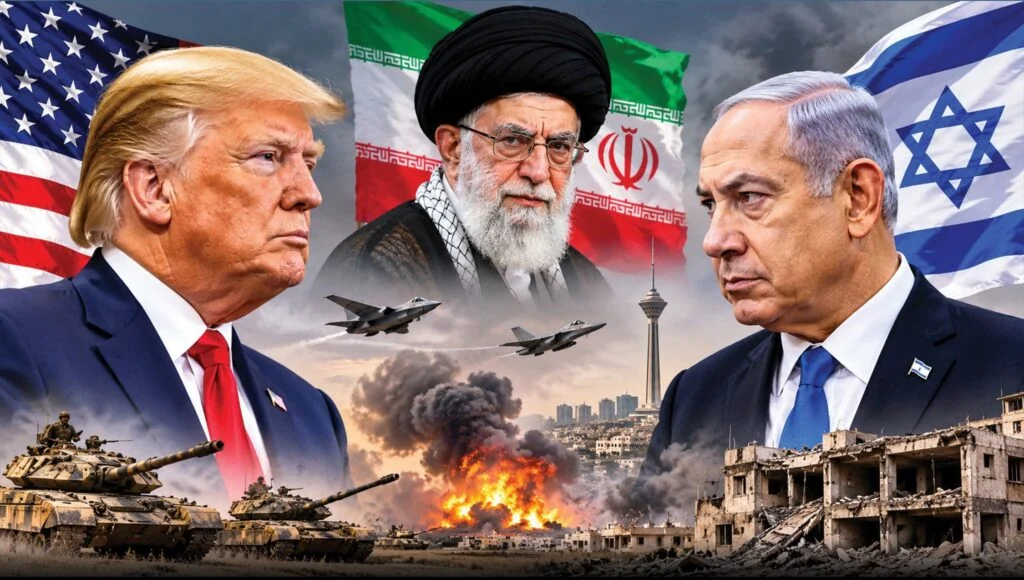
The Middle East is approaching another critical juncture, but the prospects for peace remain uncertain. Political instability, military confrontation and diplomatic manoeuvring are converging at a dangerous moment. Benjamin Netanyahu has emerged from Israel’s Oct.28 election without a parliamentary majority, while Donald Trump faces mounting domestic and international pressure over a war that has failed to deliver a decisive outcome. Iran, despite months of military and economic pressure, has refused to accept Washington’s terms, while keeping the door to negotiations open.
The danger was underscored by US strikes on Iranian targets on Qeshm Island, near the Strait of Hormuz. Trump described the operation as a limited strike on an Iranian anti-aircraft facility. Coming amid Qatar-led negotiations, the strikes exposed the contradiction at the heart of Washington’s approach: pursuing diplomacy while keeping military escalation firmly on the table.
Meanwhile, Palestinians remain trapped in a conflict in which their rights and political future are repeatedly subordinated to the calculations of powerful governments. Israeli attacks have continued despite the Gaza ceasefire, while Palestinian communities in the occupied West Bank face escalating settler violence, land seizures and inadequate protection from Israeli authorities.
What is unfolding is more than a contest between political leaders. It is a test of whether military superiority can compel political submission, whether leaders can evade accountability by keeping societies mobilised around permanent threats, and whether international institutions retain the authority to restrain powerful states.
Netanyahu: A Victory That Looks Increasingly Like Defeat
Israel’s Oct.28 election has left Netanyahu politically weakened, though not defeated. His bloc secured 53 seats in the 120-member Knesset, against 48 for the opposition led by Gadi Eisenkot, while Arab-led parties won 19. Neither side has the 61 seats required for a majority.
The opposition has agreed to recommend Eisenkot to President Isaac Herzog as its candidate to form a government. Its prospects may depend on support from Arab-led parties, although some opposition leaders remain reluctant to cooperate with them. A unity government, prolonged negotiations or another election remain possible.
The election aftermath has also exposed a troubling feature of Israeli politics. Netanyahu and Likud alleged voter fraud and foreign interference involving Arab parties but offered no substantiated evidence of systematic electoral wrongdoing. Israel’s Central Election Committee rejected claims that the integrity of the vote had been compromised, while Qatar denied allegations of interference. Such accusations risk delegitimising the democratic participation of Palestinian citizens of Israel.
Netanyahu’s loss of a parliamentary majority does not necessarily signify a rejection of his ideology by Israeli voters. Nevertheless, it exposes the fragility of a political strategy built around permanent security mobilisation. The October 2023 Hamas attack and the subsequent war in Gaza have brought immense humanitarian devastation, international condemnation and mounting legal scrutiny.
In its Oct.26 report, the UN Independent International Commission of Inquiry found Israel responsible for war crimes and crimes against humanity in the occupied Palestinian territory and characterised the situation in Gaza as continuing genocide. Israel has rejected these findings. They are significant investigative conclusions, not final judicial determinations. Netanyahu’s political difficulties are compounded by his ongoing corruption trial and scrutiny of the security failures preceding the October 2023 attack.
His departure, however, would not automatically transform Israeli policy towards Palestinians. The larger question is whether Israel can move away from a political culture that equates military domination with security and treats the denial of another people’s rights as an instrument of national policy.
Trump: The Limits of Power Without Political Exit
For Donald Trump, the Iran conflict has become a test of political credibility. His administration entered the confrontation alongside Israel, apparently expecting overwhelming military pressure to force Tehran into submission. Eight months later, there is still no comprehensive settlement.
The domestic costs have mounted. A Reuters/Ipsos poll published on Oct.26 put Trump’s approval rating at 32 per cent, while registered voters favoured Democrats over Republicans by 47 to 36 per cent on the generic congressional ballot. The US midterm elections took place on Nov. 3, although the final balance of power in Congress remained uncertain at the time of writing.
A politically weakened president is not necessarily a restrained one. Domestic pressure may encourage compromise, but it can also create incentives to project strength through military action. The US strikes on Qeshm demonstrate that the military option remains open even as negotiations continue.
Another complication concerns Trump’s relationship with Netanyahu. On Nov. 3, Trump announced that the United States would end approx. $4 billion in annual assistance to Israel after 2026, while continuing arms sales and other support. He presented this as an arrangement reached with Netanyahu. However, the existing US-Israel memorandum provides $3.8 billion annually in military assistance through September 2028, and no implementing agreement explaining an early termination has been published. The announcement therefore raises questions about the future of a relationship long regarded as strategically indispensable.
The Associated Press also reported that Netanyahu had urged Trump to authorise another extensive round of strikes against Iran after the midterm elections. Neither government officially confirmed the reported conversation, and Trump has not committed to such an operation.
The danger is that both leaders may increasingly view military action through the prism of political survival. When national interest becomes indistinguishable from personal prestige, the consequences can be catastrophic.
Iran: Neither Defeated Nor Victorious
Iran presents a difficult strategic calculation for Washington and Tel Aviv. Its military infrastructure has suffered, its economy faces immense pressure and its people are bearing the costs of prolonged confrontation. Yet Tehran has refused to accept the political outcome sought by its adversaries.
Its principal leverage lies in its ability to make continued warfare costly, particularly through the Strait of Hormuz, a vital artery of global energy supplies. The strikes on Qeshm demonstrate that confrontation can still escalate, even if neither side appears eager to return to full-scale war.
Diplomacy remains alive. Qatar has hosted consultations with Iranian officials and acted as the principal mediator between Tehran and Washington. Proposals under discussion include reopening Hormuz, ending the US blockade of Iranian ports, easing restrictions on Iranian oil exports and releasing frozen Iranian assets. Iran has indicated that it could reopen the Strait within two days of an agreement. Washington, however, wants the nuclear question addressed, while Tehran insists that economic and maritime restrictions must first be resolved. No agreement has been reached.
The disagreement reflects a deeper problem: neither side wants to negotiate from a position that appears to signify defeat. Iran’s most plausible objectives are regime survival, preservation of its deterrent capabilities and an agreement permitting economic recovery without appearing to capitulate. But the survival of the Iranian state should not be confused with the welfare or political aspirations of its people. Nor does resistance to external pressure absolve its government of responsibility for domestic repression and restrictions on political freedoms.
The conflict illustrates a fundamental distinction: damaging an adversary’s military infrastructure is not the same as achieving a sustainable political settlement. Tactical gains cannot guarantee strategic success.
Palestine: The Question the World Cannot Afford to Forget
Perhaps the greatest injustice of the present geopolitical calculations is that Palestine continues to be treated as a secondary question.Netanyahu’s electoral setback may create an opportunity for a different diplomatic approach, but there is little basis for assuming that his replacement would automatically support Palestinian independence. Significant sections of Israel’s political establishment continue to reject Palestinian statehood.
The UN Commission of Inquiry’s findings deserve serious international attention. Its report documents grave violations in Gaza and the West Bank and raises fundamental questions about international law and accountability.
Developments in recent days underline the urgency. Israeli strikes killed Palestinians in Gaza on Nov. 1, 2 and 3, according to hospital officials and Palestinian authorities. Israel said it was targeting militants; the civilian toll and circumstances of individual attacks require independent scrutiny. The ceasefire has not ended military violence or the humanitarian emergency. The World Food Programme has reduced food assistance, leaving approximately 500,000 people without the support they previously received. Sanitation and essential services are also deteriorating.
In the West Bank, an Israeli military operation in Hebron ended on Nov.2 after ten days. The UN reported that more than 3,000 Palestinians had been displaced. Meanwhile, Reuters reported that around 30 former senior Israeli military officials, including six generals, joined Palestinian farmers harvesting olives near Qusra in response to escalating settler violence. Their presence alongside Palestinian farmers reflects concern within Israeli society itself.
The world cannot consistently condemn territorial aggression in one region while treating occupation and the denial of self-determination elsewhere as an inconvenient diplomatic complication. Palestinian civilians must not be reduced to statistics or bargaining instruments. Israeli civilians, too, have the right to live without attacks, hostage-taking and fear. The security and freedom of one population cannot legitimately be built upon the permanent insecurity and subjugation of another.
The Widening Circle: Regional and Global Consequences
The conflict has extended well beyond its original boundaries. Gulf states are increasingly alarmed by threats to their energy infrastructure and maritime routes. Saudi Arabia faces a particular dilemma: it needs regional stability, yet its economic and security interests remain exposed.
Qatar has emerged as the principal mediator, while Pakistan, Türkiye and Saudi Arabia have also engaged Tehran diplomatically. China has announced plans to send a special envoy to Iran, Oman and Saudi Arabia, seeking regional stability and protecting its energy interests. These developments suggest that regional powers are increasingly reluctant to leave the Middle East’s future entirely to Washington and Tel Aviv.
Russia could benefit from higher oil prices and America’s strategic distraction, although prolonged instability also carries risks for Moscow. Europe faces rising energy costs, inflationary pressures and deeper divisions over its relations with Washington and Israel.
The crisis is also spreading into Yemen, where renewed fighting has displaced hundreds of thousands. The UN has warned that more than 13,000 pregnant women in Taiz lack essential healthcare. The possibility of attacks on Saudi infrastructure and Red Sea shipping adds another dangerous dimension.
Oil, Hormuz and Economic Punishment of Ordinary People
The economic costs are increasingly visible. Brent crude, which approached $118 per barrel on Oct. 30, fell to approx. $103 by the morning of Nov. 4 as markets responded to hopes of a diplomatic breakthrough. But the decline should not be mistaken for a resolution. Gulf exports remained substantially below pre-war levels in October, while shipping risks and depleted inventories continued to threaten supplies.
An LNG carrier operated by Qatar’s Nakilat was struck by unidentified objects on Oct. 30. On Nov. 2, the Indian-flagged vessel MSV AL JUSUFI was hit by an unidentified aerial object near Oman. One Indian seafarer died and 13 others were rescued. Responsibility for these incidents has not been established.
India is particularly exposed. A substantial share of its crude imports passes through Hormuz, while Qatar is a major LNG supplier. Petronet LNG has disclosed that between 75 and 80 Qatari cargoes have been delayed because of the conflict. Prolonged disruption could widen India’s trade deficit, weaken the rupee, increase transport and manufacturing costs and fuel inflation. Households would ultimately bear the burden through higher prices of fuel, food and other essentials.
For poorer Asian and African economies, already struggling with debt, currency instability and food insecurity, the consequences could be even harsher. This is the cruel economics of war: decisions made in military headquarters and political offices are paid for by ordinary people who have little control over them.
The World Needs Accountable Leadership, Not Stronger Strongmen
The coming months could bring negotiated de-escalation, prolonged confrontation without a decisive victor or a wider regional war. Qatar’s mediation may produce a phased agreement on maritime access, sanctions and nuclear negotiations. Alternatively, Washington and Tehran may continue negotiating while sustaining military and economic pressure. A collapse of diplomacy, followed by further attacks on shipping or energy infrastructure, could draw more countries into the conflict.
None of these outcomes is inevitable. But the risks are heightened when leaders face domestic political pressures and begin to equate compromise with weakness.
The deeper lesson of the political difficulties facing Netanyahu and Trump is how personalised power can undermine democratic accountability. When leaders equate their political survival with national interest, dissent becomes disloyalty, independent institutions become obstacles and military force becomes proof of strength. This danger is not confined to any one ideology or political system. Iran’s government is no exception. No leader should be above scrutiny, and no state should enjoy immunity from international law because of its military might or strategic importance.
The fate of millions must not be held hostage to the ambitions of political leaders. A Palestinian child in Gaza, an Iranian family struggling under economic hardship, an Israeli civilian fearing attacks and an Indian seafarer exposed to danger share one fundamental reality: ordinary people pay for decisions over which they have little influence.
History will judge leaders not merely by territories conquered or enemies defeated, but by lives protected, injustices ended and opportunities for peace seized. True strength lies not in the ability to wage war indefinitely, but in the wisdom and courage to prevent war from becoming humanity’s permanent condition.