

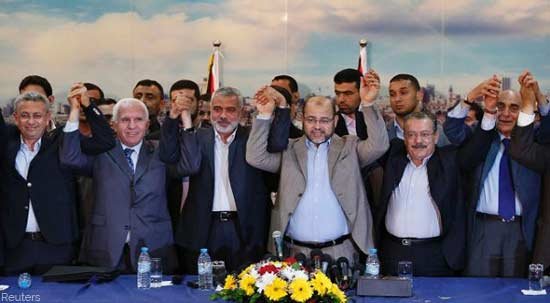
Hamas and Fatah on 24 April signed an agreement that aims to end years of division between the two factions. The deal calls for the formation of a national unity government to pave the way for presidential and parliamentary polls. This historic decision has been greeted by mixed reactions.
Turkish Prime Minister Recep Tayyip Erdogan told Khaled Mashaal, Hamas political bureau chief, on 24 April that he welcomed the reconciliation deal between the two rival Palestinian factions Hamas and Fatah.
Mashaal called Erdogan and informed him about the deal with Fatah, according to the Turkish Prime Ministry. Erdogan reportedly told Mashaal that Turkey gives a great importance to the compromise among Palestinian groups and the national unity of Palestinians.
Meanwhile, Salim al-Zanoon, speaker of the Palestinian National Council, said that he had invited representatives from Palestinian resistance faction Hamas to attend a council meeting in Ramallah on Saturday and Sunday.
It is the first time for Hamas, which rules the Gaza Strip, to be invited to such a meeting since tensions emerged between it and Fatah, which rules the occupied West Bank, in 2007. “We hope Hamas can send representatives to next month’s council meeting if it fails to send representatives to this month’s meeting,” al-Zanoon told Anadolu Agency.
Relations between Fatah and Hamas had been tense since the latter seized control of the Gaza Strip following deadly clashes with pro-Fatah forces in 2007 – one year after Hamas defeated Fatah in Palestinian legislative polls. Al-Zanoon said Hamas would be allotted with 15 seats in the Palestinian National Council, the legislative body of the Palestine Liberation Organisation.
Discussions at the upcoming council meeting are expected to cover a range of issues, including ongoing peace talks with Israel and healing inter-Palestinian rifts.
The Arab League on 24 April said that it backs Palestinian President Mahmoud Abbas in the face of Israeli pressures following the signing of a reconciliation deal with the Palestinian resistance movement Hamas.
“This achievement [the agreement] will boost the Palestinian unity in the face of the serious challenges that face the Palestinian cause at this critical juncture,” the statement quoted al-Arabi as telling Abbas in the conversation.
Secretary-General of the Gulf Cooperation Council (GCC) Abdullatif al-Zayani also welcomed the reconciliation deal hammered out in the Gaza Strip by Fatah and Hamas, the two main Palestinian factions. “I am confident that ending rifts between the Palestinians will be a step in the right direction,” al-Zayani said.
However, Israel’s security cabinet on 24 April unanimously decided to suspend peace talks with the Palestinians in response to the deal. “The government decided that Israel will not negotiate with a Palestinian government backed by Hamas,” Ofir Gendleman, a spokesman for Israeli Prime Minister Benjamin Netanyahu, wrote on Twitter.
The United States has threatened to reconsider its assistance to the Palestinians if Hamas and the Palestinian Liberation Organisation form a government together, a senior U.S. administration official said on 24 April.