

SYYED MANSOOR AGHA analyses the acquittals of 12 Muslim youth within a week, following long ordeal in jails, in three separate cases.
Just like many other terror cases slapped on educated Muslim youth and collapsed during trial, three more cases saw their dismissals in one week, resulting in acquittals of 12 persons after long ordeal in jails. A Kurla court of Mumbai acquitted eight persons arrested in 2001, three arrested in Gujarat eight years ago and a Hyderabad court set aside the case against one Ziaul Haq after four years. One more case in Aurangabad court is expected to meet the same fate. Several witnesses deposed in the court against the prosecution story and strengthened the doubt that the accused had been falsely implicated.
Some elements have been working in India since pre-Independence days to isolate the Muslim community from the rest and consolidate the majority, in spite of their inherent contradictions and historical clashes in social life. In the absence of positive ground, a negative approach has been invented. To incite hatred and create false fears against minorities, mainly Muslims, seems to be their motto.
In the beginning, the strategy was to create communal tensions and clashes by spreading rumours. It is still being used as a political tool to polarise voters. In the wake of the terror bogey created by the USA, European countries and Zionist forces, to revive the evil spirit of crusades against Islam, Zionist minded strategists in India also did the same by implicating Muslim youth in fake terror cases to malign the Muslim community. In this case we do not differentiate between those who express their allegiance to “secularism” and those who oppose it. Thanks to our judicial system, large numbers of such cases have fallen flat and the accused persons now stand absolved though only after their futures were ruined and families devastated. Radiance has reported several such cases in the past. Now here is the story of eight youth arrested in Maharashtra, three in Gujarat, and one in erstwhile Andhra Pradesh.
8 ABSOLVED IN KURLA
Eight Muslim young men were arrested in Kurla on 27 September, 2001, the day the then NDA Government banned Students Islamic Movement (SIMI) for alleged involvement in terror activities. Defence counsel Sharif Sheikh told media, “Mumbai police had begun a crackdown throughout the city against SIMI on September 27, 2001, the day it was banned by the Centre under the Unlawful Activities Prevention Act (UAPA). Police raided an office in Kurla and claimed to have found some literature, photo of Osama bin Laden besides other material.
“However, the court granted bail to all the accused as the copy of the notification in the official gazette had not reached the state home department on the day of ban.”
The eight accused, immediately after being granted bail in the case, were never set free but shown arrested next day with fresh accusation of “shouting slogans against the country and Mumbai police.” The accused stated in the court, “The police, instead of releasing us, took us back to the police station and prepared a false case against us.”
The case was based on two FIRs – one for giving provocative speeches and the other for distributing pamphlets outside a mosque in suburban Mumbai. To prove the story, the police produced eight witnesses, three from public and five from police officers. The defence led by Advocate Sharif Sheikh and his assistant Adv. Ansar Tamboli argued that the accused were students and weren’t even aware of the ban. “According to law, a notification regarding the ban has to be issued, a copy of which is put up either at the head office or at a branch of banned organisation. But these people were allegedly arrested on the day the ban was announced, without any of the criteria being fulfilled.”
Many articles purportedly recovered from the accused were not even sealed with properly signed by police officers and the witnesses. The police also could not produce any document that proved that they were “members of SIMI”. The officers who testified only said the accused were sitting in the room, but could not elaborate what was being discussed.
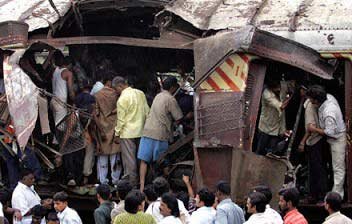
According to the charge sheet, SIMI was “responsible” for the 2006 Mumbai local train blast that killed 188 people and injured over 800. The case is still pending in the court; therefore, it cannot be conclusively deduced whether or not the police allegation against SIMI has any substance. The judgment is expected only next month.
In the slogan-shouting case, the police produced only policemen as witnesses while no advocates or litigants were brought as witnesses. The court acquitted all the eight persons in both the cases.
The metropolitan magistrate Ashish Ayachit observed in his judgment delivered on 20 November, “Due to lack of evidence the court extends to them benefit of doubt.” The judge also said that “the prosecution could not prove that the accused tried to incite any unlawful activity.”
Those acquitted by the Kurla court include Ehtesham Siddiqui and Tanvir Ahmed Ansari, who are also facing a trial in the July 2006 Mumbai train blast case. The eight accused were booked under Section 13 (punishment for unlawful activities) and Section 14 (offences to be cognisable) of the Unlawful Activities (Prevention) Act, 1967.
Narrating the “gravity” of the offence, the Police Officer, who had led the operation, told the court that he was informed about the group’s headquarters in Kurla. “The office in a house near Fitwala Compound had board of SIMI with a map of earth along with the inscription, “We be the helpers of Allah”. In the room, I saw the eight of them (the accused). One among them named, Irshad Khan (41), a civil engineer, claimed to be the group’s president.”
The prosecution alleged that the eight accused possessed pamphlets stating, ‘how to join SIMI’, a jihadi book, a poster of Osama Bin Laden and other incriminating materials.
The flaw in the statement may be imagined as SIMI membership is limited up to the age of 30 and no person above that age may be a Member. No person of 41 years old could ever be its President. Ironically, as The Indian Express reported, amongst the “middle aged” persons picked by the police most of them were either civil engineers or businessmen based in Thane.
ATS had used this case against one of the accused to invoke MCOC Act in Mumbai 7/11 train serial blast case. On the basis of this acquittal, Tamboli said that “the defence would again argue before the MCOCA court that a false case was used to implicate innocent men in the MCOCA case.” This is bound to weaken the ATS side in the train blast case.
AHMEDABAD BLAST CASE
On the same day an Ahmedabad metropolitan court discharged the three accused – Afroz Pathan (33), Bilal Ahmed alias Bilal Katib (32) and Mustafa Sayyed (30) – for their alleged involvement in the conspiracy of February 19, 2006 Gujarat’s Kalupur Railway Station blast, in which 10 persons were injured. Earlier in 2013, two other Muslim youth were similarly acquitted in separate blast related cases as the ATS could not provide evidence against them.
Defence Advocate Shahid Nadeem said that the trio came to know about their “involvement in the Ahmedabad case” two years ago while they were in jail since May 2006 for their alleged role in the arms haul case of Aurangabad.
After hearing of the case, the accused had to file RTI applications before the Ahmedabad police, seeking information about the case but were refused to share information on the pretext that the “probe was on and they could not share the information”.
In Ahmedabad, they hired advocate D D Pathan, who got all the documents legally. They were first taken to the Ahmedabad court as arrested accused on June 12, 2014. Failing to find any evidence to show their involvement in the blast case, the Gujarat ATS filed an application to discharge all three persons and filed a report under Section 169 of CrPC.
Earlier, on December 12, 2013, Additional Sessions Judge B S Upadhyay had acquitted Mohammad Iliyas Abdul Memon, a resident of Paldi in Ahmedabad, and Kamlesh Bhagora, a constable of GRPF – in the same case for want of evidence against them.
The trio was arrested for criminal conspiracy, waging war against the nation and having association with SIMI, supporting a terror outfit, etc. Four other arms haul case accused – Shakeel Aamir, Akhef Biyabani, Aslam Kashmiri and Sayyez Zabihuddin alias Abu Jundal are facing trial in Gujarat also. Jundal is a prime suspect in the 26/11 serial train blast cases in Mumbai and had been described as “handler” of the Pakistani terrorists who killed 166 people in Mumbai on November 26, 2008.
ODEON THEATRE BLAST CASE
In Hyderabad, a court acquitted a young person Zia Ul Haq, who was arrested in 2010 in connection with the 2006 Odeon theatre blast for want of credible evidence against the accused arrested by Hyderabad Police and NIA. First Additional Metropolitan Sessions Judge on 25 November set aside the prosecution case and ordered to set Haq free.
The NIA, in its charge sheet, had alleged that Haq was an operative of a banned outfit SIMI and had further plans of waging war against the country. A crude explosion had taken place at the Odeon theatre at night in May 2006 in which two people were injured.
The allegations were proved wrong in the court, but not before the youth and his family – residents of Eidi Bazaar area – suffered for four years.
[The writer is Gen. Sec, Forum for Civil Rights; syyedagha@hotmail.com]