

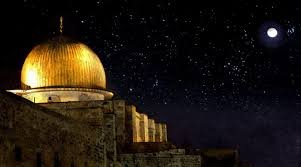
SAMEEN AHMED KHAN dwells upon the two most important events in the life of Prophet Muhammad (peace and blessings of Allah be to him) – the Israa (Night Journey) and Miraaj (Ascension) – in the light of the Qur’ān and ahadith, and warns the believers against committing bidah of celebrating it.
The life of the Holy Prophet Muhammad (peace and blessings of Allah be to him) was marked with many events. Two of the most remarkable events were the Israa (Night Journey) and Miraaj (Ascension). Israa refers to how one night Allah Almighty took Prophet Muhammad from the Ka’bah (in Makkah Mukarramah) to Bait Al-Maqdis (the Sacred Mosque) in Jerusalem. See the following Ayah (verse) from the Holy Qur’ān:
Limitless in His glory is He who transported His servant by night from the Inviolable House of Worship [at Makkah] to the Remote House of Worship [at Jerusalem] – the environs of which We had blessed – so that We might show him some of Our symbols: for, verily, He alone is all-hearing, all-seeing. [Surah Israa (Bani Israil), 17:1]
The exact date of Israa and Miraaj are not known. Even the exact year is not known. Some sources place it in the first year, or the fifth year or the tenth year, or the twelfth year or the thirteenth year of the prophethood, with varying months and dates. Had the date been of any importance, it would have been prescribed in the Shari’ah or documented by the rightly guided Caliphs and the Sahabah (may Allah be pleased with them all).
The incident of the Prophet’s journey is very instructive. Before the Prophet took this night journey, the ceiling of the house in which he was staying was opened, and Jibreel (the Archangel Gabriel) descended. Jibreel cut open the chest of Prophet Muhammad and washed that open area with Zamzam water. Then he emptied something from a container into the chest of the Prophet to increase his wisdom as well as the strength of his belief. This was done to prepare the Messenger of Allah Almighty.
Jibreel had brought with him a white animal, called “buraq”, one of the animals of the Jannat (Paradise). Buraq is slightly larger than a donkey and smaller than a mule. The buraq is a very fast animal; the length of the buraq’s stride is the farthest distance its eye can see. Jibreel held the buraq by his ear and told the Prophet to mount it. The Prophet Muhammad and Jibreel rode the buraq to the Sacred Mosque in Jerusalem. Once there, the Prophet tethered the animal outside the mosque where earlier prophets had tied their mounts. Then the Prophet entered the mosque. In the mosque he found the grand assembly of all the prophets from Adam to Isa (peace be to them all). Jibreel asked Prophet Muhammad to lead the Salaat (prayer). The Prophet Muhammad offered two Rakah of Salaat as Imam of all the messengers assembled there. Hence, he is also called as Imam-al-Ambiya.
Jibreel brought two vessels to the Prophet Muhammad (PBUH), one filled with wine, the other with milk. The Prophet chose the second vessel. Jibreel commented on the Prophet’s choice:
“You chose milk in accordance with the purity of your nature. Hence you have received guidance and your followers have too. Had you chosen wine, your followers would have been astray.” [Sahih Bukhari, Book #55 (Prophets), Hadith #607]
The Prophet was then taken to the first level of heaven, which was the first stage of his Ascension. Jibreel asked for the door to be opened for the Prophet, and there stood Adam the first man and prophet. Adam said, “Peace be to you,” to which the Prophet responded, “And to you be peace.” Adam then testified that Muhammad was the Prophet of Allah. Adam looked to his right and smiled, and then looked to his left and wept. The Prophet saw two groups of people on either side of Adam, and the ones he smiled at were the believers, while the ones that caused him to weep were unbelievers.
The Prophet was then escorted to the second level of heaven. Jibreel asked for the door to be opened, and there the Prophet saw two cousins, the prophets Yahya bin Zakariya (John, son of Zechariah) and Isa bin Maryam (Jesus, son of Mary). The Prophet greeted them and they returned the greeting, and then they testified that Muhammad was Allah’s Prophet. On the third level of heaven, the Prophet met Yusuf (Joseph). After an exchange of greetings, Yusuf also testified that Muhammad was Allah’s Prophet. On the fourth level the Prophet met Idrees (Enoch). Both the prophets exchanged greetings, and Idrees testified that Muhammad was the Prophet of Allah. On the fifth level of heaven the Prophet met Haroon (Aaron), who, like all the previous prophets, exchanged greetings and testified that Muhammad was Allah’s Prophet.
On the sixth level of heaven the Prophet met Musa (Moses). After greeting the Prophet and testifying that Muhammad was indeed a Prophet, Musa began to weep. When Musa was asked why he was weeping, he said: “The reason for my tears is that a youth was commissioned as prophet after me, but his followers will enter heaven in greater numbers than mine.”
On the seventh level of heaven, the Prophet met Ibraheem (Abraham) resting against Bait Al-Ma’mur, a celestial house of worship which seventy thousand different angels circumambulate every day. The Prophet Ibraheem returned the greeting of his descendant and testified that Muhammad was the Prophet of Allah. At this point, the Prophet Muhammad was then led up to Sidrat Al-Muntaha, a tree of Paradise. Its leaves were the size of an elephant’s ears, and its fruits the size of small pitchers. It was covered by golden moths, and no words can describe its beauty.
The Prophet Muhammad was then brought before Allah the Almighty. Since no human eyes could take in the majesty of Allah, the Prophet could not actually look upon Allah, but he stood in close proximity to Him. Allah informed the Prophet that it was now obligatory for his followers to perform Salaat fifty times a day. The Prophet was then led away by Jibreel. Musa, however, halted the Prophet and asked him what Allah had commanded. “Fifty prayers a day,” the Prophet said. Musa advised: “Your followers are not strong enough. Go back to your Lord and ask Him to make it lighter.” The Prophet looked at Jibreel who said, “You may do so if you so desire.”
The Prophet returned to Allah and did as he had been advised. Allah reduced the obligatory number of prayers from fifty to ten. Again the Prophet was led away and once again Musa stopped him. Upon hearing that the number had been reduced to ten, he advised the Prophet to ask for another reduction. Allah reduced the number to five. When Musa learned of this, he again advised the Prophet to ask Allah to reduce the number. Musa said: “The Children of Israel were asked to do less, but still they were unable to carry out their duties.” The Prophet did not intend to return another time. “I feel ashamed before my Lord,” he said. A voice then announced:
“I have enforced My obligation and made it light for My servants. He who prays these five prayers will be rewarded as if he had prayed fifty. What I decree cannot be changed.”
During the Miraaj the Holy Prophet was shown certain signs of the heaven and hell.
The Prophet returned to Makkah before dawn, and the next morning he told the people about his miraculous journey and ascension to heaven. The Makkan pagans, of course, scoffed at his claim. Some ran to Abu Bakr and told him, thinking that it would shake his faith in the Prophet. Abu Bakr remarked: “If the Prophet said so it must be true.” Abu Bakr later justified his remark which is an inspiration to generations of Muslims till the Day of Judgment. Since he had believed the Prophet was indeed a prophet, one to whom an angel brought revelations from Allah, Lord of the worlds, why should he not also believe the Prophet’s account of his travel through space and time? From that day onward, Abu Bakr was called ‘Siddeeq’ one who believes.
The pagan Makkans tried another idea. They quizzed Prophet Muhammad in detail about the journey to the Sacred Mosque in Jerusalem. Allah revealed the looks of the mosque in Jerusalem and then the Prophet described everything in detail, and no one could fault his description. Additionally, the Prophet told the Makkans about a caravan traveling from Jerusalem to Makkah, mentioning the number of camels, their condition, and the time that they would arrive in Makkah. The caravan from Jerusalem appeared exactly when the Holy Prophet said it would, and everyone saw that his description was accurate. But the pagans remained fettered to their disbelief. The description of the Israa and the Miraaj was a test for both the believers and the nonbelievers.
That same morning Jibreel descended and taught Prophet Muhammad how to perform the five daily Salaat. Following Jibreel’s visit, the Muslims began praying five times each day instead of praying morning and evening.
The Holy Prophet (peace and blessings of Allah be to him) was given three things during the Miraaj [Sahih Muslim, Book #1 (Kitab Al-Iman, The Book of Faith), Hadith #329]:
1. Five daily Salaat (prayers) equal to the reward of fifty daily Salaat.
2. Revelation of the last two Ayat (verses) of Surah Al Baqarah:
“The Apostle, and the believers with him, believe in what has been bestowed upon him from on high by his Sustainer: they all believe in Allah, and His angels, and His revelations, and His apostles, making no distinction between any of His apostles; and they say: We have heard, and we pay heed. Grant us Thy forgiveness, O our Sustainer, for with Thee is all journeys’ end! [Surah Baqara (The Cow), 2:285]
“Allah does not burden any human being with more than he is well able to bear: in his favour shall be whatever good he does, and against him whatever evil he does.
“O our Sustainer! Take us not to task if we forget or unwittingly do wrong!
“O our Sustainer! Lay not upon us a burden such as Thou didst lay upon those who lived before us! O our Sustainer! Make us not bear burdens which we have no strength to bear!
“And efface Thou our sins, and grant us forgiveness, and bestow Thy mercy upon us! Thou art our Lord Supreme: succour us, then, against people who deny the truth!” [Surah Baqara, 2:286]
3. Remission of serious sins for those among his Ummah who associate not anything with Allah.
The first thing points to the significance of the daily five Salaat. The second thing has to do with the tenets of Iman (faith). In the third point, there is the Promise of Allah that the sins of the people from the ummah of Prophet Muhammad would be forgiven except those who died associating partners with Allah. It means that the believers will not suffer eternal punishment on account of their serious sins, but will instead be pardoned either through taubah (sincere repentance) and istighfaar (seeking the forgiveness of Allah), or after first being punished for their sins. The mushriks (those who assign partners to Allah) will suffer eternal punishment. The third point mentioned above has to do with tauheed (oneness of Allah) and Iman (faith), needs to be understood in precise detail. The very basics of tauheed need to be understood, believed and importantly practised as prescribed in the Shari’ah. One may be forgiven or punished for the non-shirk sins; but the ones doing shirk there is the internal fire of hell.
May Allah Guide us to do Salaat regularly and save us from the grave sins of shirk, Amen.
We have seen a concise description of the Israa and Miraaj. The Holy Prophet was shown certain signs of the heaven (jannah) and hell (jahannum), which can be read in the Hadith. We have to overcome the misconceptions about the miracle of Israa and Miraaj. First, the Israa and Miraaj was physical with body (not spiritual; and not in a dream). The other misconception has to do with seeing Allah Almighty. It is clearly evident from the Quran and Hadith that the Holy Prophet did not see Allah Almighty. We quote a few Hadith:
1. Narrated by Hazrat Aisha: Whoever claimed that (the Prophet) Muhammad saw his Lord, is committing a great fault, for he only saw Jibreel in his genuine shape in which he was created covering the whole horizon.
[Sahih Bukhari, Book #54 (Beginning of Creation), Hadith #457]
2. Narrated Masruq: I said to ‘Aisha, “O Mother! Did Prophet Muhammad see his Lord?” Aisha said, “What you have said makes my hair stand on end! Know that if somebody tells you one of the following three things, he is a liar:
a. “Whoever tells you that Muhammad saw his Lord, is a liar.” Then Aisha recited the Ayat: ‘
No human vision can encompass Him, whereas He encompasses all human vision: for He alone is unfathomable, all-aware. [Surah Al-An’am (The Cattle), 6:103]
And it is not given to mortal man that Allah should speak unto him otherwise than through sudden inspiration, or [by a voice, as it were,] from behind a veil, or by sending an apostle to reveal, by His leave, whatever He wills [to reveal]: for, verily, He is exalted, wise. [Surah Al-Shura (The Consultation), 42:51]
b. Aisha further said, “And whoever tells you that the Prophet knows what is going to happen tomorrow, is a liar.” She then recited:
Verily, with Allah alone rests the knowledge of when the Last Hour will come: and He [it is who] sends down rain; and He [alone] knows what is in the wombs: whereas no one knows what he will reap tomorrow, and no one knows in what land he will die, Verily. Allah [alone] is all-knowing, all-aware. [Surah Luqman (The Wise), 31:34]
She added: “And whoever tells you that he concealed (some of Allah’s orders), is a liar.” Then she recited:
O Apostle! Announce all that has been bestowed from on high upon thee by thy Sustainer: for unless thou doest it fully, thou wilt not have delivered His message [at all]. And Allah will protect thee from [unbelieving] men: behold, Allah does not guide people who refuse to acknowledge the truth. [Surah Al-Ma’idah (The Table Spread), 5:67]
c. Aisha added. “But the Prophet saw Jibreel in his true form twice.” [Sahih Bukhari, Book #60 (Prophetic Commentary on the Quran), Hadith #378]
3. It is narrated on the authority of Abu Dharr: I asked the Messenger of Allah (may peace be to him): Did you see thy Lord? He said: He is a Light; how could I see Him? [Sahih Muslim, Book #1 (The Book of Faith or Kitab Al-Iman), Hadith #0341]
In the light of the above Ayat and Hadith, we have to be conscious that the Holy Prophet did not see Allah, did not have the knowledge of the unseen and did not hide the revelation of Allah. These are the worst accusations against our beloved Prophet.
The Ayat 7-18 in the Surah Najm (The Star) are also related to the Miraaj:
4. (7) appearing in the horizon’s loftiest part, (8) and then drew near, and came close, (9) until he was but two bow-lengths away, or even nearer. (10) And thus did [Allah] reveal unto His servant whatever He deemed right to reveal. (11) The [servant’s] heart did not give the lie to what he saw: (12) will you, then, contend with him as to what he saw? (13) And, indeed, he saw him a second time (14) by the lote-tree of the farthest limit, (15) near unto the garden of promise. (16) with the lote-tree veiled in a veil of nameless splendour. (17) [And withal,] the eye did not waver, nor yet did it stray: (18) truly did he see some of the most profound of his Sustainer’s symbols. [Surah Najm (The Star), 53:7-18]
Narrated Masruq: I asked Aisha What about His Statement: “Then he (Jibreel) approached And came closer, And was at a distance of but two bow-lengths or (even) nearer?” (Ayat 53:8-9) She replied, “It was Jibreel who used to come to the Prophet in the figure of a man, but on that occasion, he came in his actual and real figure and (he was so huge) that he covered the whole horizon.” [Sahih Bukhari, Book #54 (Beginning of Creation), Hadith #458]
In the above Ayat and the supporting Hadith it is evident that the Holy Prophet saw Jibreel and not Allah Almighty.
There is no authentic date of Israa and Miraaj. Even if the date is proven, it is not permissible to celebrate it in any form. The reason is simple and straightforward: the Prophet and his Sahabah (companions) did not celebrate it. If celebrating it was something that is prescribed in the religion of Islam, the Prophet would have told his ummah about that, either in word or in deed. If any such thing had happened, it would have been well known, and his companions would have transmitted the information to us. They narrated from their Prophet (peace and blessings of Allah be to him) everything that his ummah needs to know, and they did not neglect any aspect of the religion, rather they were the first ones to do anything good. If celebrating this night had been prescribed in Islam, they would have been the first people to do so. The Prophet was the most sincere of people, and he conveyed the message to the people in full, and he fulfilled the trust. If venerating and celebrating this night were part of the religion of Allah, then the Prophet would have done that and would not have concealed it. Since no such thing happened, it is known that celebrating it and venerating it is not part of Islam at all. Allah has perfected this ummah’s religion for it and has completed His favour upon them, and He condemns those who introduce things into the religion which Allah has not ordained. Allah says in the Holy Quran:
1. Today have I perfected your religious law for you, and have bestowed upon you the full measure of My blessings, and willed that self-surrender unto Me shall be your religion. [portion of Surah Al-Ma’idah (The Repast or The Table Spread), 5:3]
2. Is it that they [who care for no more than this world] believe in forces supposed to have a share in Allah’s divinity, which enjoin upon them as a moral law something that Allah has never allowed? Now were it not for [Allah’s] decree on the final judgment, all would indeed have been decided between them [in this world]: but, verily, grievous suffering awaits the evildoers [in the life to come]. [Surah Al-Shura (The Consultation), 42:21]
In the saheeh ahaadeeth it is proven that the Messenger of Allah warned against bidah (innovation) and stated clearly that it is misguidance, so as to show the ummah how serious the matter is and put them off it.
3. Jabir b. Abdullah said: When Allah’s Messenger delivered the sermon he would say: “The best of the speech is embodied in the Book of Allah, and the best of the guidance is the guidance given by Muhammad. And the most evil affairs are their innovations; and every innovation is going astray.” [Sahih Muslim, Book #004 (Kitab Al-Salat or The Book of Prayers), Hadith #1885]
“And every going astray will be in the Fire.” [Al-Nasaa’i]
4. Narrated Abdullah: the Prophet said, “I am your predecessor at the Lake-Fount (Kauthar) and some men amongst you will be brought to me, and when I will try to hand them some water, they will be pulled away from me by force whereupon I will say, ‘O Lord, my companions!’ then the Almighty will say, ‘You do not know what they did after you left, they introduced new things into the religion after you.’ [Sahih Bukhari, Book #88 (Afflictions and the End of the World), Hadith #173]
We all should avoid and condemn such innovations called Shab-e-Miraaj (The Night of Journey with the assigned date 27 Rajab) and Shab-e-Baraat (practised on 15 Shabaan), as innovations would deprive one from the pond of Kauthar. The Prophet and his Sahabah, the Rightly Guided Caliphs; and Tabi’un (generation which saw the Sahabah and not the Prophet); Tabi’ al-Tabi’in (generation which saw the Tabi’un but not the Sahabah), may Allah’s blessings be to them all, never did any special prayers or rituals or any kind of such celebrations.
We ask Allah to help us all to understand His religion and adhere to it, to bless us all by making us follow the Sunnah, and to protect us from bidah, for He is the Most Kind and Generous. May Allah bless our Prophet Muhammad, and his family and companions.
[SAMEEN AHMED KHAN <rohelakhan@yahoo.com> teaches at Department of Mathematics and Sciences, College of Arts and Applied Sciences, Dhofar University, Salalah, Sultanate of Oman.]