

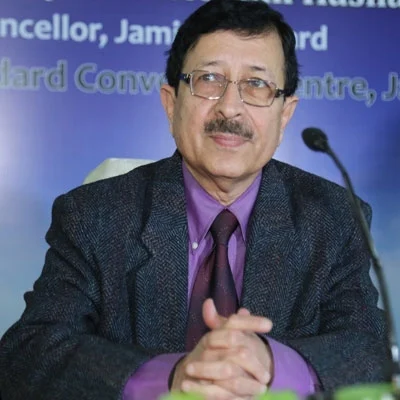
In an exclusive and wide-ranging interview with Mohd Naushad Khan, Professor Seyed Ehtesham Hasnain, one of India’s most distinguished scientists and academic administrators, provided a profound look into the evolution of molecular biology in the country. Prof. Hasnain, who has served as the Vice-Chancellor of both Jamia Hamdard and the University of Hyderabad, shared his journey from a young researcher to a global authority on DNA fingerprinting and tuberculosis.
The interview touched upon his pioneering role as the first Director of the Centre for DNA Fingerprinting and Diagnostics (CDFD) in Hyderabad, his revolutionary findings in tuberculosis research, and a critical, candid discussion on the health challenges and awareness gaps within the Muslim community.
Prof. Hasnain’s career is marked by a deliberate choice to build India’s scientific infrastructure rather than remaining abroad. After training in the United States and Canada, he returned to India with a vision to do something ‘very different’ that could be uniquely identified as Indian research. He credits much of his early success to the institutional support he received at the National Institute of Immunology under Directors Prof. G.P. Talwar and Prof. Sandeep Basu.
“My vision was that I should do something very different for which people can quote me and say this is his work and not the work that he did in the US or a foreign country,” Hasnain remarked, reflecting on the infrastructure and the ‘best minds’ that joined his lab as PhD and postdoc students.
As the founding Director of the CDFD, Prof. Hasnain was at the forefront of bringing DNA technology into the Indian mainstream. He noted that when the institute was first established by the Department of Biotechnology, the concept of DNA was virtually unknown to the public and the legal system.
To bridge this gap, an international meeting was organised in Hyderabad, inaugurated by the then-President Dr. A.P.J. Abdul Kalam. The event was attended by Supreme Court judges and legal luminaries who were introduced to the science of DNA typing. This education of the judiciary proved pivotal, as the CDFD soon became the primary centre for high-profile forensic cases.
Prof. Hasnain recounted several landmark instances where DNA evidence changed the course of justice. DNA fingerprinting was used to prove that a famous actor had indeed shot an endangered blackbuck, debunking his claim that he had shot a ‘bear while bored’.
Following the devastating tsunami in Tamil Nadu, the CDFD helped identify thousands of dead bodies, allowing families to give their loved ones burials consistent with their backgrounds.In a highly sensitive case, DNA testing was used to identify four individuals gunned down and buried as ‘foreign terrorists’. Initial tests were botched when a blood sample supposedly from a grieving mother turned out to be of male origin. A subsequent, carefully monitored test by the CDFD proved the deceased were actually local civilians, leading to significant political fallout and the resignation of high-ranking officials.
A significant portion of Prof. Hasnain’s research has been dedicated to tuberculosis, a disease he describes as being shrouded in misconception. He strongly challenged the notion that TB is exclusively a ‘poor man’s disease’.
While TB is prevalent among the economically disadvantaged due to poor nutrition and congested living conditions, notably in the tea gardens of Northeast India, Prof. Hasnain pointed out that the rich and famous are equally vulnerable. He noted that a ‘most powerful’ former Prime Minister and one of India’s ‘most successful’ actors were both cured of TB, highlighting that the primary difference lies in the completion of treatment.
“The rich and the famous go for the complete treatment,”Prof. Hasnain explained. “Poor, because of livelihood issues, stop after two or three months when they find they don’t have fever anymore”. This premature cessation of the four-antibiotic regimen is what leads to the rise of multi-drug-resistant (MDR) TB.
Prof. Hasnain’s lab was the first in India to use an automatic DNA sequencer for field studies on the TB bacterium. This led to two major breakthroughs that changed national health policy. His team discovered that testing for resistance to just one drug, Rifampicin, was a reliable proxy for multi-drug resistance, simplifying the diagnostic process significantly.
They found that the Indian strain of TB was different from Western strains. This led the government to ban ELISA-based testing, which frequently produced false positives or negatives because the tests were based on non-Indian antigens.
To address the cost of diagnosis, Prof. Hasnain’s team developed the C-TB machine, a low-cost diagnostic tool that functions like a fluorescent microscope but costs only a few thousand rupees and requires no specialised training or air conditioning.
In perhaps the most urgent part of the interview, Prof. Hasnain addressed the specific challenges of TB awareness within the Muslim community and other minority groups. He emphasised that the risk of transmission is particularly high during mass religious gatherings.
“Millions of people go for Hajj and TB is a disease close contact,”Prof. Hasnain warned. He explained that during Hajj or Umrah, pilgrims breathe the same air in extremely close proximity, making it easy for an infected person to spread the airborne bacteria to others. He noted that this risk is equally present during large Hindu festivals like the melas in Allahabad.
Prof. Hasnain pointed out a critical cultural factor in health outreach. “The community as such goes more by what the religious leaders tell.” He argued that to effectively combat TB within the Muslim community, it is essential to create awareness through these religious figures.
“We need to create an awareness,” he stated, suggesting that the way forward involves mobilising religious leadership to educate the community about the reality of TB, its treatment, and the necessity of completing the long-term antibiotic course to prevent drug resistance.
Looking ahead, Prof. Hasnain discussed the integration of Artificial Intelligence (AI) and CRISPR-Cas technology in medicine. He noted that we are entering an era where defects in DNA can be removed to cure diseases.
He also touched upon the concept of the “holobiont,” explaining that human gene expression is not just determined by the DNA from our parents, but also by the bacterial flora (microbiome) in our bodies. He used the example of South Indians eating curd rice (lactobacillus) after meals to reinforce ‘good bacterial load’, which helps the body adapt to different environments and nutritional needs.
Prof. Hasnain’s insights serve as a bridge between high-end genomic science and the lived realities of India’s diverse population. From identifying victims of natural disasters to pioneering low-cost TB diagnostics, his work underscores the necessity of ‘science with a soul’.
His message to the minority communities and the nation at large is clear, health challenges like TB can only be overcome through a combination of cutting-edge technology, the dismantling of social stigmas, and the active participation of community and religious leaders in the crusade for public health.