

BJP is looking forward to keep the pitch of political pot boiling at regular interval to polarise the masses, observes MOHAMMAD NAUSHAD KHAN
It is in the interest of both, BJP and SP, to extract political mileage from communal tension, but it is yet to be seen whether both parties had some kind of tacit understanding to flare up communal passion as speculation doing rounds in socio–political circles. By and large people have lauded the efforts of Akhilesh administration to curb the move of VHP and its supporters aimed at disturbing peace and tranquillity in the state by flaring up religious sentiments of the people through manipulated hype generated from the yatra. Many believe that BJP may keep on trying to polarise the masses in one way or the other in and out of UP till Lok Sabha polls in 2014.
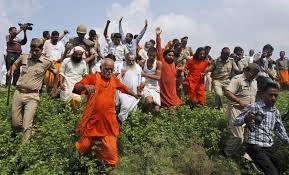
The 84–Kosi parikarma yatra of VHP was scheduled to begin from Ayodhya on 25 August and was to pass through mostly Muslim concentration districts (Faizabad, Basti, Barabanki, Gonda, Bahraich and Ambedkar Nagar) till 13 September 2013. VHP leaders were adamant to take up the yatra despite ban order issued by the Uttar Pradesh government. All those defying the ban order were arrested and put in judicial custody for next 14 days. RK Vishwakarma, IG, law and order, while talking to reporters in Lucknow, said that tight security measure will continue in the state to prevent those trying to attend VHP yatra. So far more than one thousand people, including Ashok Singhal and Praveen Togadia have been arrested in the crackdown. Kamal Saxena, Secretary (Home), has said that those arrested for defying ban will not be released because the programme of yatra is till 13 September and preventive detention will continue.
The yatra was banned by the Uttar Pradesh government on the ground that the yatra was an attempt to vitiate communal atmosphere in the state and also because the yatra could have violated the Supreme Court order on maintaining status quo on the Ram temple issue. The VHP yatra was aimed at mobilising public support to construct a Ram temple at the disputed site. However, the yatra turned out to be a lacklustre one and failed to provoke religious sentiments of the people because the call for such a yatra was not endorsed by the local people who remained less enthusiastic about this entire drama. Mahant Gyandas, head of the committee that organises the parikarma each year, criticised the VHP for going against traditional norms and for politicising a religious issue. According to him, the yatra has always been held from Chaitra Purnima to Baisakh Navami (during April- May) as per rituals.
The Shankaracharya of Govardhan Peeth, Swami Adokhshajanand Teerth Saraswati, in an interview to the Times of India, said, “VHP’s attempt to disturb communal harmony is a cause of major concern. The political outfit is using a religious issue, the Ram Mandir, to divide the nation on religious grounds. This should not be allowed.” State police while justifying the ban informed Union Home Ministry that VHP yatra was a threat to the communal harmony and the motive behind this yatra was to bring the Ram Janambhoomi issue back in the limelight.
According to the police report, VHP planned to get participants from North Bihar, Malwa in Maharashtra, Gujarat, Rajasthan, Uttarakhand, West Bengal, Haryana, Punjab, Jharkhand and even Jammu & Kashmir on different pre-determined dates from 25 August to 13 September to maintain a steady flow of people to Ayodhya. A pamphlet was also distributed by Sangh Parivar before the yatra with an appeal inviting all Hindu saints to join and support the demand for a law on building the Ram temple and to oppose any new mosque or Islamic centre coming up in Ayodhya.
If we go by the political history of the Samajwadi Party, we may come across that whenever BJP or its affiliated wings have charged SP for having appeased minorities that has fetched him additional minority votes, such an accusation only consolidated Muslims towards SP. Mulayam Singh has always in his mind that no matter what people say about his hobnobbing with the BJP or any other affiliates, the Muslims will think twice before accepting those charges against his party because they still have in their subconsciousness that it was Mulayam Singh Yadav government that ordered to fire on the kar sevaks in Ayodhya. Samajwadi Party wants to keep the ante of Muslim appeasement charges on high to keep a vigil on his Muslim support base and not let them drift away to BSP or the Congress. Azam Khan recently said that the meeting between VHP leader Ashok Singhal and his party chief Mulayam Singh Yadav would send a wrong message to the minority community. Muslims across the world consider Singhal equally guilty for the demolition of the mosque and it is not in the interest of the party to give so much importance to them.
Faisal Fareed in his article, “VHP yatra ban: Wheels within wheels” in The Indian Express, has rightly said that Mulayam understands that an election fought on religious lines is beneficial for his party as he still remains the first choice among Muslims. The script for this row appears to have Mulayam written all over it. A yatra which had remained a non-starter since its announcement (during Kumbh Mela in February) suddenly became news when on 17 August, VHP leaders including Ashok Singhal had a two-hour unscheduled meeting with Akhilesh and Mulayam. Soon emerged the reports of the VHP hailing the SP government for agreeing to the yatra. A day later, Azam Khan, the Muslim face of the SP government, objected to the meeting. The next day, Akhilesh banned the yatra.
Similarly, BJP is desperate to get maximum seats out of 80 Lok Sabha seats in the 2014 elections. There has been steep decline for the BJP in the state since 1998. In 1998 the party was on the top with maximum 57 seats. Notably, the number of seats came down to 10 in 2009. In a period of one decade BJP’s vote share declined from 36 per cent to 17 per cent. BJP is looking forward to keep the pitch of political pot boiling at regular interval to polarise the masses. People of Uttar Pradesh deserve all praise for avoiding a possible communal rift in the state by not getting tempted by the buzz orchestrated by religious and political leaders in the state.
Despite all tall claims made by the Samajwadi Party that it is the only party that takes care of the minorities the most, there have been 27 incidents of communal violence in the state since Samajwadi Party came to power last year. Recently, Chief Minister Akhilesh Yadav, in a written reply to a question raised in the assembly, informed the House that between 15 March 2012 and 31 December 2012 there were some big communal violence at places like Mathura, Bareilly and Faizabad. Communal violence also took place at Pratapgarh, Ghaziabad, Sambhal, Bijnore, Allahabad, Meerut, Muzaffarnagar, Kushinagar, Lucknow, Sitapur, Bahriach, Sant Ravidas Nagar, and Moradabad. Surprisingly, at some places there were incidents of communal violence more than once or even more than two times. These many incidents of communal violence in the state in less than a year speak volumes about the administrative failure and seriousness of the government in taking care of minorities.