

One of the concepts that makes up “Postcolonial Theory” is “Internal Colonialism”, which talks about how dominant ethnic/religious groups colonise minorities, centres (urban, developed) colonise peripheries (rural, tribal), upper castes colonise lower castes and linguistic majorities colonise minorities. Some of the tools used by dominant groups to browbeat minorities include doing polarisation politics (deliberately create communal tensions before elections) and conducting loyalty tests, by demanding that minorities prove their patriotism constantly. For example, forcing Muslims to say “Vande Mataram” or “Bharat Mata Ki Jai”; alleging that Muslims support Pakistan during cricket matches and pressurising Muslims to condemn terrorist acts committed anywhere by their co-religionists. If Muslims fail in these tests, their “othering” is legitimised and justified.
Resurrecting the Vande Mataram debate uses several tools, such as symbolic politics (song as loyalty test), historical revisionism (selective reading of freedom struggle), collective guilt (Congress/Nehru favoured Muslims over Hindus), victimhood reversal (Hindus as victims of appeasement), and political mobilisation (for the upcoming Assembly elections). It is a fool proof, “all gain – no pain” political strategy that is bound to pay electoral dividends. With the upcoming elections in West Bengal, it was only natural for the ruling party to initiate a special discussion in Parliament to mark 150 years ofVande Mataram (Mother I Bow to Thee).
Priyanka Gandhi
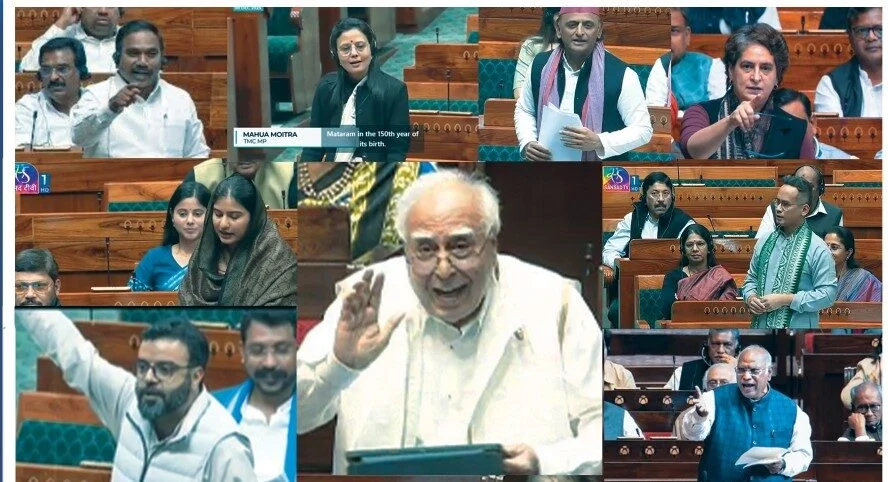
It is important to record the arguments made by lawmakers and community leaders on this issue. In her speech in Parliament, senior Congress leader Priyanka Gandhi pointed out, “Seventy-five years after Independence, why is there a need to debate our national song? What purpose does this serve, and how are we using the responsibility entrusted to us by the people?”
Calling out the political greed behind the move, she averred, “This discussion is happening for only two reasons: one, because elections are approaching, and two, because there is a deliberate attempt to divert the country’s attention from its real and pressing issues.”
Accusing the government of shying away from bread and butter issues faced by the common man, Ms Vadra stated, “This debate is being conducted only to divert attention, because this government neither wants nor is able to look at the present and the future.”
Another important issue raised by her was the apparent animosity towards the Constitution that was raised by conducting special discussions. She stated, “Raising questions about the form of Vande Mataram accepted by the Constituent Assembly is not only an insult to the makers of our Constitution, but it reveals an unconstitutional intent.”
Malikarjun Kharge
The President of Indian National Congress, Mallikarjun Kharge, reminded Parliament, “Vande Mataram is a national celebration, not a subject for political debate,” yet it is being repeatedly reopened for controversy. Kharge was critical of the timing and intent of this exercise, stating that “this entire discussion on Vande Mataram has been initiated keeping the West Bengal elections in mind. By raising a fresh controversy on this issue, the Prime Minister has insulted not just national leaders but especially Gurudev Rabindranath Tagore. True patriotism is not limited to symbolic speeches; it lies in addressing the real suffering of the people.”
Mahua Moitra
Senior Trinamool Congress (TMC) leader, Mahua Moitra bluntly observed in Parliament, “There is no doubt that the Vande Mataram card, if played right, is expected to give the BJP an advantage in the 2026 Bengal elections – there is no other reason behind the timing of this discussion.”
Accusing the government of trying to divert attention from real issues, she said, “When youth unemployment is over 20 percent, when people are choking in toxic air, and when opposition voices are bullied and prevented from raising urgent national issues, suddenly the government finds it necessary to discuss the historical complexities of a song.”
Citing a recent parliamentary bulletin, she noted that “Vande Mataram itself was officially recorded as a ‘slogan’ – indecorous and non-serious, yet the same slogan is now considered worthy of a ten-hour debate.” She reminded the House that BJP leaders once demanded that “Muslims sing a song that the leaders demanding it could not even sing correctly themselves.” Talking about the condition of Muslims in India, Ms Moitra stated, “To be a minority in India today is to be perpetually suspect, perpetually second-class, and perpetually subordinate.”
Syed Sadatullah Husaini
One of the most thought-provoking and sincere reactions to the deliberately cooked-up Vande Mataram controversy came from the President of Jamaat-e-Islami Hind, Syed Sadatullah Husaini. Talking to the media at the JIH headquarters, he said, “It is a universally accepted principle that every individual has the freedom to act according to their own belief. This is not merely a general notion; it is explicitly stated in the Constitution of our country that every person has the freedom to practise and follow their own belief. Therefore, the expression of patriotism, of one’s relationship with the nation, will also naturally vary according to individual belief and conscience. Patriotism cannot be confined to any one particular slogan or any one particular song. The problem arises when there is an attempt to impose this on the entire country, insisting that everyone must sing the same song and that only through this act can one’s patriotism be proven. Clearly, no sensible or rational person can accept such a proposition. Those who wish to express their love for the country through Vande Mataram are free to do so; equally, those who wish to express it through some other means should also be free to do so, within the framework of the law and the Constitution. Every citizen has the full right to choose from the various options provided by the Constitution. There is therefore no scope for debate on this issue. It is entirely illogical and a non-issue.”
In another interaction with the media, the JIH President stated, “I believe that a very meaningful debate has taken place in Parliament, in which all aspects of the issue have been discussed. Whether it is the national song, the national anthem, or any national symbol, their fundamental purpose is to unite people, to bring them together. Dividing people or setting them against one another can never be the purpose of any national song. In this context, the kind of politics being conducted around our national song, which attempts to divide society using it, is deeply condemnable and must be condemned from all sides. It has been turned into a political tool, an instrument of a “divide and rule” policy.”