

The Union Government has amended the Prevention of Insults to National Honour Act, 1971, in August 2026. Through this amendment, Vande Mataram has been given legal protection similar to that given to the National Anthem, the National Flag and the Constitution.
Concerns are being raised about the law that permits legal action to be taken for refusing to recite the song at government or private programmes. There is considerable concern among Muslims across the country because they believe that the song conflicts with their religious beliefs and Muslims may violate the law. Islam teaches the worship of one and only one God, Allah, whereas Vande Mataram, according to their interpretation, presents India as a divine figure worthy of worship.
For Muslims, this raises the question of shirk, or associating anyone or anything with Allah in worship. Several Muslim organisations, including Jamaat-e-Islami Hind, All India Muslim Personal Law Board and Jamiat Ulama-i-Hind, have reportedly criticised the law and called for its withdrawal. Some organisations have also challenged it in the Supreme Court.
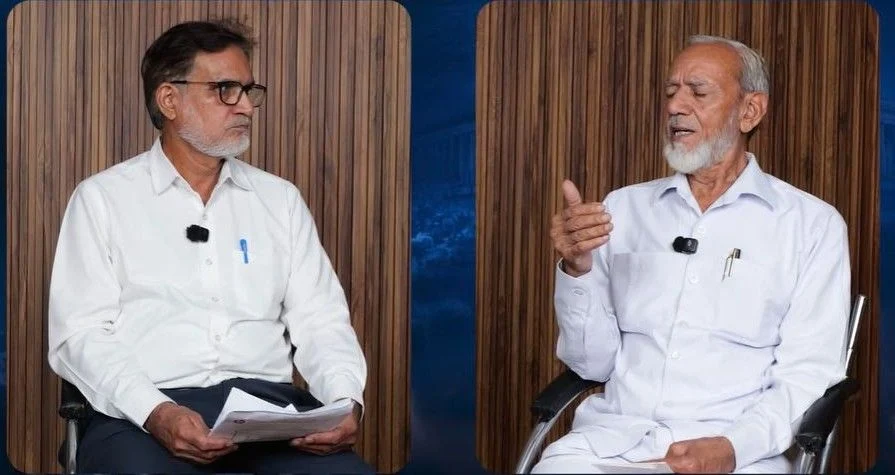
One of the organisations that have challenged the law is the Hakim Ajmal Khan Forum for Peace and Harmony(HAKFPH). In an interview with senior journalist Syed Khalique Ahmed, Forum’s general secretary Dr. Syed Ahmed Khan gives the reasons for challenging the mandatory singing of the Vande Mataram song at government functions, in schools, colleges and other institutions for people from all faiths. Hakim Ajmal Khan was a prominent freedom fighter and a strong advocate of Hindu-Muslim unity. He established Ayurvedic and Unani Medical College in Karol Bagh in Delhi and worked throughout his life to promote communal harmony.
Dr. Syed Ahmed Khan is a retired Deputy Director and former In-Charge of the Unani Medical Centre at Safdarjung Hospital, who served for over 30 years in the Central Council for Research in Unani Medicine (CCRUM) under the Ministry of Ayush, Government of India.
After his retirement, he is very active in public health advocacy and promotion of Unani and Ayurvedic medicines. He is currently serving as a General Secretary of All India Unani Tibbi Congress (AIUTC) and participating in national Unani health camps and academic lectures on pharmaco-vigilance. Besides, he also takes part in activities involving community amity and national integration through HAKFPH.
Senior journalist Syed Khalique Ahmed talks to Dr. Syed Ahmed Khan on the various aspects of Vande Mataram Controversy. Here are the excerpts of the interview:
Dr. Syed, we would like to understand why your organisation has challenged the law concerning Vande Mataram. On what grounds have you challenged it, and why?
Dr. Syed Ahmed Khan: Our position is that whenever legislation is enacted, whether in Parliament or state legislatures, certain fundamental questions must be considered. First: Is the proposed law genuinely in the public interest? Second: Could it hurt the religious sentiments of any section of society?
The law making the recitation of Vande Mataram compulsory was introduced and passed in a haste without any discussion in Parliament. The government did not consider the sentiments of the Muslims about the song. Muslims had always opposed its mandatory singing ever since 1947. It was because of this reason the then Congress government and subsequent governments of other parties never agreed to Vande Mataram’s compulsory singing. Hence, the passing of the law by the BJP government has created concern among people who believe in the absolute Oneness of Allah.
Muslims believe that there is only One God and that no one besides Allah is worthy of worship. As the Upanishadic expression “Ekam Brahma, DvitiyamNasti”(God is One, no second God exists) also conveys the idea of one supreme reality, our belief is that worship must be directed exclusively towards Allah.
Muslim organisations, including All India Muslim Personal Law Board, Jamiat Ulama-i-Hind and Jamaat-e-Islami Hind, have discussed this matter extensively and opposed the recitation of Vande Mataram strongly.
Our objection is that certain portions of the song, calls for something that Muslims consider as ‘shirk’ (polytheism or associating somebody or something with Allah). Since ‘shirk’ is prohibited in Islam, Muslims cannot participate in an act that has an element of ‘shirk’ in it.
We must understand that loving one’s country and worshipping one’s country are two entirely different things.Loving India does not mean that we must give the country the status of a deity or worship it.Every Muslim who offers prayers does so while standing on the earth. However, the Muslim worships Allah alone and believes that there is no deity worthy of worship except Him.That is the distinction we are making. We have highlighted this aspect in our petition, based on which we have demanded that the singing of the song should not be made compulsory for Muslims. Muslims should be exempted from its singing. But there seems to be political purpose behind the making of the recitation of the song compulsory for people of all faith groups.
You have raised two important issues. First, you have questioned whether the law was enacted in accordance with the interests and sentiments of the people. Second, you have argued that making the recitation of Vande Mataram compulsory may clash with the religious beliefs of Muslims. You have also questioned the necessity of this legislation. Since India already has a National Anthem, Jana Gana Mana, why was there a need to make the recitation of Vande Mataram compulsory? You have suggested that there may be a political purpose behind this decision. Could you explain your concerns?
Dr. Syed Ahmed Khan:The first question is why such a law was needed in the first place. The government has to consider whether legislation is necessary and whether it serves the public interest.A considerable amount of public money is spent on making and implementing laws. Therefore, the government should explain the need for such legislation.
India already has a National Anthem, Jana Gana Mana, which people have been singing for decades.Why was it necessary to introduce another legal requirement concerning a song that had not previously been compulsory? Our concern is that the decision may have political implications.We believe that the government should consider whether such legislation could create divisions between religious communities.
Our Forum’s founder-president, Tej Lal Bharti, is a veteran Congress leader who was associated with Mahatma Gandhi and Hakim Ajmal Khan. He has worked for Hindu-Muslim unity for many years. He was expected to attend this interview of yours but could not do so due to his failing health as he is more than 90 years old now. He has consistently spoken against developments that he believes may create divisions between communities.
Our Forum has also been involved in other matters concerning communal harmony and constitutional rights.For example, we previously approached the Supreme Court regarding the status of Urdu as a second official language in several states. In its judgment dated 4 September 2014, the Supreme Court of India held that Urdu could constitutionally be declared the second official language, alongside Hindi, for specified official purposes. So, the Supreme Court recognised the importance of India’s shared cultural traditions and the rights of its citizens.
The broader principle is that people should not be compelled to accept the beliefs or cultural practices of others.India has a long tradition of Hindu-Muslim coexistence. We should preserve that tradition rather than introduce measures that create unnecessary controversy.
You have emphasised that legislation must be consistent with the Constitution, particularly the fundamental rights of citizens. You have also expressed concern that making Vande Mataram compulsory could increase polarisation between Hindus and Muslims. Do you believe that compulsory recitation could create greater distance between the two communities?
Dr. Syed Ahmed Khan:Our founder-president, Tej Lal Bharti, has expressed similar concerns. He believes that laws and policies should bring Hindu and Muslim communities closer together rather than create divisions between them. We should not look at India’s population merely as separate religious communities. We should recognise that we are all citizens of the same country. When people are divided along religious lines, the entire country suffers.
History shows that whenever social divisions and communal tensions increase, the consequences are harmful.The government has a responsibility to maintain peace and harmony among citizens.It should create conditions in which people belonging to different religions can live together with mutual respect.
India’s democracy is based on the principle that every citizen deserves equal dignity and equal rights.A citizen’s rights should not depend on whether that person belongs to the Hindu majority, the Muslim minority or any other community.Every citizen should enjoy the rights guaranteed by the Constitution.
Therefore, lawmakers must carefully consider the constitutional implications of any legislation they introduce.They should ask whether the proposed law respects fundamental rights and whether it serves the interests of the country as a whole.
While hearing petitions challenging the Vande Mataram’s mandatory singing, the SC on September 22 indicated that people whose religious sentiments would be violated by singing Vande Mataram should not be compelled to recite it. The bench included Chief Justice Surya Kant and Justices Joymalya Bagchi and Vipul M. Pancholi. What is your response to the Supreme Court’s position?
Dr. Syed Ahmed Khan:We welcomed the Court’s observations because they recognise the importance of respecting people’s religious sentiments.We believe that the government should consider these observations seriously.The Court has not yet delivered its final judgment, and the hearing is still continuing. Therefore, we should not treat the observations as the final resolution of the case.However, the Court has raised an important constitutional question. The government should consider whether legislation concerning national symbols can be implemented without violating the religious freedom of citizens.
We have consistently maintained that no law should be introduced that unnecessarily hurts the religious sentiments of any community.The Court’s observations provide an opportunity for the government to reconsider the matter.We believe that the government should examine the amendment again and consider whether it needs to be revised.
Do you demand that the government reconsider the amendment and withdraw the requirement making the recitation of Vande Mataram compulsory?
Dr. Syed Ahmed Khan:Yes. We believe that the government should reconsider the amendment and withdraw the compulsory aspect of the requirement.For decades after independence, successive governments did not make the recitation of Vande Mataram compulsory. This was the case under governments led by different political parties, including the Congress, and other non-BJP government.
Even during the tenure of late Prime Minister Atal Bihari Vajpayee, the recitation of Vande Mataram was not made compulsory in the manner now being discussed.The country continued to function without such a requirement.The important question is whether the absence of compulsory recitation weakened India’s patriotism or national unity. We do not believe that it weakened the national unity. Similarly, we do not believe that making the song compulsory will automatically increase patriotism.
Love for one’s country is a personal feeling. It cannot be measured simply by whether someone sings a particular song.Citizens demonstrate their commitment to the country through their conduct, their contributions to society and their respect for fellow citizens.Therefore, compulsory recitation should not be treated as a test of patriotism.
Read in fullhere