

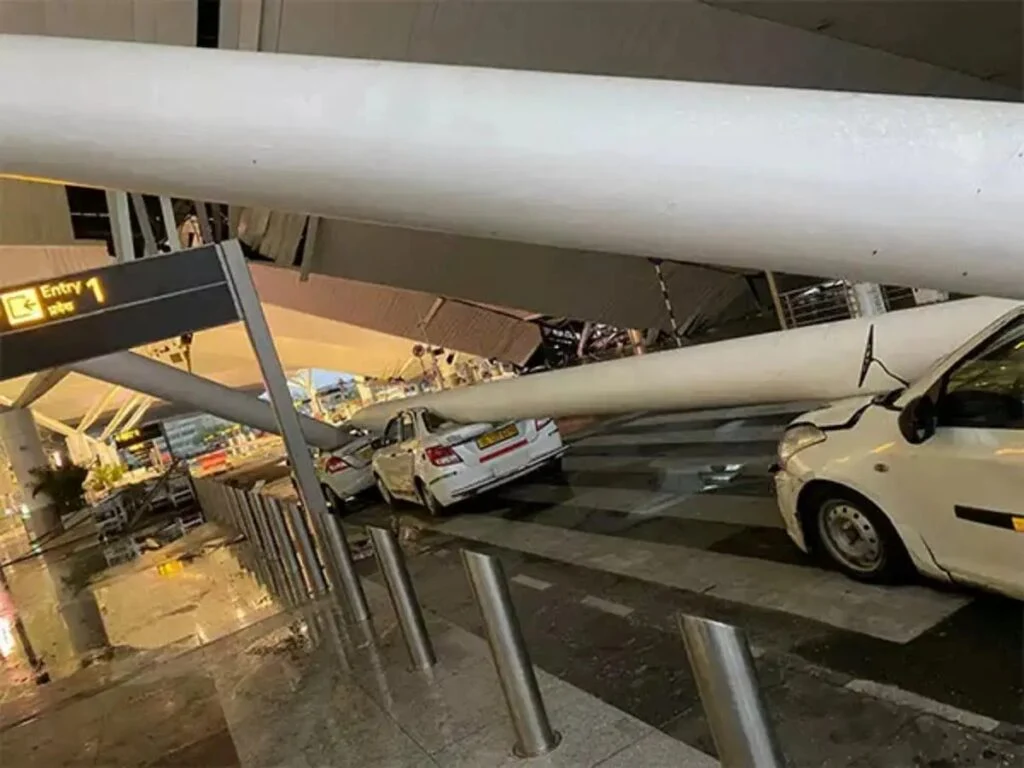
A developed nation is not measured by the kilometres of highways it builds, but by whether those highways, bridges and public institutions remain safe, durable and worthy of public trust.
India today stands at a defining crossroads. On one side is the ambitious vision of Viksit Bharat 2047,Prime Minister Narendra Modi’s promise to transform India into a fully developed nation by the centenary of Independence. On the other is a growing list of collapsing bridges, damaged highways, washed-away roads and failing public infrastructure that raises uncomfortable questions about the quality of India’s development model and alleged corruption.
The Modi government has made infrastructure the centrepiece of its economic narrative. Union Road Transport and Highways Minister Nitin Gadkari frequently boasts record highway construction, new expressways, tunnels, flyovers and logistics corridors as evidence of India’s rapid transformation. Billions of rupees have been invested in roads, railways, airports, ports and urban infrastructure.
Yet every monsoon tells another story.Bridges collapse before their expected lifespan. Newly built roads develop cracks or are washed away. Under-construction structures fail. Urban flooding paralyses cities despite massive investments in drainage projects. Instead of symbolising progress, many public works become symbols of poor planning, weak execution or inadequate maintenance. The contradiction is difficult to ignore.
The latest infrastructure failures paint a troubling picture. The Prime Minister had envisioned transforming his parliamentary constituency, Varanasi, into a ‘smart heritage city’ inspired by Kyoto, Japan, with modern, world-class infrastructure. Yet, recent events raise serious questions about the quality and durability of that development. Following heavy rainfall, the ceiling of Platform 8 at Varanasi Cantt Railway Station began leaking profusely, with water cascading from the roof and dripping through ceiling fans, exposing glaring construction and maintenance deficiencies.
Similarly, Maharashtra’s ₹7,000-crore Missing Link project on the Mumbai-Pune Expressway, inaugurated by Chief Minister Devendra Fadnavis on May 1, 2026, suffered a major setback just nine weeks later when intense monsoon rains triggered a massive landslide at the Tunnel-2 exit on July 6, burying the Pune-to-Mumbai carriageway under more than 100 tonnes of debris. Another alarming example is the newly inaugurated Delhi-Dehradun Expressway, where sections near Shamli in Uttar Pradesh developed severe cave-ins and massive potholes after heavy rainfall. The damage, occurring barely 79 days after the expressway’s inauguration with much fanfare, required emergency repairs by the National Highways Authority of India (NHAI), yet it continues to raise serious concerns about construction quality, public safety, and the long-term resilience of India’s rapidly expanding infrastructure.
Can a nation truly claim to be ‘Viksit’ if its infrastructure repeatedly fails the most basic test – surviving ordinary use and seasonal rains?
The Promise of Clean Governance
Before becoming Prime Minister in 2014, Narendra Modi’s anti-corruption pledge became one of his defining political slogans: ‘Na khaunga, nakhanedoonga’ (Neither will I indulge in corruption, nor will I allow others to).
However, recurring infrastructure failures have revived difficult questions about the clean governance as the anti-corruption slogan sounds hollow. Every collapsed bridge or damaged highway prompts familiar public concerns.
Investigations are routinely announced after such incidents. Committees are formed, compensation is declared and technical reports are ordered. Yet many critics argue that systemic reforms and visible accountability remain inconsistent.
Government data itself indicates that the problem extends beyond isolated accidents. In June 2024, the Ministry of Road Transport and Highways informed Parliament that 15 operational bridges and 11 under-construction bridges on National Highways had collapsed during the previous three years. Six people lost their lives in these incidents.
The operational bridge collapses occurred across several states, including Haryana, Odisha, Manipur, Andhra Pradesh, Himachal Pradesh, Madhya Pradesh, Meghalaya, Sikkim, Uttar Pradesh, Jammu & Kashmir, Arunachal Pradesh and Tripura.NHAI also reported 55 instances of damage or collapse affecting highway projects over roughly the same period.
Independent compilations suggest the problem may be even broader, estimating around 170 bridge and structural failures across India between 2021 and 2025, including 42 major and minor bridge collapses over a recent 5-year period. These are not random engineering mishaps. They point to a recurring pattern that deserves serious public scrutiny.
A Structural Problem
A 2020 peer-reviewed study, Analysis of Bridge Failures in India from 1977 to 2017, published in Structure and Infrastructure Engineering, documented approximately 2,130 bridge failures during different phases of construction and operation over four decades, excluding culverts and pedestrian bridges.
The study suggests that India’s infrastructure challenges are rooted not only in extreme weather but also in persistent issues involving design, construction quality, maintenance, supervision and institutional oversight.
Heavy rainfall is a natural phenomenon. Infrastructure failure should not be. Developed countries design bridges, highways and drainage systems to withstand severe weather. In India, however, the annual monsoon increasingly resembles a nationwide stress test that exposes engineering weaknesses.
Recent heavy rains blocked or washed away more than 120 roads, including key stretches of the Yamunotri and Rishikesh-Yamunotri National Highways in Uttarakhand.
Other recent incidents include a bridge section collapsing in Nanded, Maharashtra; failure of the strategic Kumey Bridge in Arunachal Pradesh; collapse of an under-construction bridge in Hamirpur, Uttar Pradesh, after severe storms; an under-construction bridge collapse in Uttar Pradesh in July 2026 that reportedly killed several workers following heavy rain;and a building collapsed in Delhi’s Rohini area that claimed multiple lives.
Each incident has its own technical explanation. Collectively, however, they point to a broader concern about resilience, maintenance and quality assurance.
The Gujarat Question
For years, Gujarat has been promoted as a model of infrastructure-led development.Yet reports indicate that more than a dozen bridges in Gujarat have either collapsed or suffered major structural damage over the last five years.If a state widely associated with infrastructure development experiences recurring structural failures, what lessons should policymakers draw for the rest of the country?
Development should not be judged solely by ribbon-cutting ceremonies or project announcements. Its true measure is longevity.
India’s infrastructure expansion has unquestionably improved connectivity. But infrastructure is not built merely to be inaugurated. It is built to serve safely for decades.
Critics argue that political pressure to complete projects before elections or major public events can create unrealistic deadlines. When speed becomes the overriding priority, there is a risk that quality control, engineering scrutiny and independent inspections receive less attention than they require. Whether that is the case in any particular project depends on its specific facts, but repeated failures inevitably fuel public concern.
The Corruption Debate
Whenever infrastructure collapses, public debate often centres on rainfall or technical faults. Less frequently does it examine whether governance failures played a role.Public procurement has long been vulnerable to allegations of inflated contracts, poor-quality material, inadequate supervision and weak enforcement of standards. Whether corruption contributed to any individual project requires evidence and investigation, but repeated structural failures inevitably raise questions about transparency and accountability.
Commentator Pankaj Kumar captures this frustration in stark terms:“So many bridges collapse in India, and yet we keep acting shocked – as if gravity suddenly stopped working. Corruption isn’t a bug in the system;it is the system itself.”
A developed nation is not built merely by pouring more cement.It is built through institutions that value expertise, scientific planning and accountability. Infrastructure failures therefore reflect more than engineering shortcomings.They reveal institutional weaknesses.
Beyond Roads and Bridges
Infrastructure is only one pillar of a developed nation. India has also grappled with examination paper leaks, institutional controversies and governance failures in other sectors. These issues may appear unrelated. They aren’t. A developed country is built on institutions that citizens trust. The question is not whether India can build more infrastructures. These questions – not merely GDP figures or kilometres of highways – will determine whether Viksit Bharat becomes a durable reality or remains an aspirational slogan. Every bridge that collapses weakens public trust. Every washed-away highway raises questions about governance. Every preventable failure reminds us that development is not only about building faster;it is about building better.