

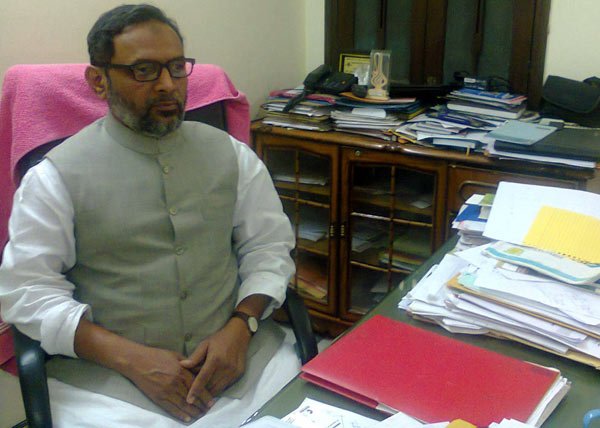
Dr. SYED QASIM RASOOL ILYAS, newly elected president of Welfare Party of India, in an interview with MOHAMMAD NAUSHAD KHAN, elucidates the guidelines required to take the party forward and urges the cadre to translate the policy of the party on the ground in order to make it more effective and strengthen its support base by doing all for the welfare of the people.
How do you rate the performance of Welfare Party since its inception?
The performance of Welfare Party so far can be said to be satisfactory because within three years and a half the party has been established in 12 states. And in many states its network has reached the grassroots level. For example, in Kerala, West Bengal, Andhra Pradesh, Telangana and Rajasthan the network has reached the ground level. Welfare Party has participated in Lok Sabha and assembly polls but the performance was not on the desired line. During Parliament elections in Andhra Pradesh, the party fielded four candidates and in three constituencies the candidates of Welfare Party came third in terms of votes. The party got more than 40,000 votes. In the same manner, the party performed satisfactorily in Kerala. In Andhra Pradesh and West Bengal, the party has won many Local Body elections.
The party without having won any assembly election seat has forced the state government in Kerala to act on some public issues. For example, the party launched the landless issue because in Kerala the population density is high and there is paucity of lands. The price of land is alarmingly high. There are lakhs of people who do not have their own lands and homes. The Welfare Party launched the ‘land for landless’ campaign and that campaign gained so much strength that the government brought in a Bill and provided land for those who were in the category of Below Poverty Line. This was one of major achievements there.
The party raised some other issues and pressurised the government and mobilised a campaign to get the government’s nod on public issues. The other big issue the party took up recently has been endorsed by many political parties. The present electoral system, which has got FPTP method, does not correspond in any way to the call of democracy being a “government of the people, for the people and by the people”. Under the present system, the party which gets minimum votes can also form the government and the majority votes are wasted and are of no use. There are many parties that got plenty of votes but could not open their account, like the BSP.
The Welfare Party has proposed Proportional Representation System before the Election Commission and will launch a massive campaign for it. Many political parties have agreed to this proposal. In a programme on Proportional Representation in Delhi, as many as six parties endorsed the call for a Proportional Representational System. The party will also try to include some other small parties in order to launch a popular campaign.
The period of three years and a half cannot be said too long for a party that talks of value-based politics and is not ready to compromise just for the sake of power. The party does not believe in muscle and money power and instead it is trying to gain strength through public campaigns and movements.
How far do you want to take the party forward? Have you fixed any target to achieve?
Our Federal Committee meeting is proposed in December wherein the party will formulate the future course of action and prepare guidelines. The party will stick to the slogan of value-based politics and whether the party wins or loses elections we will keep on fighting for people’s rights and issues like those of farmers and minorities, including the issue of effective utilisation of Waqf properties. With the help of people’s collective voice and intellectuals, the party will do all that is good for the people and try to bridge the gap between the rich and the poor. Because of the economic policies of the present government, this gap may further widen. The party will launch a nationwide movement against it. In one year, the party will try to launch a movement across India on such issues.
The present government is gradually subsiding people’s schemes like MNREGA introduced by the previous government. The party will minutely observe the government’s approach towards such people’s schemes and assert whenever required to ensure the benefit of all such schemes reaches the people for whom they were envisaged.
Another area where the party will look into is to incorporate all other like-minded parties sharing same ideas or ideologies to form a new viable front as an alternative to corrupt, communal, opportunist and criminal politics. In West Bengal, the party has launched a front with the help of smaller parties. In 2016 elections there, it will be further strengthened and experienced.
The party wants to ensure that Muslims and women are politically empowered and play their roles in the decision making process. The youth form the larger election campaign process for most of the parties but their issues and problems are seldom addressed. The party will try to engage youth in the process of nation building.
The party will try to minimise malpractices in the electoral system. Recently, when the Election Commission of India sought suggestions for electoral reforms, the Welfare Party submitted detailed and thought-provoking suggestions. All parties were asked to submit suggestions but only two parties, Welfare Party and the Congress submitted their suggestions. The EC publicly endorsed that only these two parties have submitted suggestions on electoral reforms.
Would you like to change the earlier defined policies of the party or effect any change in the strategy?
We do not think of any changes in policy documents as defined earlier or some change in the strategy because they are very comprehensive and inclusive. Every aspect of all sections has been included. What is required is to translate those policies on the ground in order to strengthen the party and its support base.
Will Welfare Party contest assembly elections in Delhi?
The Delhi chapter of Welfare Party has been established recently and it is still in the primary stage. Efforts are on to explore the opportunity to find a few selected seats to contest polls in Delhi. By the end of this month, the party will take a decision thereon.
If AAP approaches Welfare Party for any kind of tie-up, will you agree to it?
We consider AAP a better party as compared to others. This is so because they raised the issue of corruption and are still firm on it. But unfortunately, the party has not made any clear-cut policies on other issues. Earlier, I talked at length with Arvind Kejriwal on a variety of issues before the last Assembly elections in Delhi. When I asked him about his policies on some issues, he replied that so far the party had not thought on such issues and was thinking thereon. I told him that we appreciated his stand on corruption; but corruption is one issue, what is the party’s stand on the economic issue or FDI, minority and women issues; he said his party was thinking on these matters. It is still not clear what kind of India the party wants to build. Even though, if we get an opportunity for any kind of alliance with them, the party is ready for tie-up with Aam Aadmi Party.
As new president, what is your message to the Welfare Party cadre?
We would like to say to our cadre that the party has taken all issues as challenge. The value-based polity is not only a slogan; the party will not compromise under any circumstances. I have asked the cadre to work in the areas like policy intervention to change wrong policies of the government and to bring in policies beneficial to the people. I would like the party cadre to be on streets and whenever they get a call from the party they must be ready to intervene and assert themselves in the larger interest of the country.
With pressure politics, we will try to raise the issues of the people. To monitor whether social schemes are implemented on the ground the party will put pressure on the government. We will also ask our cadre to keep vigil on the funds released under various schemes whether they are utilised or not. Our cadre should also provide leadership for the people. Leadership in the sense that if there is any problem from any side, either from administration or police or government to an individual or group, the cadre should strive for them. I have told them to be present 24/7 for the people and their doors must remain open all the time for the suppressed, weaker and deprived sections of society.