

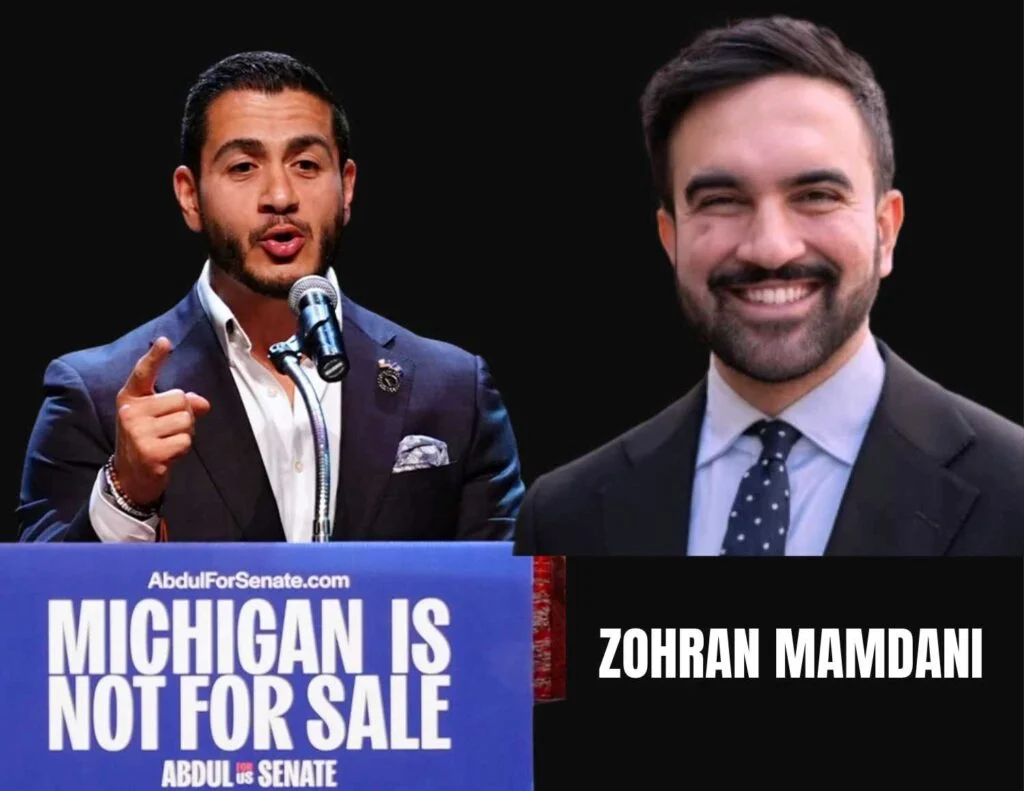
 The discussions surrounding Zohran Mamdani’s election as the Mayor of New York were still going on when Abdulrahman Muhammad Al-Sayyid’s victory in the US midterm elections sparked another debate. While this debate has brought new perspectives to the United States, its impact is also being felt in India. Following the victories of these two leaders, Indian social media witnessed a variety of discussions and opinions.
Abdulrahman Al-Sayyid’s Muslim identity is clear, while there is some confusion in certain circles about Zohran Mamdani’s identity. However, both are widely seen as Muslim leaders. Although several other candidates have also won in the US midterm electionsAbdulrahmanAl-Sayyid has particularly attracted attention. One reason is that his wife, Dr Sarah Jukaku, belongs to Bhatkal, a town in Karnataka, India.
The success of these leaders and other Muslim candidates is significant for young Muslims in many ways. Of course, their field of activity is the United States, and they have no direct connection with India. However, in today’s world, which has become a global village, developments in a distant country like the US can directly or indirectly influence different aspects of life in India. Therefore, it is natural that their electoral victories have also generated interest and discussion here.
In this article, rather than examining the wider impact of these victories, we will focus on one question: What lessons can Indian Muslims learn from the success of Zohran Mamdani and AbdulrahmanAl-Sayyid? Many thinkers may already be reflecting on this subject and sharing their views. Here, we would like to highlight a few important lessons that deserve serious attention from the Indian Muslim community.
First Lesson: Moving Forward While Preserving One’s Identity in Difficult Times
AbdulrahmanAl-Sayyidand Zohran Mamdani have both succeeded in an environment where the memories of Islamophobia in the United States have not yet faded. The wave of Islamophobia that emerged in American institutions and different sections of society after 9/11 was not limited to the United States. Its impact was felt across the world, and it will take time for its effects to disappear completely. The generation that witnessed that period and experienced its consequences is still around.
Despite these difficult circumstances, both leaders have maintained their Muslim identity, established themselves in American society, demonstrated their abilities and earned public trust.
India, too, is going through a period in which Islamophobia is visible in different forms. Certain sections of the media and various organisations are trying to create an atmosphere of hatred and spread propaganda against Islam and Muslims to serve their political interests. In such circumstances, should we lose hope?
The success of Zohran Mamdani and AbdulrahmanAl-Sayyidoffers a message of courage, confidence and continuous struggle rather than despair. Their success teaches us that an atmosphere created through Islamophobia is not permanent. Politics based on hatred cannot solve people’s economic problems. It cannot pay their electricity bills, reduce the burden of rising petrol prices, pay their children’s school fees or meet hospital expenses. The real problems of ordinary people can only be addressed through good governance, responsible leadership and practical public service.
Second Lesson: Building Strong Public Connections Through Service
Another important lesson from the success of these two leaders is that they worked consistently to connect with ordinary people and earn their trust. They understood public concerns, remained among the people and demonstrated through their conduct and work that the basic purpose of their politics was to serve humanity.
More importantly, they did not hide or abandon their identity while reaching out to people. Instead, they maintained their identity and demonstrated their abilities and usefulness through practical work.
This is precisely the message that reminds us of our responsibilities as a community described as the Khair-e-Ummah (the best community). There is an urgent need for Indian Muslims to take an active interest in public issues, resolve the difficulties of ordinary people and play a practical role in resolving their problems.
Unfortunately, within our community, publicity campaigns, posters and excessive closeness to political leaders are sometimes seen as ways to gain political recognition and positions. These methods are commonly used to move ahead in politics. Undoubtedly, such activities have had their place in Indian politics, but times are changing.
Public demonstrations and protest movements witnessed in different cities recently have shown that the political awareness and approach of the younger generation are changing. These young people belong to the age of artificial intelligence, have greater access to information and are more aware of their problems and rights. They are no longer easily influenced by traditional slogans alone.
Therefore, we also need to move away from publicity-driven and symbolic activities towards politics based on values and public service. Staying among the people, understanding their problems and working continuously to find solutions are the most effective ways to build public trust and credibility in politics.
Third Lesson: Bringing Educated and Talented People into Politics
The third important lesson is that both Zohran Mamdani and AbdulrahmanAl-Sayyidare highly educated and capable individuals. Their success highlights the importance of education, intellectual ability, an understanding of public issues and a commitment to public service in modern politics. Educated and capable people should have a proper place in politics and leadership. It is also their right.
A look at Indian politics suggests that wealth, power, influence, strong political networks and large groups of supporters are often considered necessary for gaining political recognition. Greater importance is sometimes given to people who can provide resources for rallies and public meetings, mobilise crowds and spend large amounts of money on election campaigns. At some places, distributing liquor and biryani to bring people to rallies and processions has also become part of this political culture.
However, this situation is gradually changing. The participation of large numbers of educated and politically aware young people in protests, rallies and public meetings in Mumbai, Delhi and other parts of the country in recent days is a clear indication of this change. These were not crowds brought together by paying people. They were young citizens who came forward on their own, driven by political awareness, social responsibility and a desire to stand up for their rights.
It is, therefore, time for educated and talented people to enter politics. The Muslim community must also create opportunities for capable individuals, young people and those with knowledge and leadership skills to come forward.
For this purpose, the community must begin by reforming its own internal organisations and institutions. Traditionally, much of our community’s collective and organisational activity begins with the management of mosques, Eidgahs and graveyards. A general assessment suggests that educated people and those with administrative abilities often do not receive adequate representation in the committees managing these institutions.
There is a need to begin the process of reform at this basic level by involving educated, honest and capable individuals in their management and responsibilities. Only when we develop a culture of entrusting our local and grassroots institutions to competent people will we be able to produce better leadership for larger social and political platforms.