

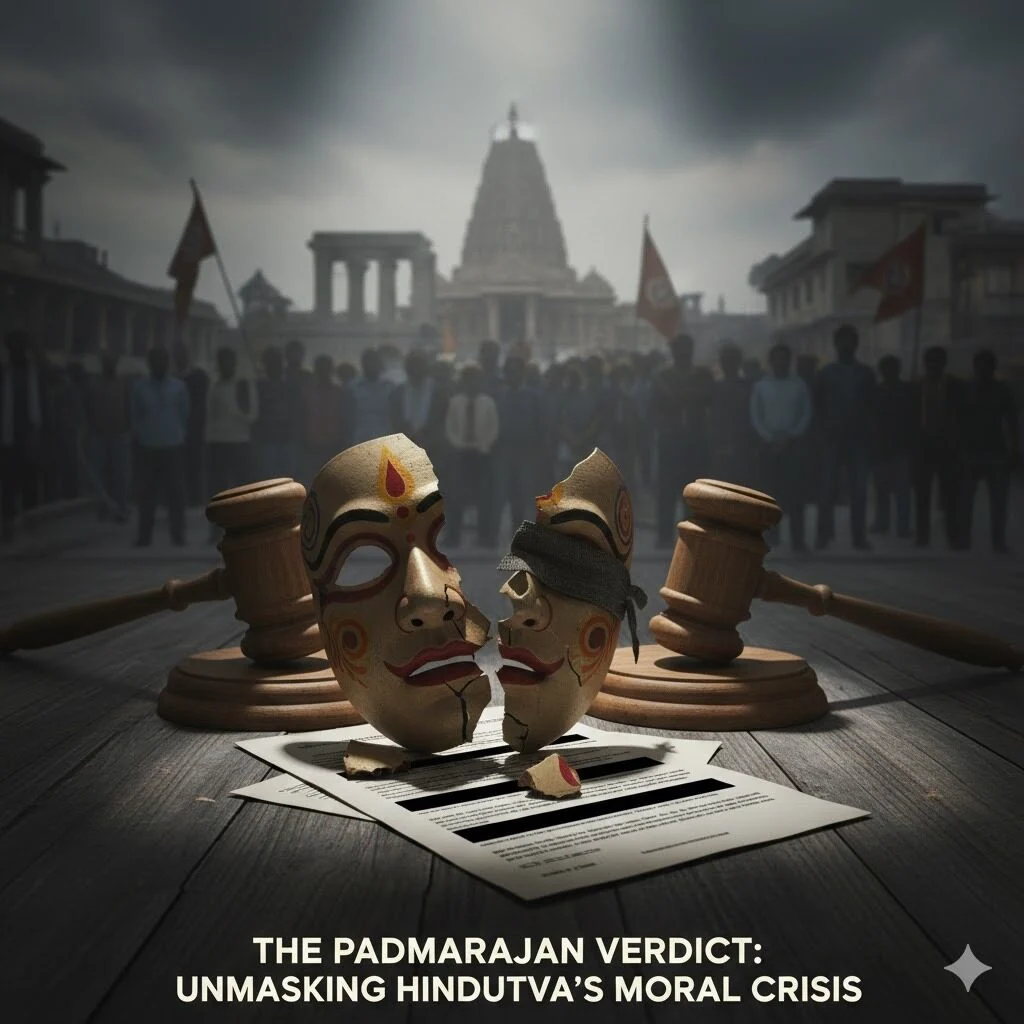
On 15 November 2025, the ThalasseryPOCSO Special Court delivered one of the most searing judgments in recent memory. BJP leader and schoolteacher K. Padmarajan, known locally as Pappan Master, was sentenced to life imprisonment till death for repeatedly sexually assaulting a 10-year-old Muslim girl inside her school.
The courtroom’s silence during the verdict was not merely the weight of the crime; it was the collapse of a carefully protected political narrative – the claim that Hindutva represents the moral spine of the nation.For years, that narrative has been aggressively promoted.The reality, however, is beginning to speak louder.
The Crime and the Courtroom
According to the prosecution, Padmarajan sexually assaulted the minor three times between January and February 2020, taking her to the toilet of the school where he taught.The child’s distress became visible only when she suddenly refused to attend school.It took immense courage for her and her family – a Muslim family in a communally sensitive region – to file the complaint.The investigation faced familiar patterns:
- initial dilution of charges,
- multiple investigation teams,
- and allegations of political interference, as the accused was a local BJP figure.
Yet despite the systemic pressures, the court dismantled every layer of protection.POCSO Judge M.T. Jalajarani declared Padmarajan guilty under multiple sections of POCSO and IPC, awarding a sentence that ensures he will never walk free again.The verdict reaffirmed a crucial fact:When evidence speaks, power cannot silence justice.
The Larger Picture: When Propaganda Becomes a Shield
To understand the deeper significance of this verdict, we must step beyond this one case and examine the ideological ecosystem around it.For years, Hindutva groups have vigorously promoted the idea that Muslim men pose a threat to Hindu women.Phrases like “Love Jihad” have dominated speeches, WhatsApp forwards, television debates, and social-media propaganda despite the fact that:
- No police investigation,
- No court,
- No state government, and
- No national agency
has ever found credible evidence of such a conspiracy.
It is a political myth, repeated until fear becomes habit.
How Cinema Amplified the Myth
This manufactured fear extends beyond speeches and enters popular culture.A recent example is the film “The Kerala Files”, which portrays Muslim men as organised predators targeting Hindu and Christian women.The film offers no credible legal or investigative evidence, yet it was promoted as “the truth” and marketed with intense political enthusiasm.
While such cinema fuels public suspicion against Muslims, courtrooms across India present a very different reality – several individuals associated with Hindutva parties and organisations themselves stand convicted of sexual crimes against women and minors. The contrast between fiction and documented truth could not be starker.This, more than anything else, exposes the moral inversion at play:those who project others as threats often escape scrutiny of their own actions.
A Pattern Emerging Across India
The Padmarajan case is not an isolated incident.It fits into a growing, disturbing pattern involving leaders, office-bearers, or prominent faces of Hindutva organisations:
Kuldeep Singh Sengar, BJP MLA, Unnao (Uttar Pradesh) was convicted for the rape of a minor and sentenced to life imprisonment.
Swami Chinmayanand, BJP Minister and religious leader was arrested for sexually exploiting a law student.Video evidence exposed a system of intimidation and coercion.
Jayanti Bhanushali, Gujarat BJP Vice President was booked in a minor rape case; but died before trial.
Multiple Bajrang Dal and RSS activists were arrested in cases of molestation, moral policing violence, and intimidation of couples.These cases do not represent Hindus; they are only tip of the iceberg. They represent the failure and hypocrisy of those who claim monopoly over Indian morality.
Exposing the Hypocrisy – Calmly, Factually, Unavoidably
The question this article raises is not communal.It is ethical and structural.Why does an ideology that aggressively labels Muslim men as threats remain silent when its own leaders are convicted of sexual crimes?Why are fabricated narratives amplified through films, rallies, and media campaigns, while the crimes of its own leaders are met with whispers or silence?Why does the ecosystem obsess over marriages between consenting adults when its political elites are involved in crimes against minors?These are not emotional questions.They expose the double standards that have distorted India’s moral landscape.
The Impact on Vulnerable Communities
The Palathayi(where the incident is said to have taken place) case carries an additional wound: the victim was a Muslim minor girl, assaulted by a man who wielded authority as both a schoolteacher and a BJP functionary – a combination that often discourages families from pursuing justice.
In a climate where Muslims are routinely stereotyped, accused, and targeted,the courage of this family to pursue justice is profound.Despite fear, political power, and systemic pressure,they persisted and they prevailed.Their victory is a victory for India’s constitutional values.
What This Reveals About India Today
The Padmarajan verdict underscores two uncomfortable but essential truths about the country today:
- Courts, even amid political pressures, remain among the few institutions where truth can still surface.Not every victim reaches the courtroom.Not every crime receives an FIR.Many cases collapse under intimidation, delays, or silence.But when a case survives the system and reaches its conclusion, the judiciary often becomes the only space where propaganda, power, and ideology lose their influence and facts regain their strength.
- These verdicts repeatedly puncture the moral claims of Hindutva politics.For all the loud rhetoric about culture, purity, and protecting society,it is often in courtrooms – not in rallies or social-media campaigns – that the real face of this ideology is exposed.
Morality does not belong to a political slogan.It does not belong to a colour, a costume, or a chant.Morality belongs to conduct – and conduct alone.
And every time a court delivers a verdict in a case like this,the gap between Hindutva’s claims and its actions becomes impossible to hide.
The Moral Question India Must Ask
The Hindutva narrative claims to defend the nation’s soul.But every time a court convicts another leader for crimes against women or children,the country is forced to ask:Who is truly endangering India’s social fabric – the imaginary threats, or the real ones hiding behind moral rhetoric?
The Padmarajan verdict does not merely punish one man.It punctures a narrative, exposes a pattern, and reminds India that the true battle is not between Hindus and Muslims but between truth and propaganda, justice and impunity.In that battle,a secular, pluralistic democracy must always stand with truth.