

History usually records wars in numbers – bomb tonnage, casualty figures, cities reduced to rubble. Yet some wars demand to be remembered not only for what they destroyed, but for what they failed to extinguish.
In Gaza, while bombs fell in unprecedented volume, something else unfolded quietly, almost defiantly. Women, children, and displaced families memorised the Holy Qur’an. Hungry. Thirsty. Homeless. Under bombardment.This was not symbolism. It was lived reality.
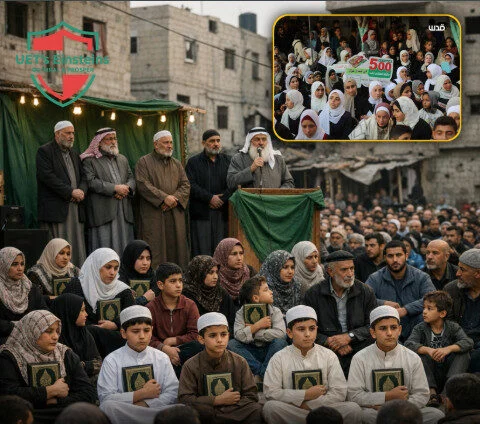
International reports confirm that during the ongoing war, hundreds of Palestinians completed memorisation of the Qur’an. In one widely reported instance, around 500 memorisers were honoured in Gaza’s Al-Shati refugee camp – individuals who completed hifz amid relentless airstrikes, displacement, and siege.
Behind the ceremony lay a truth difficult to articulate: memorisation without classrooms, electricity, teachers, or even printed copies. Schools were bombed. Mosques were flattened. Libraries were buried under rubble.Yet learning continued – not in institutions, but in memory.The Qur’an was not memorised despite the war.It was memorised within it.
Hunger, Thirst, and the Discipline of Memory
War collapses the human mind into survival mode. Hunger dulls concentration. Thirst fractures thought. Trauma erodes memory.Gaza had all three.Food shortages were severe. Clean water became scarce. Families rationed bread and counted days without meals. Under such conditions, education usually halts. Memory weakens.Yet Gazans memorised 6,236 verses.
They memorised with empty stomachs and dry throats.They memorised while displaced again and again.They memorised because the Qur’an was not a subject; it was orientation.To commit it to memory was to preserve identity when everything else was being erased.
Bombardment and the Soundscape of Revelation
Gaza’s bombardment invites historical comparison. Hiroshima and Nagasaki witnessed sudden annihilation. Iraq and Afghanistan endured prolonged aerial wars.Gaza, however, experienced sustained, concentrated bombing on one of the most densely populated places on Earth.
And within this soundscape – jets overhead, walls collapsing, ambulances screaming – people recited verses from memory.Bombs did not pause for prayer.Prayer did not pause for bombs.This coexistence of annihilation and articulation – of destruction and disciplined memorisation – has no clear parallel in modern documented warfare.
The Unexpected Guardians of Revelation
Perhaps the most unsettling aspect of this story is who carried the Qur’an forward.Not scholars in protected institutions.Not seminaries with endowments.But women managing shattered households.Children who had lost parents.Teenagers living in tents.Reports document children of martyrs completing memorisation, alongside young women who continued hifz amid displacement and grief.
Those the world routinely labels “the weakest” became guardians of the strongest text.This was not empowerment rhetoric. It was responsibility assumed under fire.
When Schools Died, Memory Became Infrastructure
The war erased Gaza’s educational landscape. Universities, schools, and libraries were reduced to ruins.Yet education did not vanish. It transformed.With classrooms destroyed, memory became the classroom.With textbooks burned, the heart became the page.With teachers displaced, recitation became pedagogy.
The Qur’an functioned not only as scripture, but as structure, offering rhythm in chaos, continuity in erasure.
Beyond Memorisation: Doctors Graduating Under Siege
And then came another scene, equally startling.Even as the war raged, Gaza’s universities conducted graduation ceremonies for medical doctors – students who had completed their studies amid bombardment, shortages, and institutional collapse.
This detail changes everything.It reveals that Gaza’s resilience is not selective or symbolic. It is comprehensive.
Gazans did not retreat into spirituality alone, nor did they cling to education as mere survival strategy. They did both – simultaneously.
While some memorised revelation, others mastered medicine.While bombs fell, verses were preserved – and doctors were trained.
What Does This Mean?
Logically, this defies conventional explanations.It is not explained by resources – there were none.Not by stability – there was none.Not by external support – there was little.What remains is belief.Not belief as comfort, but belief as worldview.
In Islamic consciousness, knowledge is not divided between sacred and worldly. Memorising the Qur’an and saving human lives are not parallel pursuits; they are connected obligations.
Belief in Allah produces a particular clarity: that chaos does not negate responsibility; it sharpens it.Thus, Gazans did not choose between faith and reason. They acted upon both.
Belief Beyond Consolation
It would be misleading to frame this merely as spiritual endurance.The Qur’an was not recited to escape reality. It was recited to interpret it.Medicine was not studied for career advancement. It was pursued to preserve life.
Belief in Allah, in this context, did not anesthetise pain. It organised response.
Memorisation and medical education together formed a declaration: that even genocide would not interrupt Gaza’s moral and intellectual continuity.
Is There a Precedent?
History records cities rebuilding after wars. It records underground schools, clandestine teaching, cultural resistance.But a population that, under continuous bombardment, produces hundreds of Qur’an memorisers and graduates doctors?This remains almost without precedent in modern warfare.
Wars have silenced civilizations. Gaza responded by speaking – through revelation and reason alike.
What History Must Ask
This story does not exist to romanticise suffering.It exists to document a moral reality.When a people under annihilation preserve scripture and train healers, the narrative shifts. The question no longer concerns their resilience.It concerns the world’s failure.
What kind of power drops bombs on universities?And what kind of faith produces doctors and memorisers beneath them?In Gaza, bombs fell.Verses rose.And life, against all logic, was prepared to continue.