

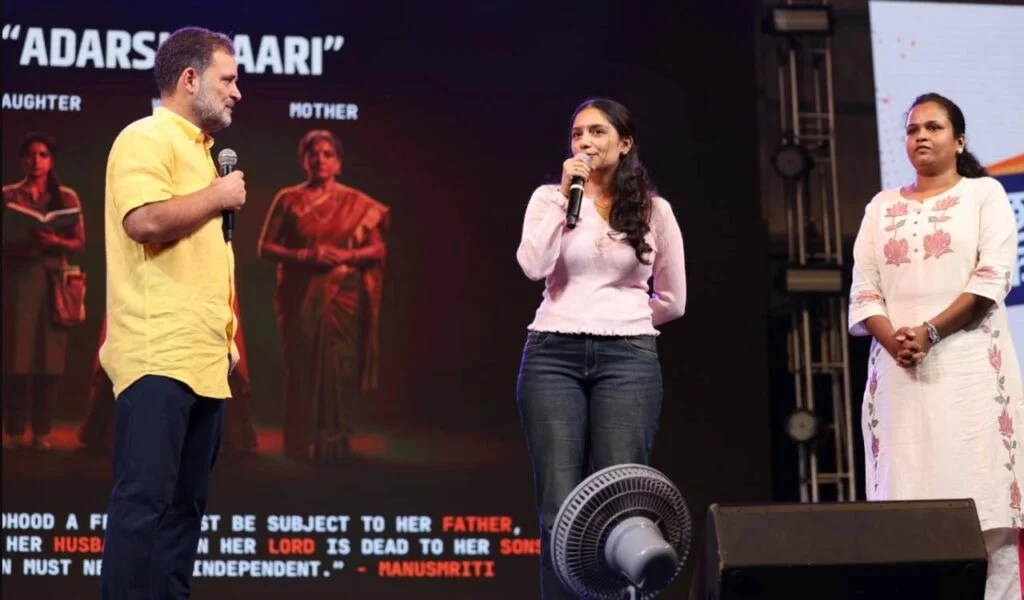
Ever since the Leader of the Opposition, Rahul Gandhi, spoke to female students in Maharashtra on August 22, 2026, against the ‘Manusmriti mindset’, called on students to ‘smash patriarchy’, and said that women belonged to themselves, not to their fathers, husbands or sons, there appears to have been a storm in BJP circles. BJP supporters rushing to defend the Manusmriti should surprise no one. For years, the politics of cultural nationalism has selectively elevated ancient texts and traditions as symbols of civilisational pride. But there comes a point when cultural reverence collides with the fundamental values of a modern democracy.
The question is simple: Can a document containing deeply patriarchal, discriminatory and caste-based ideas be defended without defending the ideas themselves? For millions of Indian women, the answer should be an unequivocal no.
The problem with the Manusmriti is not limited to one or two controversial passages. Critics have long pointed to numerous verses that reflect an order in which women were denied autonomy, subordinated to male guardianship, restricted in social and educational life, and treated through a deeply unequal lens. One of the most frequently cited verses, Manusmriti5.148, declares that a woman should remain under the protection of her father in childhood, her husband in youth and her sons in old age, and that she should never be independent.
Think about what that means in a modern democracy.A woman, according to this worldview, cannot be the master of her own life. Her father decides for her. Then her husband. Then her sons. Her freedom is not considered a right but a threat to be controlled.Is this the India that BJP leaders and supporters want to defend?
Other passages attributed to the text have also been criticised for portraying women as naturally untrustworthy, sexually tempting or requiring constant supervision. Such thinking does not merely belong to the distant past. These ideas have historically helped create societies where women were denied education, independence and equal decision-making.
Some verses even reflect an extraordinary suspicion of women. Women are portrayed as capable of corrupting or misleading men merely through their presence. In this worldview, the responsibility for male behaviour is shifted onto women themselves.
Imagine the absurdity. A man cannot control himself, so the woman must be blamed. A man commits wrongdoing, so the woman must be restricted. A woman seeks freedom, so she must be placed under male supervision. This is not morality. It is patriarchy disguised as social order.
The Manusmriti has also been criticised for passages dealing with women’s access to property, education and social status. In a society where constitutional equality is the foundation of citizenship, defending a text that emerged from a rigid hierarchy of gender and caste should raise serious questions. India did not become a modern republic by treating ancient social codes as permanent commandments.
India progressed because reformers challenged them.When Raja Ram Mohan Roy fought against Sati, there were undoubtedly people who defended tradition. When social reformers challenged child marriage, caste discrimination and the denial of education to women, they too faced resistance from those who believed ancient customs were beyond criticism. Should reformers have remained silent simply because other religions and communities also had their own social evils?
Of course not! That is why the argument that “Why are you only talking about Manusmriti? What about other religions?” is not merely childish; it is a deliberate attempt to change the subject. If one is discussing Sati, the existence of social problems elsewhere does not justify Sati. If one is discussing caste discrimination, the discrimination of another society does not make caste discrimination acceptable. And if one is discussing misogynistic passages in Manusmriti, pointing towards the flaws of other religions does not suddenly transform those passages into progressive ideas.
Wrong is wrong.The Constitution of India does not ask citizens to defend every word written in every ancient religious or social text. Nor should political parties exploit selective tradition while ignoring constitutional morality.
Women today are doctors, scientists, lawyers, judges, entrepreneurs, political leaders, soldiers, journalists and heads of institutions. They own property, run businesses, make independent decisions and determine their own futures.Would anyone seriously argue that these women should return to a system where their lives must remain permanently under the ‘protection’ of fathers, husbands and sons? If not, then why defend the Manusmriti so aggressively?
Perhaps because this debate is no longer simply about an ancient text. It is about politics.There is a growing tendency to treat criticism of a particular tradition or text as an attack on an entire religion or civilisation. This is intellectually dishonest. Every civilisation has texts that deserve respect, texts that deserve reinterpretation and texts that deserve outright rejection. Civilisation does not become weaker when it confronts its own mistakes. It becomes stronger.
The BJP and its supporters must therefore answer a fundamental question: Are they defending Manusmriti as a historical document, or are they defending its social philosophy? If they are merely defending its historical importance, nobody is asking for history to be erased.But if they are defending its discriminatory prescriptions, then they are directly contradicting the spirit of modern India.
The Constitution guarantees equality.It recognises the dignity of women. It does not declare that a woman must remain dependent on her father, husband or son. It does not treat women as property. It does not deny women the right to education, autonomy or inheritance. It does not place women below men.That is the difference between an ancient social code and a modern constitutional democracy. The anger surrounding the defence of Manusmriti is therefore understandable. What woman would not feel outraged when confronted with ideas suggesting that she cannot be trusted with her own freedom, decisions and life?
And yet, instead of addressing these disturbing ideas honestly, some defenders attempt to divert the debate. “Other religions have similar problems.” So what? Does that make misogyny acceptable? Does the existence of patriarchy elsewhere justify patriarchy here?By that logic, Raja Ram Mohan Roy should never have opposed Sati because other societies had their own injustices. B.R. Ambedkar should never have challenged caste because discrimination existed in other countries.
Social reform has never worked that way. Reform begins when people have the courage to say: This is wrong, even if it belongs to my own tradition. That is the real test of moral courage. The problem is not history. The problem is the attempt to convert regressive history into present-day politics.
India does not need to choose between its civilisation and its Constitution. But whenever the two are placed in conflict, the answer must be clear. The dignity of a living woman matters more than the unquestionable authority of an ancient text.
And if BJP supporters truly believe in the Constitution, women’s empowerment and Beti Bachao, Beti Padhao, then they cannot selectively celebrate the Manusmriti while ignoring the deeply regressive ideas associated with it. India has moved forward. The question is: Why are some people still trying to drag its women backwards?
[Mohd Ziyauallah Khan is a freelance content writer & editor based in Nagpur. He is also an activist and social entrepreneur, cofounder of the group TruthScape, a team of digital activists fighting disinformation on social media.]