

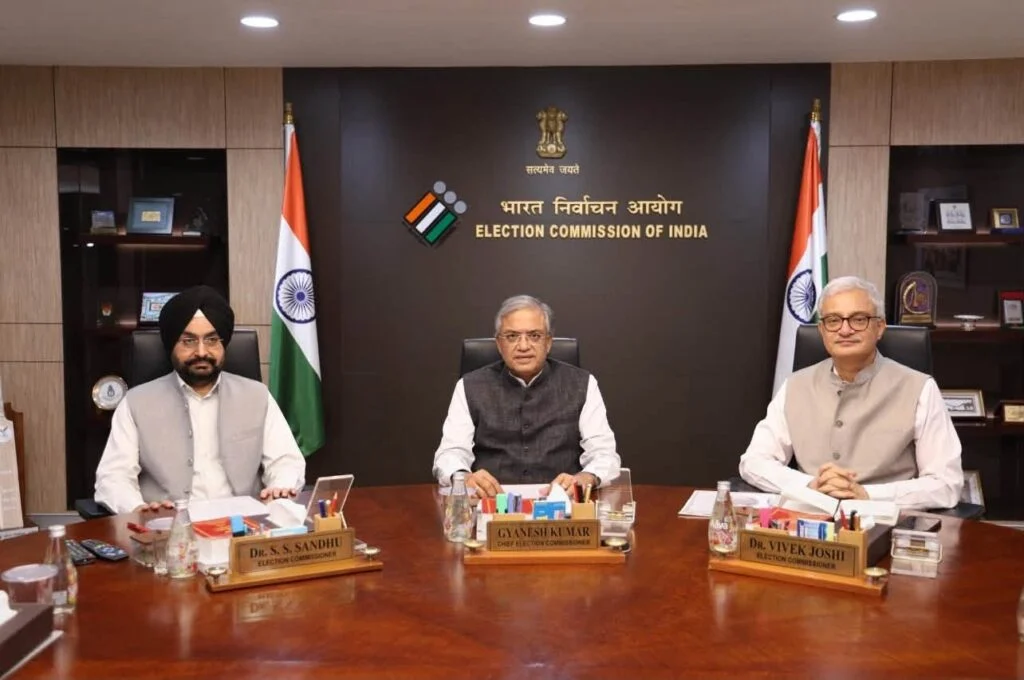
India’s democracy rests on a deceptively simple principle: those who exercise public power must ultimately remain accountable to law. This principle becomes even more important when the office concerned controls the conduct of elections – the mechanism through which citizens choose their representatives and governments derive their legitimacy.
Against this constitutional expectation stands Section 16 of the Chief Election Commissioner and Other Election Commissioners (Appointment, Conditions of Service and Term of Office) Act, 2023. The provision says that no court shall entertain or continue civil or criminal proceedings against a person who ‘is or was’ a Chief Election Commissioner or Election Commissioner for any act, thing or word committed, done or spoken while, or in the course of, acting or purporting to act in the discharge of official duty or function.
The words ‘is or was’ deserve particular attention. They mean that the protection does not end when an Election Commissioner leaves office. In relation to acts falling within the provision, the statutory shield can continue after retirement.
This creates an extraordinary situation. The Election Commission is expected to be independent of political power. Yet the officials entrusted with conducting elections have been given a statutory protection that extends beyond their tenure.The question is not whether Election Commissioners need protection. The question is whether independence requires lifelong immunity from civil and criminal proceedings.
Even President and Governors Do Not Enjoy Permanent Immunity
The comparison with the President and Governors is revealing.Article 361 of the Constitution protects the President and Governors from being answerable to courts for the exercise and performance of their constitutional powers and duties. It also bars criminal proceedings against them during their term of office and prevents their arrest or imprisonment while they hold office.But the constitutional protection is essentially tenure-based.
Article 361 does not give the President or a Governor a permanent personal immunity extending throughout life. The constitutional text specifically speaks of protection during his term of office in relation to criminal proceedings and arrest. It also provides a mechanism for civil proceedings after the required notice period.Election Commissioners, however, are protected under a statutory provision that expressly covers a person who ‘is or was’ an Election Commissioner.This distinction should concern anyone who values the rule of law.
The President is the constitutional head of the Union. A Governor is the constitutional head of a State. Yet the Constitution does not confer on either a lifelong shield against legal proceedings after leaving office.Why, then, should an Election Commissioner receive a protection extending beyond his or her tenure for official acts?
Independence Is Not the Same as Immunity
The strongest argument in favour of Section 16 is obvious.Election Commissioners make decisions affecting political parties, candidates and voters. If every aggrieved party could personally drag an Election Commissioner into civil or criminal litigation, the Commission could become vulnerable to harassment, intimidation and political pressure.That concern is legitimate.But there is a fundamental distinction between protecting an institution from frivolous litigation and placing its individual office-holders beyond effective legal accountability.
A democracy needs independent institutions. It does not need unaccountable institutions. A blanket statutory bar on courts entertaining proceedings is a much more sweeping solution.Indeed, the language of Section 16 is broad. It covers not merely ‘decisions’ but an ‘act, thing or word’ done or spoken in the course of acting, or purporting to act, in an official capacity.
The expression ‘purporting to act’ is particularly significant. It raises a difficult question: how far should the shield extend when an office-holder is accused of having abused official authority?
Who Protects the Citizen Against an Abuse of Power?
The Election Commission exercises enormous power.It supervises electoral rolls, election schedules, and recognition of parties, symbols, the Model Code of Conduct and numerous other aspects of the electoral process. Its decisions can have immediate consequences for candidates, political parties and citizens.Where such enormous public power exists, mechanisms of accountability become more, not less, important.
The Election Commission cannot be treated like an ordinary government department. Nor should its commissioners be treated like ordinary civil servants. Their constitutional position is much more significant.The 2023 Act itself provides significant security of tenure. The CEC can be removed only in the manner and on the grounds applicable to a Supreme Court judge, while an Election Commissioner can be removed only on the recommendation of the CEC.Such safeguards are justified because an Election Commissioner must not fear dismissal for taking an inconvenient decision.But security of tenure and immunity from judicial proceedings serve different purposes.
The controversy is no longer merely academic.In January 2026, the Supreme Court agreed to examine a challenge to Section 16 filed by Lok Prahari, a civil society organisation. A Bench headed by Chief Justice Surya Kant and Justice Joymalya Bagchi issued notice to the Centre and the Election Commission. The Court, however, did not stay the operation of the provision.The petition challenges the constitutional validity of the immunity provision and argues, among other things, that it creates an exceptionally broad protection for Election Commissioners.That distinction is important. In a constitutional democracy, the court, not political parties, commentators or the government, will ultimately determine whether the provision passes constitutional scrutiny.
The Danger of Confusing Independence with Impunity
The deeper issue is one of democratic philosophy.Every constitutional institution requires public confidence. The Election Commission perhaps requires it more than most because elections are the means by which citizens exercise political sovereignty.
Imagine, however, a citizen who believes that an official decision of an Election Commissioner caused serious and unlawful harm. If the law places civil and criminal proceedings outside the reach of courts merely because the person has acted, or purported to act, in an official capacity, what meaningful personal remedy remains?
The answer cannot simply be that the Commission itself is a constitutional institution. Constitutional institutions are created to exercise power under the Constitution, not above it.
Judicial review is one of the central mechanisms through which constitutional power is kept within legal boundaries. The Supreme Court’s own constitutional jurisprudence has repeatedly treated judicial review and the rule of law as fundamental features of India’s constitutional order.
The purpose of accountability is not to punish every official who makes an unpopular decision. It is to ensure that public power cannot become completely insulated from legal scrutiny.
Democracy Needs Independent but Accountable Referees
The credibility of an election does not depend only on whether votes are cast and counted. It depends also on whether citizens believe that the institution conducting the election is impartial, independent and accountable.The guardians of the electoral process must be protected from political pressure. They must also remain subject to the law.
For a democracy, the ultimate principle should be simple: no public office should become a permanent shelter from accountability merely because the office-holder once exercised public power.