

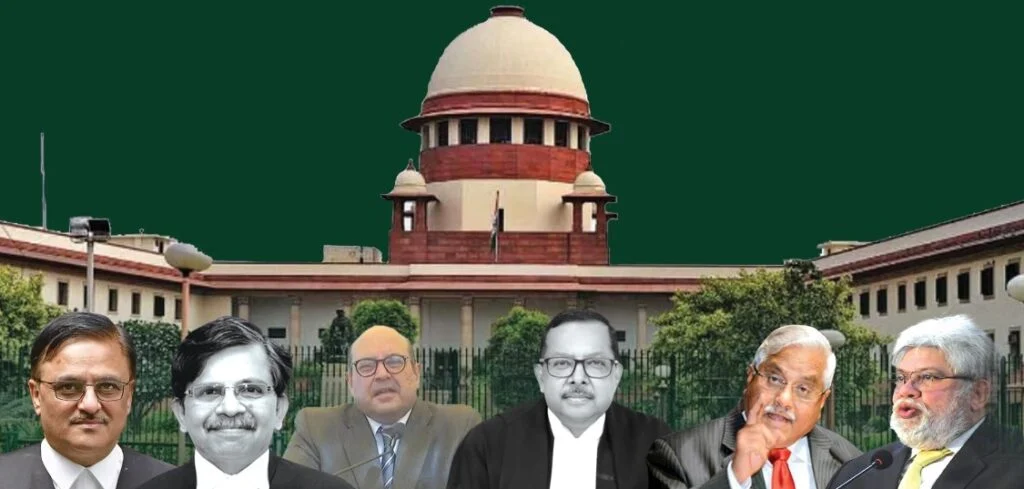
 When a sitting Supreme Court judge warns that mass disenfranchisement would strike at the heart of India’s constitutional order, and a former judge declares that the right to vote is in ‘great peril’, the country must take notice. When other senior judges raise concerns about dissent, institutional independence and legal safeguards, their interventions demand scrutiny. Recent Supreme Court proceedings on Election Commissioners’ accountability and restrictions on peaceful protest have lent these concerns added urgency.
Together, these developments pose a fundamental question: are constitutional rights being protected in practice, or are citizens being asked to trust institutions without adequate means of holding them accountable? What happens when exercising a right depends on administrative procedures that ordinary citizens can neither easily navigate nor effectively challenge?
The interventions of Justice Ujjal Bhuyan, Justice Rohinton Fali Nariman, Justice V. Gopala Gowda, Justice Sanjib Banerjee, Justice Abhay S. Oka and Dr S. Muralidhar do not constitute a unanimous verdict on Indian democracy. Their arguments differ, as do the objections raised by other former judges. Yet, taken together, they bring electoral integrity, institutional accountability and freedom of dissent into a common constitutional frame.
The task is neither to treat these warnings as proof of every allegation nor to dismiss them as political commentary. It is to examine the evidence, measure institutional conduct against constitutional principles, and ask whether citizens’ rights remain effective when their exercise challenges the interests of those in power.
Vote: Citizens’ Most Fundamental Political Instrument
Speaking at NALSAR University of Law, Hyderabad, on October 4, Justice Ujjal Bhuyan warned that wholesale disenfranchisement would strike at the heart of the constitutional order. The vote, he said, could not be separated from citizenship; doing so would be like taking the soul out of the body. Invoking Articles 14 and 326, he stressed that a billionaire’s vote carries the same value as a rickshaw-puller’s. Nor, he argued, could alleged irregularities elsewhere justify mass exclusion: no amount of ‘whataboutery’ could legitimise disenfranchisement.
Although Bhuyan did not explicitly mention the Special Intensive Revision (SIR), his warning resonated amid the controversy over electoral-roll revisions.
The following day, former Supreme Court judge Rohinton Fali Nariman warned that the right to vote was in ‘great peril’. Citing reported voter exclusions in West Bengal, he questioned the Election Commission’s functioning and urged the Supreme Court to address the challenge to the 2023 law governing the appointment of Election Commissioners.
Their concerns converge on a basic democratic principle: electoral accuracy must not come at the cost of eligible citizens’ voting rights. Article 326 provides for adult suffrage in elections to the Lok Sabha and State Assemblies, subject to constitutional and statutory qualifications, while Article 14 guarantees equality before the law. Though the right to vote is governed by a distinct constitutional and statutory framework rather than being an unrestricted Fundamental Right, its centrality to representative democracy is undeniable.
The question, therefore, is not whether electoral rolls should be revised, but whether eligible voters are protected from wrongful exclusion, informed of the reasons for deletion and given an effective opportunity to appeal before they lose their chance to vote.
A Dispute over Institutions and Evidence
Justice V. Gopala Gowda, former Supreme Court judge, has called for reconsideration of the Court’s May 2026 judgment upholding the ECI’s authority to conduct the SIR. He alleged that the Commission had misrepresented material facts to the Court – an allegation that requires verification against the relevant records. Gowda also defended Justice Bhuyan against criticism of his public remarks.
Former Chief Justice of the Madras and Meghalaya High Courts, Sanjib Banerjee, questioned whether the SIR unfairly shifts the burden of establishing eligibility onto voters, potentially leaving eligible citizens without an effective remedy before polling day.
The opposing view deserves consideration too. Forty-two retired judges defended the ECI’s statutory authority to revise electoral rolls and warned against unsupported allegations that could erode public confidence in constitutional institutions. Former Chief Justice of India B.R. Gavai questioned the propriety of a sitting judge commenting publicly on an issue pending before the Court, a concern shared by other retired judges.
Judicial restraint matters; public remarks must not appear to prejudge pending cases. But institutional credibility cannot rest on demands for unquestioning trust. It must be earned through transparency, reasoned decisions and fair procedures.
The distinction is fundamental: the legal authority to revise electoral rolls does not validate every procedure adopted, just as mass deletions alone do not prove mass disenfranchisement. The evidence must establish who was removed, why, how many eligible voters were affected and whether they had an effective opportunity to appeal. The real test is whether institutions permit scrutiny to establish the factseven when the findings may prove uncomfortable.
The Question of Accountability
Developments since these judicial interventions have added a further dimension to the debate. On October13, the Supreme Court issued notice to the Union government and the Election Commission on a petition challenging Section 16 of the Chief Election Commissioner and Other Election Commissioners Act, 2023, which bars civil and criminal proceedings against serving or former Election Commissioners for acts undertaken in the discharge or purported discharge of their official duties. The provision remains in force; the Court has sought responses, not yet delivered a verdict on its constitutionality.
The question is fundamental: how can an institution responsible for administering elections be protected from frivolous litigation without placing legitimate accountability beyond reach?
Meanwhile, the Supreme Court has issued directions concerning restrictions imposed around protests against the Election Commission and the SIR of electoral rolls. It has addressed peaceful assembly, access to courts, public transport and the ability of journalists to perform their professional duties. Allegations by women journalists of police assault have also been brought before the Court and remain to be examined.
These developments bring the debate into sharper focus. The integrity of elections depends not only on accurate electoral rolls, but also on institutions that can be questioned, citizens who can protest peacefully, journalists who can report freely and courts that can provide effective remedies. The issue is not whether constitutional institutions deserve protection. It is whether that protection can coexist with meaningful accountability.
Beyond Ballot: Right to Question Power
Justice Abhay S. Oka extends the debate from electoral participation to freedom of expression and peaceful protest. Delivering the Advocate Haroon Solkar Memorial Lecture in Mumbai on 1 August, he questioned whether Articles 19(1)(a) and 21 were being upheld in practice. Courts, he argued, must protect fundamental rights and intervene when criminal proceedings are used to silence peaceful dissent. Citizens cannot be expected to express only views acceptable to those in power.
Dr S. Muralidhar, former Chief Justice of the Orissa High Court, likewise described the Gen-Z protests at Jantar Mantar as reassuring for democracy. He warned against portraying peaceful protesters as threats to national stability and criticised the use of criminal proceedings against dissenters.
Neither argument places protesters above the law or denies the State’s duty to address violence. The constitutional test is whether restrictions are lawful and proportionate, and whether legitimate criticism is being mistaken for criminal conduct.
Arrests and prolonged prosecutions can cost people their liberty, livelihoods and years of their lives. Restrictive bail conditions can further curtail their freedoms. Even acquittal cannot restore lost time or reputation. The distinction between lawful enforcement and suppression of dissent must therefore be assessed through evidence and individual cases, not political labels.Democracy requires more than periodic elections. Citizens must also be free to question the government they elect.
Constitutional Independence isn’t Institutional Immunity
These interventions expose a wider challenge. The Election Commission must be independent, but its decisions must remain open to scrutiny. The executive must govern, but within constitutional limits. Parliament may legislate, but constitutional amendments remain subject to the Basic Structure doctrine. The judiciary must review State action independently, while maintaining standards of impartiality and judicial discipline.
Justice Nariman’s criticism of the 2023 appointments law raises questions about safeguards for the ECI’s independence. Oka’s defence of dissent highlights the judiciary’s role in protecting constitutional freedoms. Bhuyan’s remarks invite scrutiny of electoral procedures, while the controversy over his speech raises a separate question about how sitting judges should speak publicly on issues before the courts.
Justice Vikram Nath’s emphasis on judicial compassion adds another dimension: justice must recognise the human consequences of legal processes. Rights that cannot be exercised in time, or remedies that arrive after the damage is done, offer citizens only incomplete protection.
The issue, therefore, is not whether institutions should be trusted or criticised. It is whether they are capable of demonstrating their legitimacy through evidence, accountability and effective remedies.
The Constitution Must Deliver
The significance of these judicial interventions lies not simply in judges entering public debate, but in the fundamental questions they raise about India’s constitutional democracy. Can citizens exercise their right to vote without arbitrary obstruction, question those in power without disproportionate reprisals, and obtain effective judicial remedies before the damage becomes irreversible?
These questions cannot be answered by official assurances, political slogans or appeals to institutional prestige. They demand transparent procedures, verifiable evidence, independent scrutiny and reasoned decisions. The Election Commission must conduct elections independently, but independence cannot mean immunity from scrutiny. Governments must maintain public order, but peaceful dissent cannot be equated with disloyalty. Courts must exercise restraint, but constitutional rights must remain enforceable against the State.
The judges whose interventions have brought these issues into focus do not agree on every question, and their speeches are not judicial findings on all the allegations under debate. Their arguments must be tested against the Constitution, the law and the evidence. But neither should their concerns be dismissed simply because they challenge those in power.
The Constitution is not a charter of privileges for institutions or a declaration of good intentions by governments. It establishes rights, responsibilities and limits on power to protect citizens. When those limits are tested, public institutions must demonstrate that they are acting lawfully and fairly; citizens must not be expected to surrender their right to question them.
Democracy is weakened not only when elections are cancelled or constitutional freedoms formally abolished, but also when rights become difficult to exercise, remedies arrive too late and accountability gives way to demands for unquestioning trust. The ultimate test of India’s constitutional democracy is whether an ordinary citizen can rely on the Constitution when confronting the power of the State.