

The Republic Day in India is not merely ceremonial; it is a collective reaffirmation of a moral contract – the promise the Republic made to its citizens on 26 January 1950: justice, liberty, equality, and fraternity. Each year, as the tricolour rises across towns and villages, it signals a simple but profound truth: India belongs equally to all who call it home.
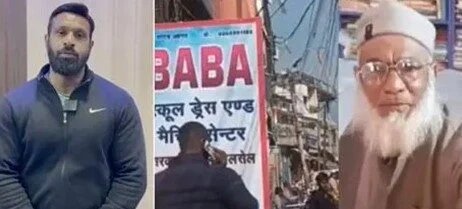
On the Republic Day 2026, that promise was tested in an unremarkable space – a small shop on Patel Marg in the hill town of Kotdwar, Uttarakhand. “Baba School Dress,” in existence for nearly three decades, sold school uniforms to children from all communities. Its owner, Vakeel Ahmed, a 70-year-old Muslim trader living with Parkinson’s disease, could not have imagined that the name of his shop would become a site of ideological confrontation.
That morning, a group of men, allegedly affiliated with the Vishva Hindu Parishad (VHP) and Bajrang Dal, confronted Ahmed and demanded that he change the shop’s name. Their claim was stark: the word “Baba,” they insisted, belonged exclusively to Hindu religious tradition and could not be used by a Muslim.
A short video of the encounter – Ahmed visibly anxious, his hands trembling – spread rapidly on social media, triggering outrage, solidarity, and unease. What began as a local act of intimidation soon drew national attention, with journalists, political leaders, and civil society weighing in.
Yet what transformed this episode from harassment into a defining constitutional moment was the intervention of two ordinary residents of Kotdwar: Deepak Kumar and Vijay Rawat. Their actions were not dramatic in scale, but they were profound in meaning. They stepped in where institutions briefly faltered, defending a fellow citizen not out of shared faith, but shared humanity – giving living expression to Articles 14 and 15, and to the idea that secularism in India is not merely legislated, but lived.
When Identity is Policed
Kotdwar, situated in Pauri Garhwal district, has long been considered a quiet transit town – a gateway to the hills, marked more by everyday coexistence than by ideological conflict. Ahmed’s shop was part of that unremarkable normalcy.
On January 26, the confrontation began with questions that quickly turned accusatory:“Why are you using the word ‘Baba’?”, “This is meant for Hindus”, “Change the name, or face consequences.”
The demand was not rooted in law, tradition, or commerce – but in religious ownership over language, a concept fundamentally alien to India’s constitutional order. No statute restricts the use of culturally common words like “Baba,” which have linguistic, familial, and spiritual meanings across communities.
For Ahmed, the harassment was not theoretical. It was deeply personal. Suffering from Parkinson’s disease, he struggled to respond coherently as the men surrounded him. For decades, he had lived peacefully in Kotdwar, contributing to its economy, dressing its children for school, and maintaining cordial relations across religious lines.
This is where the humanitarian dimension of the episode becomes impossible to ignore. Communal intimidation does not merely target identity; it preys on vulnerability – age, health, isolation. The psychological violence inflicted on Ahmed was as significant as the verbal coercion itself.
Equally troubling was the absence of immediate police intervention, raising uncomfortable questions about whether constitutional protections are always accessible to the most vulnerable in moments of crisis.
From a constitutional standpoint, such coercion strikes at the heart of the basic structure doctrine, affirmed in Kesavananda Bharati vs. State of Kerala, where the Supreme Court held secularism to be an inviolable feature of the Constitution. The State – and by extension public authority – cannot permit the imposition of religious conformity in public life.
My Name Is Mohammad Deepak
It was at this critical moment that Deepak Kumar, a local gym owner, overheard the commotion and walked toward the crowd. He was not a political activist, nor a public figure. He was simply a citizen witnessing an injustice unfold in real time.
As the men pressed Ahmed, Kumar intervened, asking a simple but disarming question:“What is the problem if his shop is called ‘Baba’?”
When challenged about his own identity, Kumar responded with words that would soon echo across the country:“My name is Mohammad Deepak. What’s it to you?”
The statement was neither provocation nor mockery. It was constitutional pedagogy in a single sentence – a refusal to allow religious identity to be weaponised as a tool of exclusion.
Standing beside him was Vijay Rawat, Kumar’s friend and associate, who echoed the call for calm and mutual respect. Together, they insisted that no citizen has the right to dictate another’s livelihood based on faith.
Kumar later stated that he acted instinctively: “If an elderly man is being harassed, I will step in – today, tomorrow, whenever needed.” Rawat described their motivation as simple: peace, brotherhood, and fairness.
Their intervention embodied Article 19 (freedom of expression and occupation), Article 14 (equality before law), and Article 15 (non-discrimination). More importantly, it revived the spirit of fraternity, often described as the most neglected constitutional value.
The public response was swift. Kumar’s social media following surged dramatically, with thousands hailing him as a symbol of “real patriotism.” But admiration would soon give way to retaliation.
Aftermath: Retaliation, Fear, and Legal Ambiguity
Within days, the situation escalated. On January31, supporters of Bajrang Dal gathered in Kotdwar, blocking a national highway, shouting slogans, and staging protests outside Kumar’s gym. Threats, including death threats, were reportedly issued against Kumar and his family.Fearing violence, Kumar temporarily shut down his gym. What began as an act of civic courage had now disrupted livelihoods and placed families under psychological siege.
The legal response proved controversial. Uttarakhand Police registered multiple FIRs:
- Against unnamed right-wing members for breach of peace, (BNS Section 223),
- Against protestors for blocking public roads, (BNS Section 223), and
- Against Deepak Kumar and Vijay Rawat, based on a complaint alleging assault, intimidation, and theft (snatching money, watch, and phone), criminal intimidation, intentional insult, unlawful assembly, and caste-based slurs during the January 26 confrontation, (BNS sections 115(2), 351(2), 352, 191(1)).
The charges against Kumar and Rawat, if sustained, would place acts of civic intervention on the same footing as organised intimidation. However, both denied all allegations and filed a counter-complaint, asserting that the FIR against them was retaliatory and disproportionate.
This equivalence of aggressor and defender raised troubling questions. When those who intervene to stop harassment are prosecuted alongside those who instigated it, the chilling effect on civic courage is profound.
From a constitutional lens, such outcomes risk undermining Article 51A, which calls upon citizens to promote harmony and the spirit of common brotherhood. Penalising those who act in defence of constitutional values sends a message that neutrality, rather than justice, is the safest path – a dangerous proposition for any democracy.
The Republic Responds: Public and Political Reaction
The viral video ignited a national debate. Across social media, citizens hailed Deepak Kumar and Vijay Rawat as rare examples of moral clarity in an age marked by fear and conformity. Civil society organisations and rights groups demanded protection for the duo and firm accountability for those who harassed Vakeel Ahmed. The response was not confined to the public alone. Former Uttarakhand Chief Minister Harish Rawat publicly lauded their intervention, describing it as “the true spirit of democracy and the Constitution,” and remarking that standing with a vulnerable elderly citizen against intimidation represented “real patriotism grounded in humanity, not hatred.”
Opposition leader Rahul Gandhi echoed this sentiment, endorsing Kumar’s stand as a reminder that the Constitution belongs to the people and cannot be surrendered to mob coercion. Equally significant were the quieter acts of solidarity: locals visiting Ahmed’s shop, interfaith neighbours expressing support, and citizens across religious lines asserting that coercion has no place in Indian society. Together, these responses reaffirmed a crucial truth – democracy does not survive on institutions alone; it survives on participation.
Communal Assertion and Constitutional Fatigue
The Kotdwar episode must be situated within a wider national pattern where cultural vigilantism increasingly intrudes into everyday life – from food choices to clothing, language, and now even shop names.Such incidents erode not only minority security but social trust itself. They normalise the idea that public space belongs to the loudest, not the lawful.
Constitutional scholars warn that secularism in India is not passive tolerance but active equal respect. Laws like the Places of Worship Act and repeated Supreme Court rulings were designed precisely to prevent religious domination of civic life.
When enforcement appears selective, constitutional fatigue sets in – where citizens begin to doubt whether the law will protect them when it matters most.
Choosing the Republic, Every Day
The Kotdwar incident, at its core, was never about a word on a signboard. It was about who gets to belong without explanation, and who is forced to justify their presence in their own country.
Deepak Kumar and Vijay Rawat didn’t invoke the Constitution in legal language, but they lived it in action. They reminded us that secularism is not anti-religious; it is anti-coercion. That patriotism is not about domination, but defence of the vulnerable.
As investigations continue, justice demands that those who harassed an elderly citizen be held accountable, and that those who stood up for constitutional values be protected, not punished.
Kumar’s words linger as both warning and hope:“I will not bow down to hatred.”In repeating that refusal – in markets, schools, streets, and homes – India chooses the Republic, not just once a year, but every day.